Small-flat dress dryers
If you need your floor space back after drying, compare the airer’s open dimensions and folded size. Check the cable’s reach and the space available for a dress to hang, too.


A vertical three-tier airer is worth considering if you have a roughly square drying area; a winged rack needs more width, while Which? reports that enclosed pods can dry faster but hold less laundry. Check your longest dress against the usable hanging space and its care label rather than relying on drying-line length alone. You will also need a ventilated place to dry clothes indoors.
If you need your floor space back after drying, compare the airer’s open dimensions and folded size. Check the cable’s reach and the space available for a dress to hang, too.
If a dress should not be tumble-dried, start with its care label. Look for a rail arrangement that lets you follow the instructions, whether the garment needs to hang or lie flat.
If condensation is already a concern at home, plan where the laundry will dry and how the room will be ventilated. A heated airer does not remove moisture from the flat.
Start with the space available while the airer is open and the instructions on your dresses’ care labels. Then assess garment clearance, ventilation and the amount of laundry you usually dry.
| Concern | What to check | Who this matters to |
|---|---|---|
| Open space and storage | Measure the full open height, width and depth, the folded size and the distance to a suitable socket. | If the airer would block the route through my flat, I need a layout that works while laundry is on it and folds away afterwards. Around 31% of consumers put space and storage first. |
| Dress length and fabric care | Compare your longest dress with the usable hanging space; check its care label and whether the rails allow the required spacing or flat drying. | I want to dry a dress without its hem resting on the floor or handling it against the care instructions. Around 25% of consumers prioritise garment fit and care. |
| Drying and ventilation | Check whether the chosen room has usable ventilation, and whether the airer’s arrangement suits the size of your usual load. | When I need a dress dry promptly, I still have to manage the moisture released indoors. Roughly 25% of consumers place drying needs and ventilation first. |
| Load and electricity use | Compare stated capacity and drying space with the clothes you wash; consider rated wattage alongside likely running time. | If I dry more than a few dresses at once, I need room for the load without choosing capacity I rarely use. Around 19% of consumers make load size and electricity use their primary concern. |
An airer that stores neatly can still obstruct a doorway or walkway while clothes are drying.
Mark its open dimensions on the floor before buying, leaving room to load dresses, reach the plug and use the room’s ventilation.
Drying-space and load figures do not show whether a long dress can hang freely or whether its care label calls for flat drying.
Measure the garment from its hanging point to the hem, then check the rail layout and care instructions.
UK government guidance explains that moisture from indoor laundry can become trapped without effective ventilation, contributing to condensation and damp.
Use the home’s ventilation as intended and choose a drying position where moisture will not be trapped in an unventilated cupboard.
Rated wattage alone does not tell you how long an airer will need for your clothes. The cited listings, for example, give maximum ratings of 300W for two rack models and 850W for the JML pod.
Compare the rating with the load each format can accommodate and the time you expect to use it; avoid crowding garments simply to fit everything into one session.
Lakeland’s range includes vertical airers for shoppers considering a tiered layout.
Minky has covered winged and four-tier models that illustrate different space and load requirements.
The DriBUDDI Compact represents an enclosed-pod option for a smaller load.
Status lists a 248W three-tier foldable aluminium airer and a 230W winged version, both on aluminium frames.
These foldable tiered and winged heated airers are options to compare if you want to dry dresses indoors and put the rack away afterwards. Check their open dimensions and usable garment clearance against your flat and your dresses before choosing.
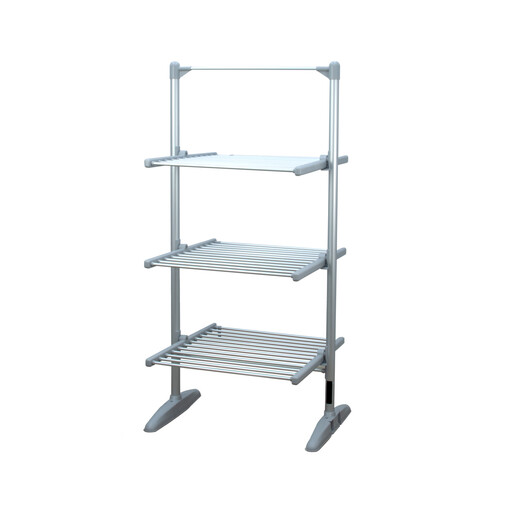 No image available
Consider this tiered model if its assembled layout fits your indoor drying position. Its aluminium design folds for storage; check the open footprint, cable reach and clearance for your longest dress, as well as the dress’s care label.
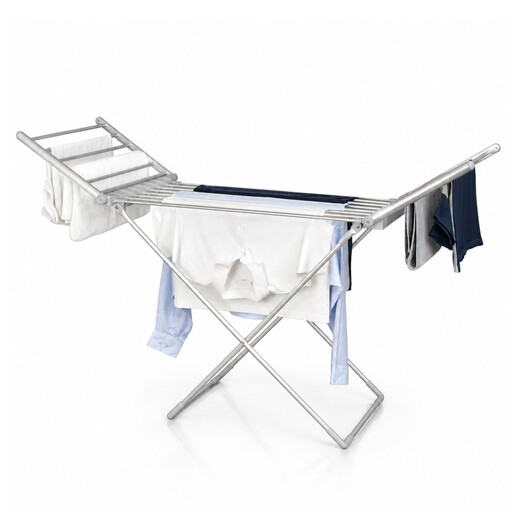 No image available
Consider this winged model if you have room to open its sides and can arrange dresses as their care labels require. The aluminium design folds for storage; measure the open width and check cable reach and garment clearance.
Measure the intended drying area against the airer’s full open height, width and depth, then check the route around it, socket distance and folded storage space. Measure your longest dress from its hanging point to the hem as well: drying-space metres cannot tell you whether it will hang freely.
A cover is designed to retain warmth around the clothes, but it does not establish how quickly your dresses will dry. Check that the format fits the load, leave appropriate space between garments and follow the appliance instructions; Which? reports that enclosed pods can dry faster but hold less.
Use the home’s ventilation rather than sealing moisture into the room. UK government guidance says moisture from drying laundry can become trapped without effective ventilation and contribute to condensation; keep provided trickle vents unobstructed and use a suitable window or extractor where available.
Do not use an overloaded extension lead. Electrical Safety First warns that overloaded sockets and extension leads create a fire risk; if you need a lead, check its rating, the total connected load and the airer manufacturer’s instructions.