Regular shirt-load households
If several cotton shirts dry alongside other laundry, look for separated rail space, easy access for hanging garments and somewhere to store the frame afterwards.


For regular loads of cotton shirts, start with a tiered heated airer if it gives you enough separated rail space and still fits the utility room when open. A winged frame suits smaller loads or a preference for a simpler layout; consider a covered hot-air system when drying time matters more, provided you check frame compatibility, rated power and ventilation.
If several cotton shirts dry alongside other laundry, look for separated rail space, easy access for hanging garments and somewhere to store the frame afterwards.
If the airer cannot stay out between loads, compare its open footprint with the available floor space and its folded dimensions with your storage gap.
If damp weather makes indoor drying a regular task, compare covers, timed operation and compatible hot-air systems alongside their rated power and the room's ventilation.
Choose enough usable hanging space for the shirt load, then check whether the airer fits both in use and in storage. Compare controls and rated power only after deciding whether a heated rack or a compatible hot-air system suits your routine.
| Concern | What to check | Who this matters to |
|---|---|---|
| Shirt spacing | Compare drying length, load limit and access to the rails; leave room between shirts rather than filling every bar. | If I dry several shirts with the rest of the wash, I need space around sleeves and overlapping fronts. Around 31% of consumers put usable hanging capacity first. |
| Room fit and storage | Measure the open position, door swing and storage gap; compare open dimensions as well as folded depth. | A frame that blocks the utility-room doorway will not work for my routine, even if it folds flat later. Roughly 25% of consumers prioritise room fit and storage. |
| Drying and controls | Check whether a cover is included, what the timer does and the rated watts of the exact rack or hot-air system. | When I need shirts ready sooner, I want to plan how long the airer runs without assuming every format dries alike. Around 25% of consumers put drying time and control first. |
| Moisture and electrical safety | Check the room's ventilation, socket reach and exact-model recall information; follow the appliance and extension-lead instructions. | I need to dry laundry indoors without ignoring condensation or relying on an unsuitable cable arrangement. Approximately 19% of consumers make moisture and electrical safety their primary concern. |
A tiered airer can fold into a narrow storage space yet need considerably more clearance when open and loaded with shirts.
Measure the intended floor position, door swing, route to the socket and storage gap before comparing frames. Check how easily you can reach the rails without crowding the garments.
A cover can retain heat around laundry, but it does not remove moisture from the utility room. UK government home-ventilation guidance explains that moisture trapped indoors can turn into condensation.
Use the room's ventilation as intended and investigate persistent condensation or mould separately from your choice of airer.
The cited Beldray winged rack is rated at 230W and the cited Minky covered rack at 300W, while Beldray's Quick-Dry hot-air system is rated at 1200W. Rated power does not by itself establish how long a particular shirt load will take to dry.
Compare the exact product's wattage, planned running time and your electricity tariff. For a hot-air system, also confirm that you have a compatible airer.
The UK Office for Product Safety and Standards recalled a specific Dunelm Heated Winged Airer in January 2025 because of a serious fire risk; the recall does not apply to heated airers generally. Electrical Safety First warns that a cable reel left wound during use can overheat.
Check recall details against the exact model, inspect its plug and cable, and follow the manufacturer's socket and extension-lead instructions. Stop using any product that matches an applicable stop-use recall.
These brands illustrate different heated-airer formats; check the specifications and included accessories for the particular model you choose.
The Deluxe 3-Tier model is a reference point for regular shirt loads: Lakeland lists 21m of drying space, a 15kg load limit, front access, a 1–12-hour timer and an 8cm folded depth.
Minky's sureDRI 4-tier model lists 23m of drying capacity, a 20kg maximum load, a 300W rating and an included cover.
Beldray offers distinct formats, including a 230W winged rack with 12m of drying space and a 1200W Quick-Dry hot-air system designed for a suitable three-tier airer.
Status lists both a three-tier 248W foldable aluminium airer and a 230W winged version, so stacked and wide layouts can be weighed side by side.
These folding heated racks are options for hanging shirts in a utility room. Compare their layouts and stated power where available, then check the open dimensions, rail spacing and controls against your room and laundry load.
 No image available
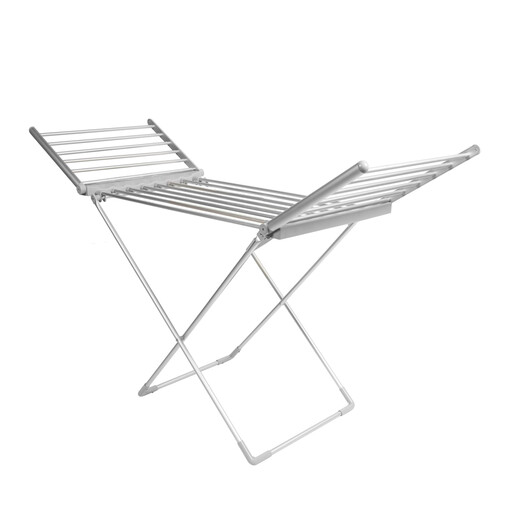
Consider this winged, three-tier format if you want to compare a spread-out hanging layout with a conventional tiered rack for your shirts.
Check its open dimensions, usable rail space, rated power and controls against your utility-room space and drying routine.
 No image available
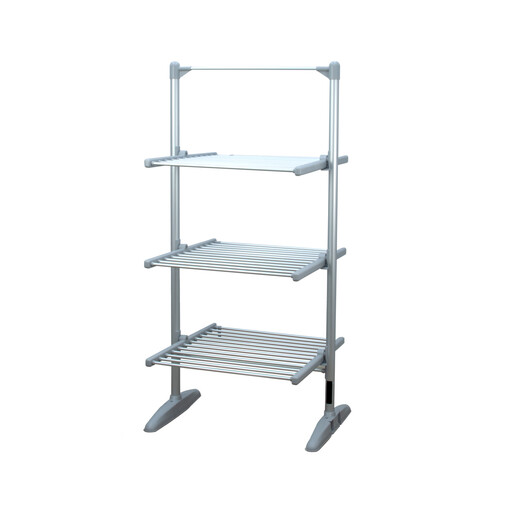
The folding three-tier frame is worth considering if you dry shirts regularly but need to put the airer away afterwards.
Rated power is 248W. Check the open dimensions, usable rail space, socket reach and controls before deciding whether it suits your room.
 No image available
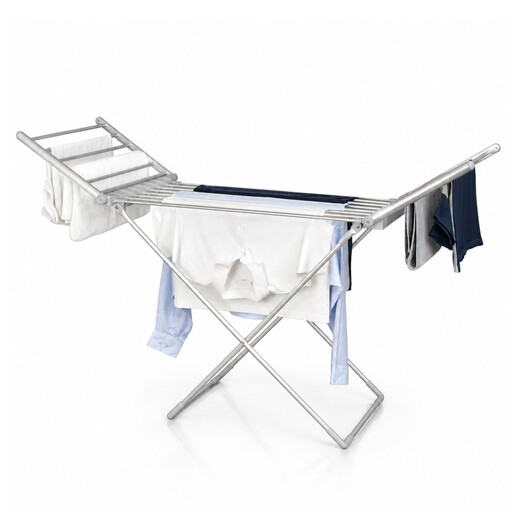
Consider this folding winged frame if that layout gives you accessible space for hanging your usual shirt load.
Rated power is 230W. Compare its open dimensions and usable rail space with the available room, and check cable reach and controls.
Start with a tiered rack if it offers enough separated rails and fits your utility room when open; choose a winged layout if it suits your load and access needs better. For context, Lakeland lists 21m of drying space for its cited three-tier model, while Beldray lists 12m for its cited winged model. Check the exact frame rather than treating rail length as a drying-time guarantee.
No: drying laundry indoors still releases moisture into the room. UK government home-ventilation guidance explains that trapped moisture can become condensation, so use the room's ventilation as intended and investigate persistent damp or mould. A cover is not a substitute for ventilation.
Compare each product's rated watts with the time you expect to run it, then use your electricity tariff to assess running cost. Beldray lists 230W for its cited winged rack and 1200W for its Quick-Dry system; Minky lists 300W for its cited sureDRI rack. These ratings alone do not establish the drying time or total cost of your own load.
Follow the instructions for your exact model and unplug it before cleaning. For the cited sureDRI model, Minky says to let it cool completely, wipe it with a soft damp cloth, dry it thoroughly and never immerse it in water.
Yes: check the exact make, model and identifying details against UK recall information. The Office for Product Safety and Standards recalled the Dunelm Heated Winged Airer with article number 30752153 and barcode 5057722844042 because it could overheat; owners were told to stop using that product and return it. The notice concerns that identified airer, not every winged model.