People drying small personal loads
If you mainly dry underwear and socks in a bedroom or shared room, the space an airer takes up when open and where it goes afterwards may matter more than maximum capacity.


For one person’s underwear and small wash loads, start with a folding winged heated airer that fits both the drying spot and its storage space. Consider a covered or multi-tier model when several housemates will share it or loads are larger, but check the open footprint, cover compatibility, ventilation and socket arrangement before choosing.
If you mainly dry underwear and socks in a bedroom or shared room, the space an airer takes up when open and where it goes afterwards may matter more than maximum capacity.
If several people use the same airer for mixed laundry, compare rail length and load limits alongside the space needed to set it up and store it.
If laundry dries indoors, plan for ventilation as well as a suitable drying spot. Government guidance for England treats persistent damp and mould as a housing issue to address, not simply a reason to change appliances.
Decide whether the airer is for a personal load or shared laundry, then check where it will stand, where it will be stored and how it can be used safely.
| Concern | What to check | Who this matters to |
|---|---|---|
| Personal loads and privacy | Check that the rail layout accommodates your usual underwear load without crowding garments, and that you can put the airer away afterwards. | If I dry small personal loads, I want somewhere for them that does not occupy the shared room longer than necessary. Around 33% of consumers put this need first. |
| Shared-load capacity | Compare drying length and stated load limit for the number of people using the airer. | When several housemates share an airer, I need enough room for mixed laundry without relying on tightly layered loads; around 25% of consumers prioritise shared capacity. |
| Space and electricity use | Measure the open and folded dimensions. To assess electricity use, consider the stated wattage alongside how long the airer runs. | I need to clear the communal floor after a load and keep track of how long the airer is switched on. For around 25% of consumers, that is the primary concern. |
| Moisture and electrical safety | Check for a dry, stable position, suitable ventilation and a safe socket arrangement; follow the exact model’s cover instructions. | If my drying spot is near a walkway or the home has recurring condensation, I want to address those risks before adding an appliance. Around 17% of consumers put this concern first. |
A multi-tier airer can offer more stated rail space while still being awkward to place in a shared bedroom or narrow communal room.
Measure its open footprint and folded size, and agree where it will be stored before choosing a larger frame.
Covers are not automatically interchangeable. Lakeland specifies its Dry:Soon 3-Tier cover for the Standard 3-Tier model, while the instructions cited for a STATUS heated airer warn against covering its heated bars during operation.
Use a supplied cover only as instructed, or confirm that an accessory is approved for the exact airer model. Do not substitute household fabric.
Drying laundry with an appliance does not address an underlying damp or mould problem. Government guidance for England identifies persistent damp and mould as issues that need attention in rented homes.
Ventilate the drying area appropriately and report persistent damp, condensation or mould to the landlord or managing agent.
Several appliances connected through one extension can exceed its rating. Electrical Safety First also warns against daisy-chaining extensions and using cable reels while wound.
Use a suitable wall socket where practical. If an extension is necessary, check its marked rating, fully unwind any cable reel and stop using damaged or overheating equipment.
Lakeland lists heated-airer formats from a compact drying pod to larger three-tier models, with accessories for particular models.
Minky has covered winged and four-tier heated-airer examples for different load sizes.
A three-tier winged airer with a foldable frame, offering open rail space that can be put away after a personal load.
Dunelm’s examples include a folding winged heated airer and a larger three-tier square format.
These folding winged and three-tier airers are options to consider for personal loads or shared laundry. Check each model’s open size and operating instructions against your drying spot before choosing.
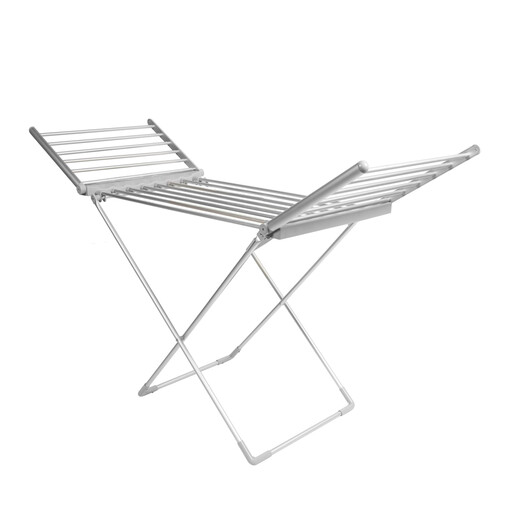 No image available
Consider the tiered, winged layout if you want space for a personal load but need to put the airer away after use. Check its open dimensions against the available floor space and follow the model’s instructions if using a cover.
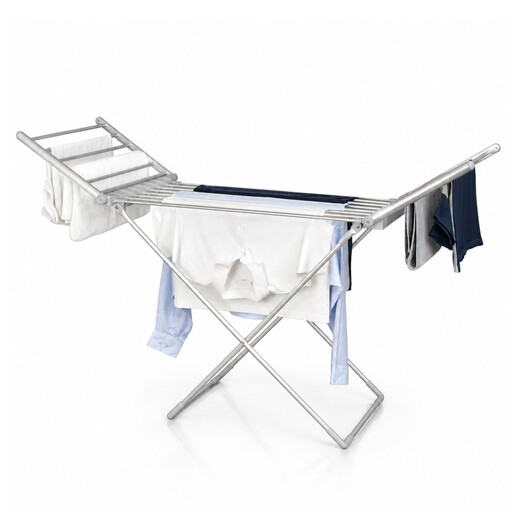 No image available
The folding winged format is worth considering if the airer must be stored between personal loads. The model name specifies a 230W rating and aluminium construction; confirm the open and folded dimensions for your space. Do not assume that a separate cover is compatible.
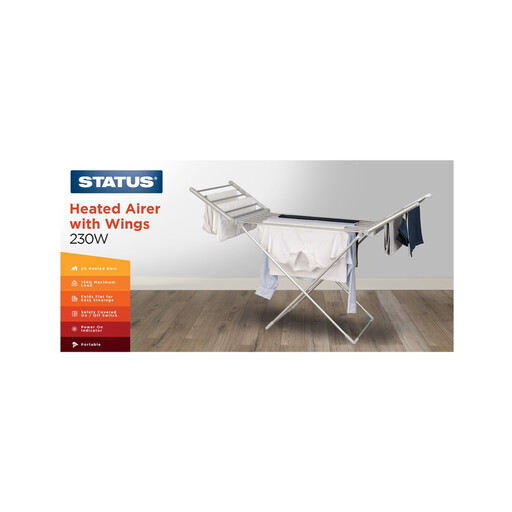 No image available
Consider the three-tier layout if housemates need to separate mixed laundry across levels. The model name specifies 248W and a foldable aluminium frame; check the open footprint and storage fit. Joybuy’s product instructions warn against covering the heated bars during operation.
No: drying laundry with a heated airer does not resolve an underlying damp or mould problem. Government guidance for England identifies risks from damp and mould and distinguishes requirements across rental settings. Ventilate the drying area appropriately and report persistent problems to the landlord or managing agent.
Use one only if it is suitable for the combined electrical load and you can position the cable safely. Electrical Safety First advises checking the extension’s marked rating, avoiding overloads and daisy-chaining, and fully unwinding cable reels. Stop using equipment that shows damage or overheating.
No: use a cover only when it is supplied for the airer or specified as compatible with its exact model, and follow the operating instructions. Lakeland specifies its Dry:Soon 3-Tier cover for the Standard 3-Tier model; an improvised fabric cover is not an equivalent substitute.
Use each model’s stated wattage, expected hours of use and your household’s electricity unit rate rather than wattage alone. Dunelm’s hourly-cost example uses a specified 26p/kWh rate; your tariff and the time your load takes to dry can change the result.