
24/7 Customer Support

Free returns

Same-day & Next-day Delivery

Quality Guaranteed

Unlock Your Welcome Offers: FREE Delivery | Up to 80% OFF | Free 30-day JoyPlus trial
Download the APP
As a Joybuy Product Recommendation Officer, I often see people in both professional and home kitchens facing the same frustration: flimsy aluminium foil that tears, punctures and fails at the worst possible moment. Choosing the right heavy duty catering foil isn't just about convenience; it's about food safety, efficiency and getting value for your money.
Many products promise strength but fall short, leading to wasted food and materials. Before you buy another roll, let's look at the common traps that catch out even savvy shoppers and how to identify a truly reliable product.
To ensure you're getting a product fit for purpose, focus on these key specifications. They are the true indicators of a quality commercial kitchen foil.
The single most important factor for strength is the foil's thickness, measured in microns (?m). One micron is one-thousandth of a millimetre.
Consider the tasks you perform most often.
A professional food service foil should come in a sturdy, robust cardboard dispenser, preferably with a tamper-proof design. This protects the roll from damage and contamination in a shared kitchen environment. A well-designed, sharp cutting edge is also crucial for safety and efficiency. Finally, look for recyclable aluminium foil to align with responsible waste management practices (always check with your local council's guidelines).
Based on these practical criteria, here are some recommendations matched to specific user needs.
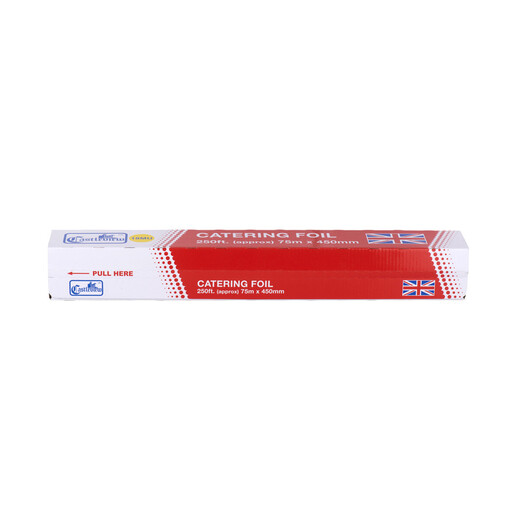
Why This Fits Their Persona: This foil is built for the demands of a commercial kitchen. The 450mm width is ideal for covering large gastronorm trays, lining commercial ovens and wrapping large joints of meat without needing to join sheets. It's a workhorse product for chefs and caterers who value efficiency.
Its 18 micron thickness provides genuine strength, avoiding the "heavy duty" deception. The 450mm width directly solves the frustration of using foil that is too narrow for professional equipment.
Generous 450mm width for full coverage of professional kitchenware. The long 75m roll offers excellent value for high-volume use.
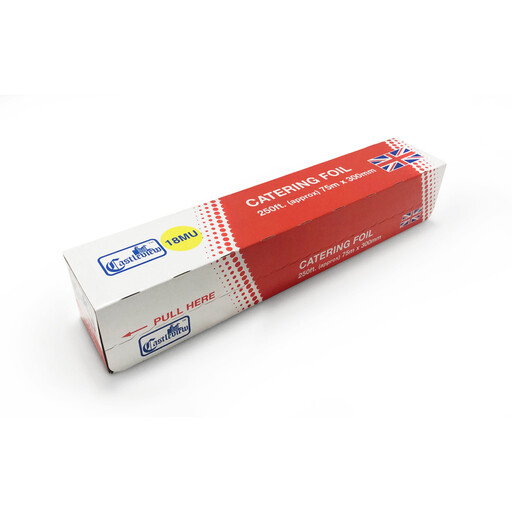
Why This Fits Their Persona: Perfect for prosumer home cooks who engage in batch cooking and meal prep, or for smaller businesses like cafes and food trucks. This roll provides professional-grade strength in a standard 300mm width that fits easily in domestic kitchens and is versatile for a wide range of tasks.
This foil delivers true extra strong aluminium foil performance with its 18 micron build. The 75m roll provides excellent long-term value, avoiding the trap of seemingly cheap but short supermarket rolls.
Professional-grade strength in a versatile 300mm width. The robust dispenser box ensures clean, easy tearing every time.
We have compiled a complete, real-time list of products that fully satisfy these strict selection criteria and UK safety regulations.
Yes, an 18 micron foil is a significant upgrade from domestic foil and is the recommended starting point for heavy-duty tasks. It provides good resistance to punctures and tears when used as foil for roasting or wrapping food for the barbecue. For exceptionally heavy items with sharp bones, some kitchens may opt for 20 microns or more, but 18 microns is a reliable and effective standard for most applications.
Yes, recyclable aluminium foil is accepted by most UK local councils for recycling. The key requirement is that the foil must be reasonably clean of food grease and residue. It is often recommended to scrunch used foil into a ball (at least the size of a tennis ball) before placing it in your recycling bin, as this helps it get sorted correctly. Always confirm with your local authority's specific recycling guidelines.
The three main differences are thickness, dimensions and packaging. Catering or food service foil is thicker (18 microns or more) for durability. It is often available in wider formats (e.g., 450mm) to fit professional equipment and comes on a large foil roll (75m or longer) for better value. The dispenser box is also typically more robust to withstand a busy kitchen environment.