
24/7 Customer Support

Free returns

Same-day & Next-day Delivery

Quality Guaranteed

Unlock Your Welcome Offers: FREE Delivery | Up to 80% OFF | Free 30-day JoyPlus trial
Download the APP
As a Joybuy Product Recommendation Officer, my role is to help you navigate the market and find products that deliver on their promises. When it comes to kitchen essentials, few items are as crucial—or as frequently disappointing—as aluminium foil. For professional kitchens and serious home cooks, a flimsy roll that tears at the slightest touch is more than an inconvenience; it's a waste of time, money and ingredients. This guide will help you identify genuine heavy duty catering foil and avoid the common purchasing pitfalls.
Before you add another roll to your basket, be aware of the marketing traps that lead to frustration in the kitchen.
To select a reliable commercial kitchen foil, focus on these non-negotiable parameters instead of marketing slogans.
The single most important indicator of foil strength is its thickness, measured in microns (μm). One micron is one-thousandth of a millimetre. Without this number, any claim of strength is meaningless.
The size of the roll must match the scale of your work.
Here are our recommendations, matched to specific user needs, helping you choose a product that genuinely meets your requirements.
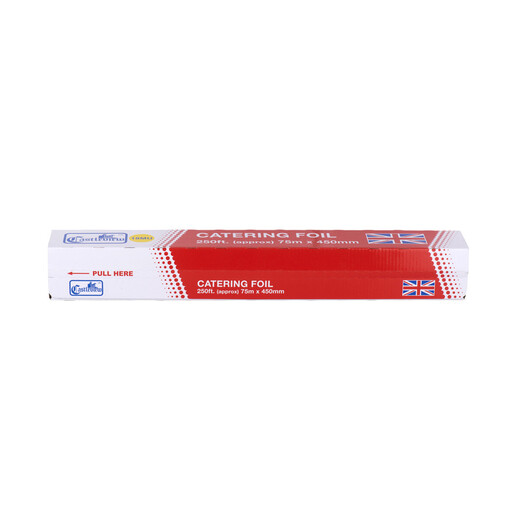
Why This Fits Their Persona: This foil is built for the demands of a professional kitchen. The 450mm width is ideal for covering large Gastronorm pans and roasting trays, while the 75m length ensures it lasts through busy service periods. It's a workhorse product for caterers, restaurants and large-scale food prep businesses.
It directly counters the "Heavy Duty" myth with a clearly stated 18 micron thickness. The extra width eliminates the need to overlap sheets on large trays and it comes in a robust, tamper-proof carton designed for commercial use.
Superior tear and puncture resistance. The 450mm width provides maximum coverage for professional kitchenware.
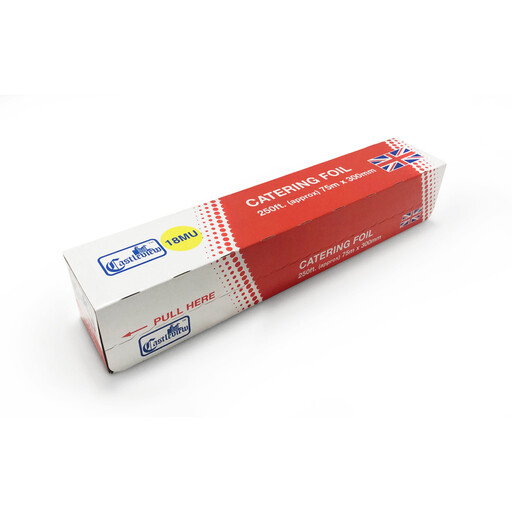
Why This Fits Their Persona: This roll offers the same professional-grade thickness for those who don't require the extra width. It's perfect for small cafes, bakeries or home cooks who do a lot of batch cooking and want a reliable, tear-resistant foil for standard-sized ovens and trays.
It delivers true heavy-duty performance with its 18 micron thickness, avoiding the flimsy foil trap. It provides the durability of professional foil without the higher cost associated with extra-wide rolls, making it a smart, economical choice.
Professional-grade thickness in a standard, cost-effective 300mm width. The 75m length offers excellent value for frequent use.
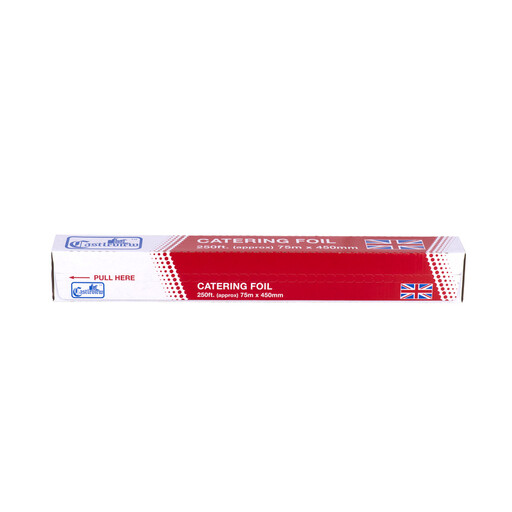
Why This Fits Their Persona: For users whose primary needs are covering and lining for lighter duties, this foil offers exceptional value. The combination of an extra-wide 450mm format and a 75m length makes it a great-value choice for delis, sandwich shops or households that use a lot of foil for general storage and wrapping.
This product is transparent about its 11 micron thickness, positioning it as a versatile cooking foil rather than a heavy-duty one. It avoids the width-versus-length trap by providing generous dimensions for light-duty tasks where extreme tear resistance is not the priority.
Excellent cost-per-metre value. The 450mm width provides great coverage for wrapping large items or lining standard trays.
We have compiled a complete, real-time list of products that fully satisfy these strict selection criteria and UK safety regulations.
A micron (μm) is a unit of measurement equal to one-thousandth of a millimetre. It is used to specify the thickness of the aluminium foil. A higher micron number indicates a thicker, stronger and more tear-resistant foil. For true heavy-duty performance in a kitchen, an 18-micron foil is a reliable benchmark.
Yes, heavy duty foil with a high micron rating (18μm or more) is well-suited for use on a barbecue. Its thickness helps it withstand high heat and resist punctures from grill grates or bones. It can be used to wrap vegetables, fish or ribs to lock in moisture, or placed on the grates to prevent smaller items from falling through and to make clean-up easier. However, never allow the foil to come into direct contact with open flames.