
24/7 Customer Support

Free returns

Same-day & Next-day Delivery

Quality Guaranteed

Unlock Your Welcome Offers: FREE Delivery | Up to 80% OFF | Free 30-day JoyPlus trial
Download the APP
From hauling gear across a muddy festival field to lugging soil around the garden, a reliable folding wagon seems like a straightforward purchase. Yet, many of us have been there: the wheel that snaps off on the first bumpy path, the frame that groans under half the advertised weight or the folding mechanism that jams shut permanently. A poorly chosen heavy duty folding camping wagon isn't just an inconvenience; it's a waste of money.
As a Joybuy Product Recommendation Officer, my role is to help you see past the marketing clutter. Before you add any cart to your basket, let's look at the common pitfalls that catch out UK buyers and what to check to ensure you get a trolley that genuinely makes life easier.
Many wagons look the part online, but their real-world performance often falls short. Here are the three most common issues we see:
To avoid these traps, focus your attention on three core specifications. These are the non-negotiable elements that separate a durable, practical wagon from one destined for the skip.
The backbone of any heavy-duty wagon is its frame. Look for models constructed from heavy-duty spray-painted steel tubes or reinforced carbon steel. These materials provide the structural integrity needed to handle genuine dynamic loads without bending or warping. This is especially critical if you need a large capacity garden cart for moving compost bags or a market stall trolley for heavy stock. A robust frame is the first sign of a product built to last.
The wheels determine where you can realistically use your trolley.
The wagon's fabric basket needs to be as tough as its frame. Materials like 600D Oxford fabric are a good indicator of quality, offering resistance to tears, scuffs and moisture. Beyond the material, consider the internal volume, measured in litres. A high weight capacity is of little use if the basket is too small for your gear. For a collapsible festival trolley, a large volume is essential for carrying bulky but relatively light items like tents, sleeping bags and chairs.
To help you match a wagon to your specific needs, here are a few options that align with different user profiles, all of which address the common pitfalls.
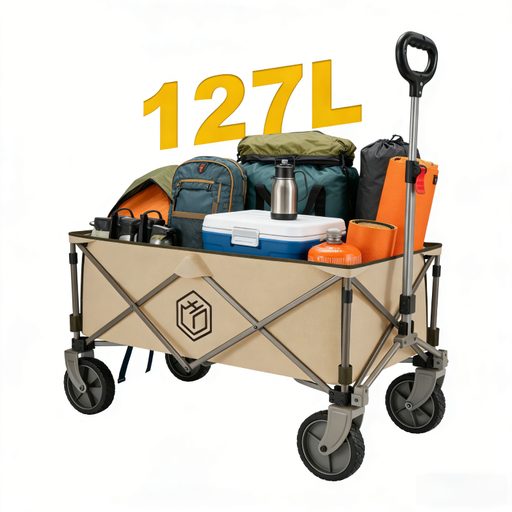
Why This Fits Their Persona: This model offers a great balance of size, strength and portability. The 127L capacity is ample for a weekend's worth of camping gear, and its compact fold fits easily into a car boot alongside everything else.
It avoids the "static load" trap with a heavy-duty spray-painted steel tube frame, ensuring its 200kg load capacity holds up during movement across campsite paths and festival fields.
Features 360° swivel wheels with a dual brake system, providing excellent manoeuvrability and safety. The folding mechanism is designed for simple, reliable operation.
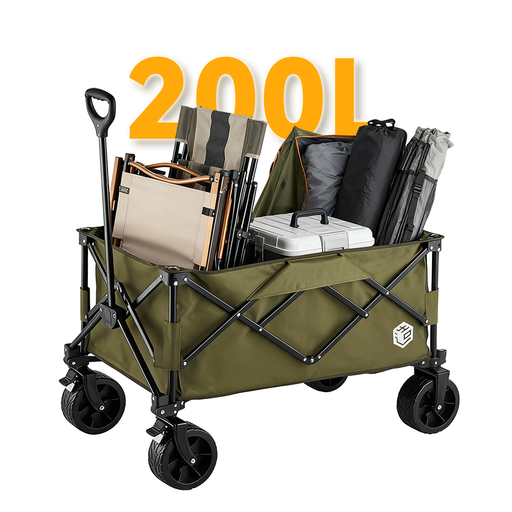
Why This Fits Their Persona: With its huge 200L capacity and high sides, this wagon is built to carry bulky beach gear—cool boxes, windbreaks, towels and toys—in a single trip from the car park to the sand.
It directly counters the "all-terrain illusion" by using genuine, oversized off-road wheels. Their wide profile is specifically designed to glide over soft sand and uneven grassy dunes rather than digging in.
The combination of a very large 200L capacity and true all-terrain wheels makes it exceptionally practical for beach days or picnics in the park. Dual brakes add a layer of safety.
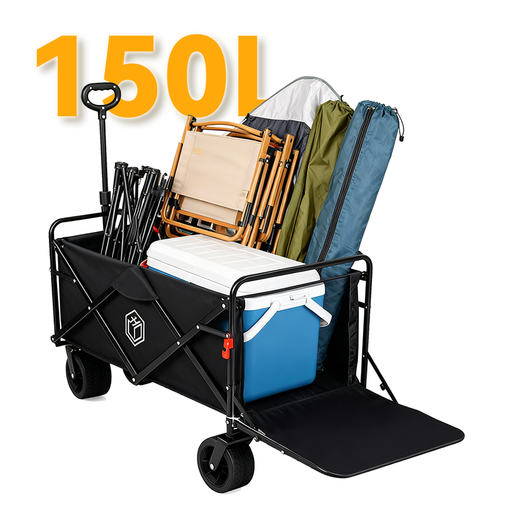
Why This Fits Their Persona: This is for users who prioritise strength above all. Its massive 260kg load capacity is ideal for transporting heavy bags of soil, tools, market stock or sound equipment without fear of the frame failing.
It sidesteps the "flimsy fold" and "weak frame" traps by using a reinforced carbon steel frame and robust "tank" style wheels, designed for sustained, heavy-duty work.
The standout features are its exceptionally high 260kg load capacity and a clever rear-opening tailgate, which allows for the transport of longer items like timber or garden tools.
We have compiled a complete, real-time list of products that fully satisfy these strict selection criteria and UK safety regulations.
Proper maintenance is simple but effective. After use, especially in muddy or sandy conditions, wipe down the frame and fabric with a damp cloth. Ensure the wagon is completely dry before folding it for storage to prevent rust on the frame or mildew on the fabric. Periodically check that wheel bolts are secure and that the braking mechanism functions correctly.
This depends entirely on the wheels. Wagons with standard, narrow plastic wheels will struggle and likely get stuck. To effectively move a loaded wagon on soft sand, you need one equipped with wide, balloon-style or treaded off-road wheels. These distribute the weight over a larger surface area, allowing the wagon to float over the sand rather than sinking into it.
Load capacity (e.g., 200kg) refers to the maximum weight the wagon's frame, wheels and fabric can safely support inside the basket. Stackable capacity (e.g., 250L) is a less standardised term, often used by manufacturers to indicate the total volume you could achieve by carefully stacking items above the rim of the wagon. You should always prioritise the official load capacity in kilograms and ensure your load is stable and secure, regardless of how high you stack it.