
24/7 Customer Support

Free returns

Same-day & Next-day Delivery

Quality Guaranteed

Unlock Your Welcome Offers: FREE Delivery | Up to 80% OFF | Free 30-day JoyPlus trial
Download the APP
For any professional tradesperson or dedicated DIY enthusiast, a reliable tape measure is a non-negotiable part of the toolkit. A flimsy tape that snaps, a blade that refuses to extend without bending or markings that fade after a few jobs can cause frustration and costly errors. When your work demands precision and durability, a standard household tape simply won't do. You need a heavy duty tape measure built to withstand the rigours of a construction site.
This guide is designed to help you navigate the key features of a professional tape measure. We will focus on the practical specifications that matter on the job, helping you select a tool that offers accuracy, longevity and ease of use, without the marketing hype.
Selecting the right tool involves looking beyond the length. Here are a few critical factors to consider when choosing a durable tape measure for professional or demanding projects.
One of the most important features for anyone working alone is the blade's 'standout'. This refers to how far the blade can extend horizontally before it bends or 'breaks'. A long standout tape measure allows you to measure distances single-handedly, significantly improving efficiency. This is largely determined by the blade's curvature and width. As a rule of thumb, a wide blade tape measure—typically 25mm or more—will offer a more impressive standout, making it ideal for measuring across rooms or between joists without a second pair of hands.
A construction measuring tape is subjected to drops, dust and moisture. Its durability comes down to two main components: the case and the blade coating. Look for cases made from high-impact ABS plastic, often with a rubber over-mould for added grip and shock absorption. The blade itself should have a protective coating, such as nylon or a polyester film, to resist abrasion and prevent the markings from wearing away. Some models feature extra reinforcement on the first few inches of the blade, which is the area most prone to damage from repeated retraction.
In the UK and EU, tape measures are certified for accuracy, most commonly to Class I or Class II standards. For most professional construction and carpentry work, Class II accuracy is the accepted standard. This guarantees a tolerance of just +/-0.5mm over a 1-metre length, ensuring reliable and precise measurements for your projects. Equally important are the markings themselves. They should be large, clear and printed in high contrast to be easily readable in various lighting conditions, from dim interiors to bright outdoor sites.
Based on the features that professionals value most, here are our recommendations for 2026.
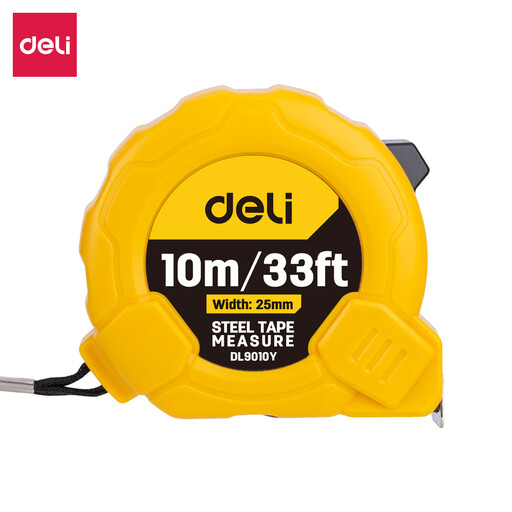
Why It Stands Out This tape from Deli is a practical workhorse designed for large-scale projects. Its standout feature is the generous 10-metre (33-foot) length, providing ample reach for site layouts, foundations and extensive renovation work. The rugged, high-impact ABS case is encased in a non-slip rubber grip, ensuring it can handle the inevitable drops and knocks of a busy job site.
Pros
Who is it for? This tape measure is well-suited for builders, landscapers and DIYers undertaking large projects who require a long, durable and easy-to-read tape for convenient and independent measurements.
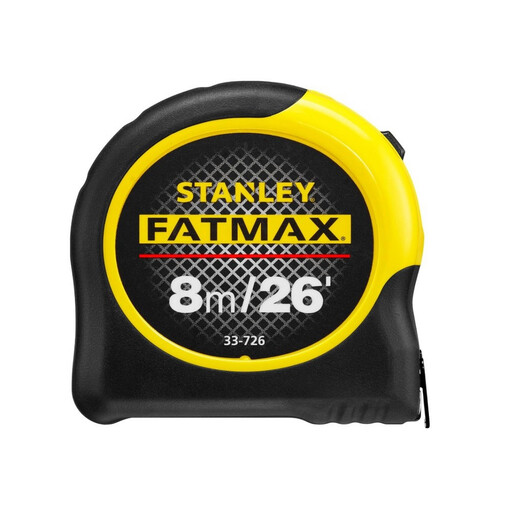
Why It Stands Out The Stanley FatMax is a widely recognised name on professional job sites, and for good reason. Its primary advantage is the exceptional blade standout. The extra-wide 32mm blade allows for an impressive reach of up to 4.2 metres, making it a top choice for professionals who frequently work alone. The blade's durability is enhanced with a specialised polyester film and an additional BladeArmor coating on the most vulnerable first 7.5cm.
Pros
Who is it for? This is an excellent choice for carpenters, electricians, builders and other tradespeople who prioritise blade standout for overhead and long-distance solo measurements and require a tool with proven job-site resilience.
If these recommendations don't quite match your specific requirements, or if you are searching for other types of marking and layout tools, we have a wider selection available.
Explore our full range of DIY tool blades and measuring equipment to find the perfect addition to your toolkit.
'Standout' is the distance a tape measure's blade can be extended horizontally before it bends under its own weight. A long standout, often found on a wide blade tape measure, is crucial for professionals as it allows them to measure significant distances without needing a second person to hold the end of the tape. This greatly improves efficiency, especially when working on ladders or measuring across large spaces.
Class I and Class II are European accuracy standards. A Class I tape is the most accurate, with a maximum permissible error of +/-0.2mm over the first metre. A Class II tape, which is the standard for most high-quality professional tape measures, has a maximum permissible error of +/-0.5mm over the first metre. For virtually all construction and trade applications, Class II provides more than enough accuracy for precise, reliable work.
To prolong the life of your tape measure, always retract the blade slowly and avoid letting it snap back into the case at full speed, as this can damage the internal mechanism and the hook. Before retracting, wipe the blade with a dry cloth to remove dirt, grit or moisture that could get pulled into the housing and cause rust or jamming. Periodically check that the hook is secure and hasn't been bent, as this can affect measurement accuracy.