
24/7 Customer Support

Free returns

Same-day & Next-day Delivery

Quality Guaranteed

Unlock Your Welcome Offers: FREE Delivery | Up to 80% OFF | Free 30-day JoyPlus trial
Download the APP
A reliable tool bag is more than just a container; it's a crucial part of a professional's daily kit. A flimsy bag that splits, or one where tools are impossible to find, costs you time and money on the job. For tradespeople and serious DIY enthusiasts across the UK, investing in a heavy duty tool bag that can withstand daily use and keep your equipment organised is essential.
This guide is designed to help you identify the key features that matter most, so you can choose a tool bag that works as hard as you do. We'll look at materials, accessibility and portability before highlighting a couple of standout options for 2026.
Choosing the right bag means looking beyond the price tag. Here are three practical considerations to guide your purchase.
The foundation of any good tool bag is its material. Look for bags made from high-density fabrics, typically measured in denier (D). A rating of 600D or higher indicates a tough, tear-resistant polyester or Oxford cloth suitable for demanding environments.
Equally important is the base. A tool bag with a waterproof base, often made from moulded plastic, is a significant advantage. It not only protects your valuable tools from wet and dirty surfaces—a common scenario on UK job sites—but also prevents sharp tools from piercing through the bottom and adds overall structural rigidity.
Time spent rummaging for the right tool is time wasted. A wide mouth tool bag, often supported by an internal metal frame, allows you to see all your contents at a glance and access them without a struggle.
Beyond the main compartment, consider the pocket layout. A good large tool organiser will have a mix of internal and external pockets of various sizes to hold everything from screwdrivers and pliers to larger power tools. For an electrician's tool bag, numerous smaller pockets for testers, wire strippers and connectors are particularly useful.
Carrying a full set of tools can be strenuous. A well-designed bag should make transport as comfortable as possible. Look for a tool tote with a shoulder strap that is both adjustable and padded to distribute weight evenly. A reinforced, padded main handle is also crucial for comfortable short-distance carrying and lifting the bag in and out of a vehicle.
Based on features that deliver durability, organisation and value, here are our recommendations.
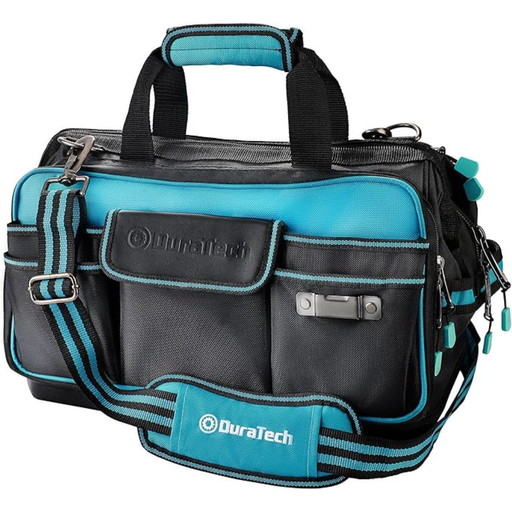
Why It Stands Out: This bag is built for those who need serious organisation and capacity. Constructed from tough 840D Oxford cloth on the exterior, it’s designed for resilience. Its standout feature is the sheer number of pockets—32 in total—allowing for meticulous organisation of a large tool collection. The hard plastic base provides a stable, waterproof foundation.
Pros:
Who is it for? Professional maintenance personnel, electricians and technicians who carry an extensive and varied toolkit and require maximum organisation to work efficiently.
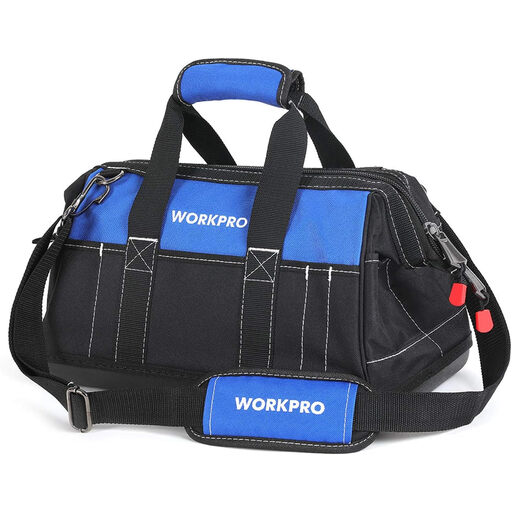
Why It Stands Out: The WORKPRO 16-inch bag offers a fantastic balance of robust construction and practical design. Made from durable 600D polyester fabric, its most notable feature is the hard, fully moulded waterproof base that protects contents from both moisture and hard impacts. The wide-mouth opening is reinforced with an internal metal frame, ensuring it stays open for easy access.
Pros:
Who is it for? Ideal for both professional tradespeople and dedicated homeowners who need a durable, all-around tool bag that offers excellent protection from the elements and job site hazards.
While these bags offer great functionality, every professional has unique needs. Perhaps you require a different size, a specific pocket configuration, or accessories to complement your setup. For components like a replacement strap adjuster or to view other tool storage solutions, you can browse our full collection.
Explore More Tool Storage Solutions
For a heavy duty tool bag, look for high-denier synthetic fabrics like 600D to 840D polyester or Oxford cloth. These materials offer excellent resistance to tearing, abrasion and moisture. A reinforced, waterproof moulded plastic base is also a key feature for maximum durability and protection.
The ideal number of pockets depends on your trade and personal preference. An electrician might benefit from a bag with 30+ small pockets for various testers, drivers and pliers. A general builder or plumber might prefer fewer, but larger, pockets to accommodate bulkier items. As a general rule, a bag with at least 20 pockets provides a good starting point for effective organisation.
For anyone working in the UK, a waterproof base is highly recommended. It protects your tools from rusting or water damage when the bag is placed on wet ground, in puddles, or on damp job sites. It also adds significant structural integrity to the bag and prevents sharp tools from poking through the bottom.