
24/7 Customer Support

Free returns

Same-day & Next-day Delivery

Quality Guaranteed

Unlock Your Welcome Offers: FREE Delivery | Up to 80% OFF | Free 30-day JoyPlus trial
Download the APP
For tradespeople, DIY users and homeowners, the right heavy duty tool bags should make carrying and finding equipment easier rather than creating another problem. A bag may look robust in product photographs but still prove inconvenient on a daily basis if the base absorbs water, the opening is too narrow or the stated capacity does not match the way you work.
Before choosing a large tool bag, look beyond the words “heavy duty”. The practical details below can help you avoid common buying traps and select a bag suited to your tools, vehicle and working environment.
Some bags use coated polyester or Oxford cloth, but that does not automatically mean the entire bag is waterproof. Water may still enter through the zip, seams or top opening. For outdoor jobs, check whether the base is moulded plastic, whether the description specifies water resistance and how the bag should be cleaned and dried.
A hard waterproof base is particularly useful on wet pavements, muddy building sites and garage floors. It can also help prevent sharp tools from puncturing the bottom of the bag.
A multi-pocket tool bag with many compartments can improve organisation, but pocket quantity alone does not determine how useful it is. Shallow pockets may suit screwdrivers and pliers but not drills, boxed fittings or larger hand tools. Deep internal pockets can also make smaller items difficult to retrieve.
Check the combination of pocket layout, internal dimensions and opening width. A wide-mouth design is useful when you need to see the contents quickly rather than search through a closed central compartment.
A large bag can encourage overloading. This places additional strain on the stitching, handles, zips and shoulder strap. Always follow the stated maximum load and avoid carrying sharp tools loosely, even where the bag has reinforced fabric.
For regular travel between vans, homes and job sites, a tool bag with shoulder strap can spread the load more comfortably than a single handle. Padded handles and adjustable straps are practical features, but they do not replace a suitable load limit.
Look for a stated fabric specification such as 600D, 840D or 1680D Oxford cloth or polyester. The “D” refers to denier, a measurement relating to the thickness of the fibres used in the fabric. It is not a complete durability rating, so also check for reinforced seams, edge binding and the quality of the base.
A hard base tool bag is suitable for users who regularly place bags on rough, wet or dirty surfaces. A plastic or rubberised base may also provide additional protection against impact and punctures. However, a waterproof base does not mean tools can be left in standing water.
Compare the external dimensions with the space available in your van, cupboard or boot. A bag measuring approximately 42–43cm long may hold a useful range of hand tools, but its actual internal storage depends on lining, padding and pocket placement.
The stated load capacity is another non-negotiable specification. For example, one bag below lists a maximum load of 30kg, while another is specified to carry 15kg. These figures should be treated as upper limits, not everyday targets. If your kit includes power tools, batteries and metal fittings, leave room below the maximum.
A double-zip, wide-mouth opening allows quicker access and makes it easier to place larger equipment inside. Look for a reinforced handle attachment and an adjustable shoulder strap if you frequently carry the bag over longer distances.
For specialist users, such as electricians or plumbers, external loops and dedicated pockets can reduce time spent searching for tape measures, screwdrivers, fittings and pliers. For general household storage, a simpler large storage bag may offer more flexible space.
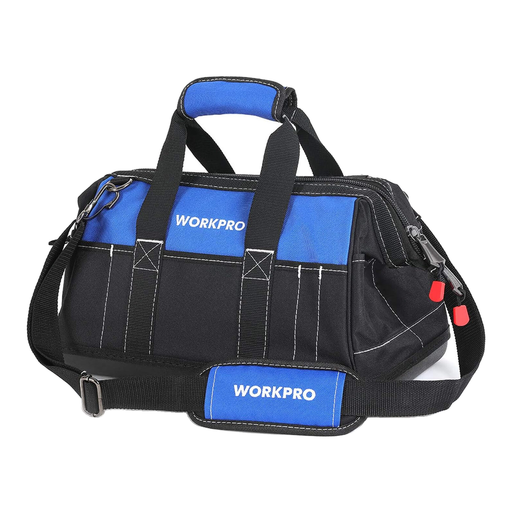
Why This Fits Their Persona: A practical option for homeowners and DIY users who need organised storage for routine repairs without selecting a larger contractor tool bag.
Its wide opening and combination of internal and external storage reduce the need to place every tool in one deep compartment. The waterproof hard base also helps separate the bag from damp floors.
600D polyester fabric, 8 internal pockets, 13 external pockets, 8 tool belts and a stated 15kg load capacity.
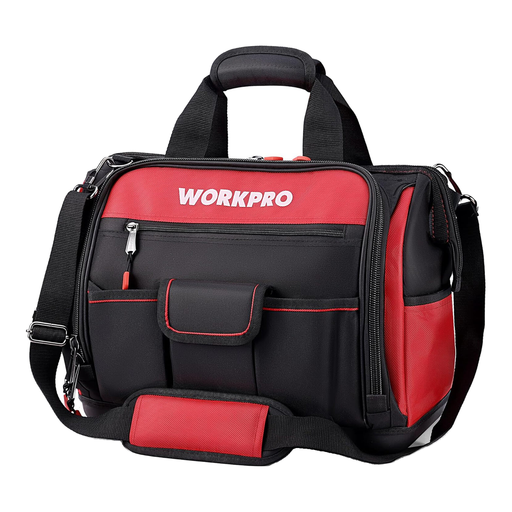
Why This Fits Their Persona: Suitable for users who value a more structured layout for frequent maintenance, carpentry, plumbing or electrical work.
The 1680D polyester body, reinforced structure and hard waterproof base address concerns about abrasion, damp surfaces and tools shifting into one central pile.
39 pockets, elastic and hook storage, 42 x 24.5 x 34cm dimensions, a double zip and adjustable shoulder strap.
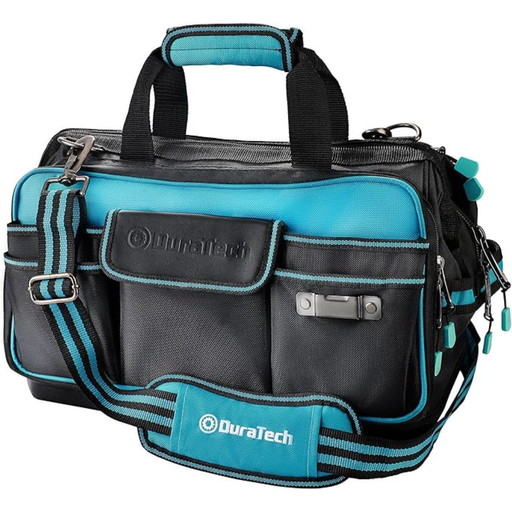
Why This Fits Their Persona: A larger format for maintenance workers, contractors and tradespeople carrying a broad selection of hand tools and equipment.
The dimensions, deepened inner pockets and wide double-zip opening make its capacity more usable than a bag judged only by its external size.
840D outer fabric, 600D inner fabric, 32 pockets, a plastic hard base and stated capacity of up to 30kg.
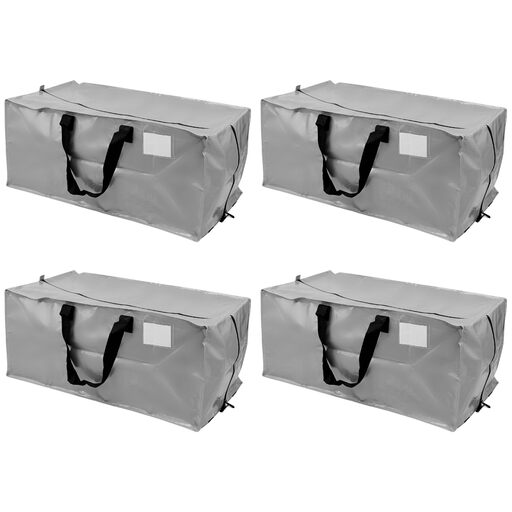
Why This Fits Their Persona: Useful for moving flats, storing bedding or organising bulky household belongings where tool-specific pockets are not essential.
Its 73 x 34 x 37cm format provides flexible bulk storage, while sturdy handles, zips and backpack-style shoulder straps offer more carrying choices than a basic box.
Four bags are included, with extra-large capacity, sturdy handles, zips and backpack shoulder straps.
We have compiled a complete, real-time list of products that fully satisfy these strict selection criteria and UK safety regulations.
Not necessarily. Some models use water-resistant fabric and a waterproof hard base, but the upper body, seams and zip may not prevent water entry. Treat a bag as suitable for damp surfaces rather than submersible unless the product information specifically states otherwise. Dry tools and the bag thoroughly after outdoor use.
Choose dimensions based on the tools carried every day. An electrician's tool bag may need separate pockets for screwdrivers, pliers, testers and tape measures. A plumber's tool bag may need deeper storage for adjustable spanners, fittings and larger hand tools. Measure your longest tool and compare it with the internal dimensions, not only the advertised external size.