
24/7 Customer Support

Free returns

Same-day & Next-day Delivery

Quality Guaranteed

Unlock Your Welcome Offers: FREE Delivery | Up to 80% OFF | Free 30-day JoyPlus trial
Download the APP
Choosing a HEIMAN smoke detector is not simply a matter of selecting the cheapest pack or the loudest alarm. UK homes differ widely: a small flat may need a discreet mini alarm, while a multi-storey property may benefit from interconnected smoke detectors that sound together.
Marketing descriptions can also make comparison difficult. Battery life, certification, sensor type and wireless connectivity all affect how practical an alarm will be over time. This guide explains the important specifications, common buying traps and suitable HEIMAN options for different household requirements.
A listing may mention a 10-year battery, but this does not necessarily mean every component will remain suitable indefinitely. Some alarms have built-in batteries and should be replaced as a complete unit at the end of their stated service period. Others use replaceable batteries, which may involve more regular maintenance.
Before purchasing, check whether the battery is replaceable, whether the product has a stated 10-year service life and what the manufacturer says about end-of-life replacement.
“Wireless” can refer to battery operation, Wi-Fi app connectivity or radio communication between several alarms. These are different functions.
A radio networkable smoke alarm can be designed so that when one detector senses smoke, connected units sound together. A Wi-Fi model may instead send notifications through an app. If simultaneous alarms across floors are important, confirm the stated network capacity and whether the units are compatible with one another.
EN 14604 is a relevant European standard for residential smoke alarms, but certification alone does not tell you whether an alarm suits your room layout or installation requirements. Check the full product information, instructions and mounting method.
For UK properties, landlords and property managers should also check current national and local requirements applying to their type of accommodation. A smoke alarm is not a substitute for a carbon monoxide detector where CO risks are present.
A photoelectric smoke detector uses light-scattering technology to identify smoke particles. HEIMAN’s listed mini models specify a photoelectric sensor, making them a practical option for bedrooms, hallways, offices and other indoor spaces.
Sensor type should not be considered in isolation. Follow the installation guidance and avoid placing alarms in locations exposed to excessive steam, dust or cooking fumes, as these conditions may cause nuisance alarms or affect operation.
An 85 dB fire alarm is a common specification in the HEIMAN range. The sound needs to be noticeable from relevant sleeping and living areas, but the actual effectiveness depends on the alarm’s position, room layout, closed doors and background noise.
For larger homes, interconnected alarms can provide broader audible coverage than relying on one unit in a hallway.
A battery-operated smoke detector can be installed without electrical wiring, which is useful for rented accommodation, flats, bedrooms, caravans and rooms where hardwiring is inconvenient. Built-in 10-year battery models reduce routine battery changes, while replaceable-battery versions may allow the alarm to remain in use with a new battery, subject to the manufacturer’s instructions.
Also check whether the alarm includes a mute button or test button. A mute function can temporarily silence nuisance alerts, but it should never be used to ignore a possible fire.
If you are protecting several rooms or floors, compare the number of units required with the product’s stated capacity. Selected HEIMAN radio models support up to 40 networkable fire alarms, according to the supplied product information. For a single flat or small property, a standalone alarm or small multi-pack may be more economical.
The following options are matched to different usage profiles rather than ranked universally.
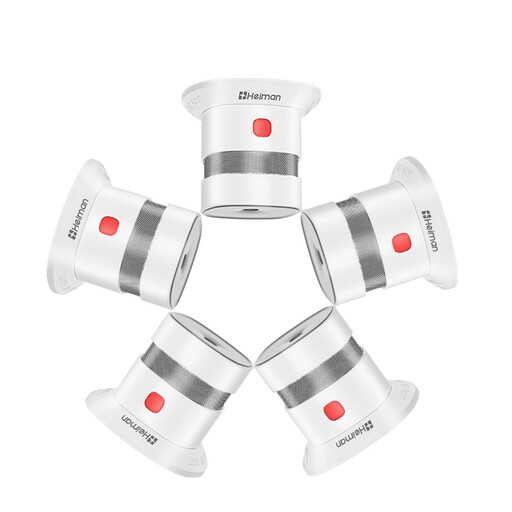
Why This Fits Their Persona: A five-unit pack suits first-time buyers protecting several rooms in a flat, house, office or small rental property.
The listing clearly specifies a photoelectric sensor, 10-year battery life, 85 dB alarm and TÜV and EN14604 certification.
Five compact alarms, photoelectric sensing and a built-in 10-year battery.
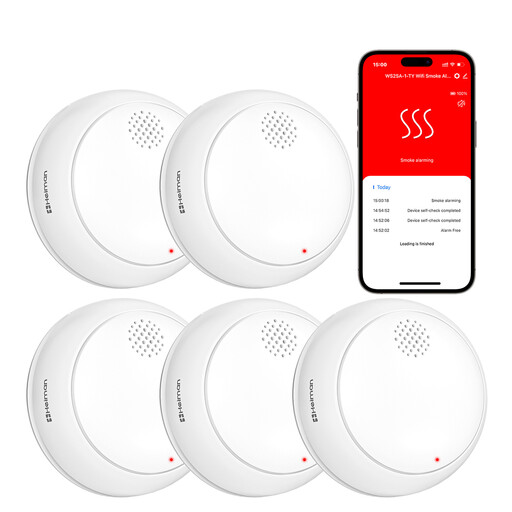
Why This Fits Their Persona: Suitable for users who want app-based monitoring and prefer a replaceable battery rather than a sealed unit.
It identifies the battery arrangement instead of presenting long battery life as the only consideration. Check app compatibility before purchase.
Wi-Fi app functionality, replaceable battery, mute button and 85 dB alarm.
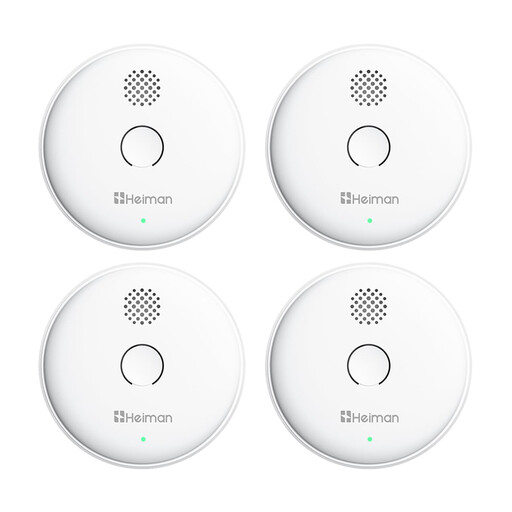
Why This Fits Their Persona: A practical match for multi-room homes, landlords, offices and properties where simultaneous alerts across floors are useful.
The product specifies radio interconnection for up to 40 alarms, rather than using “wireless” only to describe battery operation.
Up to 40 linked alarms, 10-year built-in battery, 85 dB siren and mute switch.
We have compiled a complete, real-time list of products that fully satisfy these strict selection criteria and UK safety regulations.
It can reduce the need for routine battery replacement, which is convenient in rented homes, bedrooms and multi-room properties. However, confirm whether the battery is sealed and whether the complete alarm must be replaced after 10 years. Regular testing is still necessary.
They can be useful in larger or multi-storey homes because connected alarms may sound together when one detector is triggered. Check the radio range, maximum number of units and compatibility instructions before combining alarms. Interconnection does not remove the need to position and maintain each detector correctly.
Follow the product instructions, generally placing alarms on ceilings and in hallways outside sleeping areas, with coverage on each floor where appropriate. Do not install them directly in kitchens or bathrooms if steam or cooking smoke could cause nuisance alarms. For exact requirements, consult current UK fire-safety guidance applicable to your property type.