What should you check?
Decide whether the household wants an herbal infusion or a decaffeinated tea-leaf drink, then check the individual product, its flavour and the number of bags.
| Priority |
What to check |
Your needs |
| Caffeine status |
Look for a caffeine-free statement on the exact infusion and read its ingredients. Twinings describes its fruit and herbal infusions as containing no Camellia sinensis tea leaves; Pukka says many, rather than all, of its herbal teas naturally contain no caffeine. |
I want an herbal drink without assuming that every blend in a wider range has the same caffeine status. If I prefer a conventional tea-leaf drink, I will check a separately labelled decaffeinated tea. |
| Pack size |
Compare the number of bags on like-for-like packs and use the current cost per bag when assessing value. Twinings lists Pure Camomile in both 20-bag and 4 × 20-bag formats. |
There are several tea drinkers at home, so I want enough servings without buying a large quantity of an untried flavour. |
| Flavour and ingredients |
Check whether the blend is a single herb or contains several ingredients. Clipper lists a peppermint infusion, while Teapigs lists chamomile with manuka honey granules, natural flavourings and vanilla. |
A simple flavour may be easier to try together; if we want variety, I still want to know what is in each blend. |
| Health-related use |
Keep the full ingredient list when asking a pharmacist, clinician or midwife about a relevant concern. The NHS guidance on herbal medicines calls for caution in specified circumstances, including pregnancy, breastfeeding and use of certain medicines. |
If anyone is considering a botanical product for a health purpose, a caffeine-free label alone will not answer whether it is suitable for them. |
Brand and retailer references
These references help distinguish flavours and pack formats; they do not establish that every product in a range is caffeine-free or currently available.
Pukka
Pukka describes a caffeine-free herbal collection with mint, ginger, berry, chamomile and chai-style flavours.
- Several flavour families give a household options to try before choosing a repeat purchase.
- Pukka says many of its herbal teas naturally contain no caffeine; confirm the claim on the individual blend.
Twinings
Twinings distinguishes naturally caffeine-free fruit and herbal infusions from separately identified decaffeinated traditional teas.
- Its Pure Camomile is listed in 20-bag and 4 × 20-bag formats, allowing a smaller pack and a larger repeat purchase to be compared.
- A camomile infusion has a floral flavour rather than the character of traditional black tea.
Clipper
Clipper describes its herbal infusions as caffeine-free and lists flavours including peppermint, camomile and lemon and ginger.
- Its Organic Peppermint Infusion is listed as a naturally caffeine-free, 20-bag product made with peppermint.
- Check the bag count of the particular pack against how quickly the household uses it.
Teapigs
Teapigs offers plain and flavoured herbal blends in tea-temple packs.
- Its chamomile and manuka honey blend lists its ingredients and is labelled naturally caffeine-free.
- The listed 15-tea-temple pack is a smaller quantity to consider when buying for several drinkers.
Tesco
Tesco is a retailer and own-label reference for comparing herbal tea bag counts alongside branded listings.
- Its UK search results have listed peppermint products in different bag counts, including an own-label option.
- Check the current product listing and offer dates rather than relying on an earlier promotion.
Joybuy herbal tea options
These packs offer named herbal flavours in different bag counts, from smaller flavour trials to larger household supplies. Check each exact pack’s caffeine statement and ingredients when choosing a drink for everyone.
 No image available
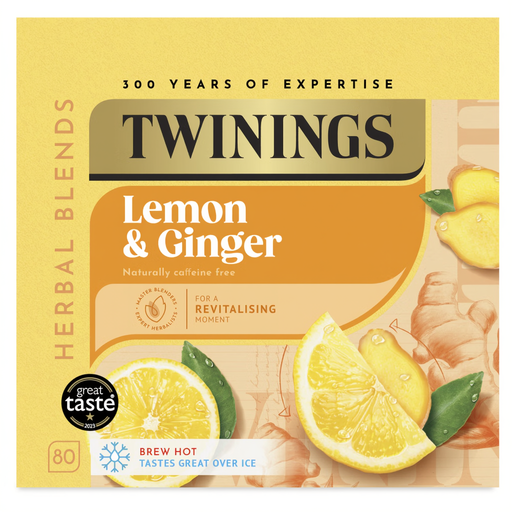
Twinings Lemon & Ginger 80 Pack
The 80-bag format is a larger supply for a household that already likes lemon and ginger. Check the exact pack’s caffeine label and ingredients before making it a regular choice, and compare its current cost per bag with a smaller pack.
View on Joybuy
 No image available
Twinings Pure Peppermint 80 Pack
This 80-bag peppermint pack is a repeat-purchase option when several people want that particular flavour. It is not a variety pack; check its caffeine statement, ingredients and preparation directions on the exact product.
View on Joybuy
 No image available
Twinings Lemon & Ginger 20 Tea Bags
The 20-bag pack provides a smaller way to try lemon and ginger before choosing a larger supply. It contains fewer bags than the Twinings Lemon & Ginger 80 Pack shown here, so consider how many people will drink it regularly.
View on Joybuy
 No image available
Tropical Sun Soursop Tea 20 Tea Bags
A 20-bag soursop tea pack offers a smaller quantity for trying this flavour. Read the exact caffeine statement, ingredient list and preparation directions before including it in a shared household supply.
View on Joybuy
 No image available
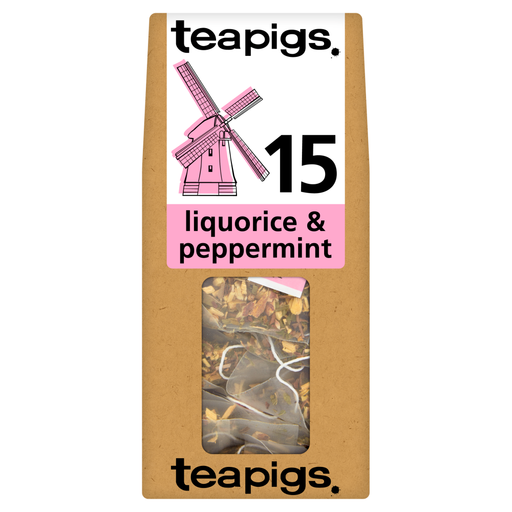
Teapigs Liquorice & Mint 15 Tea Bags
This 15-bag liquorice-and-mint pack is a smaller quantity for testing whether the household likes the flavour. Check the blend’s ingredients and caffeine statement on the exact pack, especially when choosing for several people.
View on Joybuy
Frequently asked questions
Is herbal tea automatically decaf?
No. Check the caffeine statement on the individual product rather than relying on the word ‘herbal’. Twinings describes its fruit and herbal infusions as naturally caffeine-free, while Pukka says many of its herbal teas naturally contain no caffeine; those descriptions should not be extended to every blend in a wider range.
How should I buy herbal tea for a large household?
Start with a flavour the household is willing to drink, check its bag count, then compare current cost per bag across suitable packs. Twinings lists Pure Camomile in 20-bag and 4 × 20-bag formats, so a smaller pack can be tried before a larger repeat purchase.
Should I buy several herbal flavours at once?
Choose several flavours if people in the household want variety, but try unfamiliar blends in smaller quantities first. Ingredient lists matter too: Clipper lists a peppermint infusion, whereas Teapigs lists chamomile with manuka honey granules, natural flavourings and vanilla.
Can an herbal blend be used for a health concern?
Do not substitute a blend for medical care or assume that ‘natural’ means suitable for everyone. The NHS advises caution with herbal medicines during pregnancy or breastfeeding, with kidney or liver problems, and alongside certain medicines. That guidance does not mean every supermarket infusion is a medicine; if a botanical product is being considered for a health purpose, take its ingredient list to a pharmacist, clinician or midwife for individual advice.


