What should you check before choosing?
Start with the flavour the person will actually drink, then check the exact pack format, caffeine declaration and ingredients.
| Priority |
What to check |
Your needs |
| Flavour and pack size |
Check whether the box contains one known favourite or a blend being tried for the first time. Twinings and UK grocery listings identify Lemon & Ginger as an 80-bag herbal infusion; Pukka lists its Elderberry & Echinacea fruit tea in 20 bags and Teapigs lists Super Fruit in 15 tea temples. |
I would choose 80 bags if lemon and ginger is already a familiar afternoon drink. For an uncertain preference or a berry-led tea tray, I would start with smaller packs. |
| Caffeine |
Read the caffeine declaration for the exact blend rather than assuming every product called ‘tea’ has the same status. Twinings describes its Lemon & Ginger 80-bag infusion as caffeine-free. |
If I want a caffeine-free afternoon cup, I need that stated for the product I am buying. |
| Ingredients |
Read the current pack label for botanicals and flavourings. ASDA’s listing for Twinings Lemon & Ginger names ginger root, lemon flavouring, lemongrass, blackberry leaves, lemon peel and sweet fennel; Clipper lists liquorice root in its Berry Burst catering infusion. |
When the drinker takes medication, has a relevant condition or must avoid an ingredient, I want the specific blend checked before serving it regularly. |
| Preparation |
Check the instructions on the chosen pack and whether the person enjoys the resulting strength. The ASDA listing for Twinings Lemon & Ginger says to infuse one bag in 200 ml of freshly boiled water for 3 minutes. |
I want a cup that fits the recipient’s usual afternoon routine and flavour preference, rather than assuming a longer brew will suit them. |
Brands and retailer references
These examples show why the words ‘fruit tea’ do not guarantee the same flavour or pack size across ranges.
Twinings
Twinings describes Lemon & Ginger as a caffeine-free herbal infusion sold in an 80-bag box.
- The 80-bag count fits a request for one large box.
- Its citrus-and-ginger blend is not a berry-led fruit tea; check the ingredients and flavour preference.
Clipper
Clipper lists Berry Burst as a caffeine-free fruit and herbal infusion in a 250-envelope catering pack.
- The Berry Burst listing provides a detailed ingredient list for comparison.
- Its 250-envelope format exceeds an 80-bag request, and the listed ingredients include liquorice root.
Pukka
Pukka lists Elderberry & Echinacea as a caffeine-free fruit tea containing elderberries and echinacea.
- The listed 20-bag format allows a smaller flavour trial.
- That format is not one 80-bag box; assess its ingredients for the intended drinker.
Teapigs
Teapigs lists Super Fruit with ingredients including elderberries, currants, cranberries and blueberries.
- The product listing describes it as naturally caffeine-free.
- The listed pack contains 15 tea temples, not 80 bags.
Tesco
Tesco’s fruit-and-herbal tea category lists Twinings Lemon & Ginger in an 80-bag format.
- Its listing provides another place to identify the exact large-box product.
- Check the current product listing and delivery options for your address before ordering.
Sainsbury’s
Sainsbury’s fruit-and-herbal category lists both Twinings Lemon & Ginger in 80 bags and its own Strawberry, Raspberry & Cranberry tea bags in a 20-bag pack.
- The listings illustrate the choice between a large lemon-and-ginger box and a smaller berry-flavoured pack.
- The listed own-label berry option does not meet a single-box 80-bag requirement; check current local availability.
An 80-bag option on Joybuy
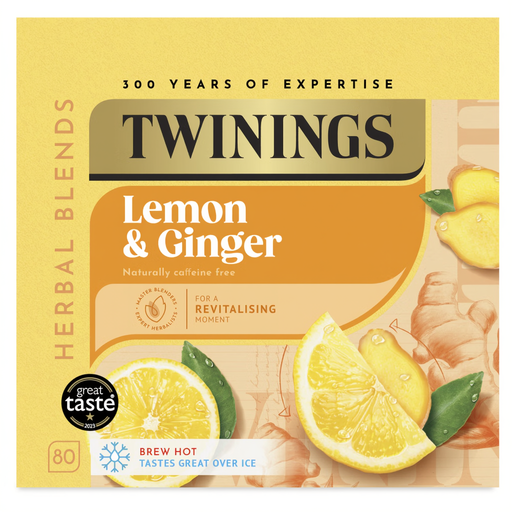
This lemon-and-ginger herbal infusion suits the large-box route when the recipient already likes that flavour. It is not a berry-led fruit tea, so check the ingredients before making it a regular afternoon drink.
 No image available
Twinings Lemon & Ginger 80 Pack
Consider this box for a regular afternoon drinker who already enjoys lemon and ginger, rather than someone seeking a berry flavour.
The Joybuy product listing identifies 80 tea bags and names ingredients including ginger root, lemon flavouring, lemongrass, blackberry leaves and sweet fennel. Twinings describes this exact infusion as caffeine-free. Check the label on the delivered pack for individual ingredient requirements.
View on Joybuy
Questions about afternoon infusions
Can fruit or herbal tea count towards an older person’s fluid intake?
Yes. The NHS says drinks other than water can count towards fluid intake. An infusion can be one drink the person enjoys regularly, but it is not a treatment for suspected dehydration or a substitute for clinical advice.
Is Twinings Lemon & Ginger 80 Pack caffeine-free?
Yes. Twinings describes its Lemon & Ginger 80-bag product as a caffeine-free herbal infusion. It tastes of lemon and ginger rather than berries, so confirm the flavour is wanted as well as checking caffeine status.
How do I prepare the Twinings 80-bag infusion?
The ASDA listing for Twinings Lemon & Ginger says to infuse one bag in 200 ml of freshly boiled water for 3 minutes, or longer for a stronger cup. Check the instructions on the pack you receive and let a hot drink reach a comfortable serving temperature.
What if the drinker takes medication or avoids certain ingredients?
Read the full ingredient list for the exact infusion and ask a pharmacist or clinician about any relevant medicines or conditions before serving it regularly. This is an individual suitability check, not a claim that a particular tea will interact with a medicine.
Should I check the box if I have already read the online ingredients?
Yes. Check the label on the delivered pack before serving, especially when the recipient has an allergy, intolerance or other ingredient restriction. Use that label to assess the product actually being prepared.


