Who each setup suits

Regular loose-herbal tea drinkers

If you make loose herbal or fruit infusions often, an appliance that controls steeping may save you from watching a separate infuser. Porter Hill Tea Company suggests 95–100°C and 3–5 minutes for fruit and herbal teas; follow your blend maker’s directions where they differ.

Brewers with limited worktop space

Compare external dimensions and the room needed to fill and open the appliance, as well as its capacity. A kettle with a separate infuser remains an option if you do not need automated steeping.

People who want tea at wake-up

If scheduling is the main task, a clock-and-alarm tea appliance may be more relevant than one designed around adjustable loose-leaf infusion.

What matters when choosing

Automatic basket tea maker

Choose it when: You frequently brew loose herbal tea and want the appliance to lower and lift the basket. Sage lists a herbal preset and automatic basket movement for its full-size Tea Maker.

Allow for: A dedicated appliance that needs a suitable place on the worktop; check its external dimensions before choosing it.

Teasmade

Choose it when: A scheduled personal brew matters more than adjustable loose-herbal infusion. Swan lists a clock, alarm and 600 ml capacity for its Teasmade.

Allow for: Its timed-tea focus; confirm that the model accommodates the tea format you intend to use.

Kettle and separate infuser

Choose it when: You mainly need hot water and are content to steep and remove the herbs yourself.

Allow for: A separate infuser or teapot and manual attention to steeping time.

Concern What to check Who this matters to
Controlled herbal infusion Check the herbal programme or steep-time controls, and how loose herbs are removed from the water. Follow the blend maker’s brewing directions. If I make loose herbal tea regularly, I want infusion to end without watching a separate timer. Around 36% of consumers put hands-off steeping first.
Worktop fit Compare external width, depth and height with the intended space, including clearance to open the lid. In a cramped kitchen, I need an appliance I can place or store without obstructing the space I use. For around 27% of consumers, physical fit is the main concern.
Simple brewing and cleaning Check which tea-contact parts are removable and whether you will need a separate infuser; follow the maker’s cleaning instructions. For a straightforward daily cup, I would rather handle the steeping myself than maintain a dedicated tea maker. Around 19% of consumers prioritise that simpler routine.
Timed morning tea Check how the alarm and brewing schedule operate, the capacity and whether the appliance takes your preferred tea format. When I want tea ready as I wake, scheduling matters more to me than adjustable infusion settings. That is the primary need for around 18% of consumers.

Buying pitfalls

  • Assuming a kettle will steep loose herbs automatically

    A standard kettle heats water; it does not lower an infuser or remove herbs when steeping is finished.

    Decide whether you need boiling water alone or automatic infusion before comparing appliances.

  • Choosing by capacity without measuring

    Litres do not tell you whether an appliance fits a narrow worktop or beneath a cupboard.

    Measure the intended spot and compare the published external dimensions, leaving room to fill the appliance and open its lid.

  • Assuming an older compact model is still available

    Sage identifies its Tea Maker Compact as discontinued. Do not treat an older listing as evidence that the model is currently available.

    Confirm the exact model, seller, availability and warranty terms before ordering.

  • Overlooking electrical-product traceability

    In August 2026, the UK Office for Product Safety and Standards reported a serious fire risk involving inadequate earthing in one electric kettle model, CZ-8520. That report concerns the identified model, not electric kettles generally.

    Keep the model details and instructions, check the power arrangement for your location and consult government product-safety alerts when assessing an unfamiliar listing.

Brands to consider

Sage

Its full-size Tea Maker is a dedicated option for people who want an appliance to manage loose-leaf infusion.

  • Sage lists a herbal preset, automatic basket movement, strength settings and up to 60 minutes of keep-warm for the full-size model.
  • Its listed dimensions are 21.9 × 21.4 × 25.8 cm, so check the available space. Sage identifies the separate Tea Maker Compact model as discontinued.

Swan

Its Teasmade STM200N is aimed at a timed tea routine near where you wake up.

  • Swan lists a combined tea maker, clock and alarm with a 600 ml capacity.
  • Confirm how you would use loose herbal tea: the stated features do not establish an automatic loose-leaf basket or adjustable steep control.

Judge

Its Electricals kettle offers a conventional water-boiling route to pair with an infuser or teapot.

  • Judge lists a 1.7 L capacity, 12.0 cm width, removable limescale filter and automatic switch-off for the cited kettle.
  • The kettle does not automate loose-herb steeping; allow for a separate infuser and manual timing.

Joybuy herbal-tea appliances

These two programmed herbal-tea appliances offer different batch sizes: a 1.5 L tea kettle and a 3.5 L decoction pot. Check the space available and how each handles your loose herbs before choosing either for a small kitchen.
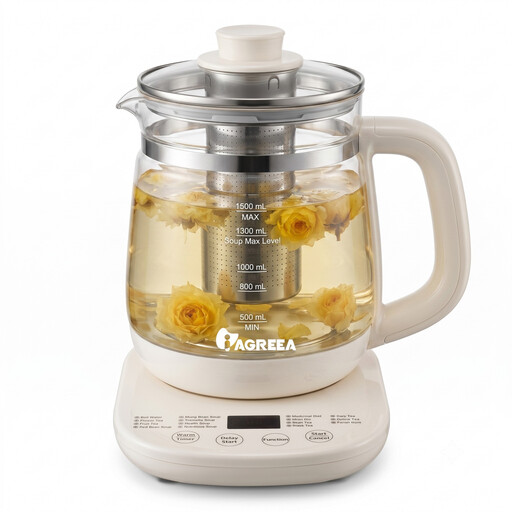
IAGREAA YSH15(69)30 1.5 L herbal tea kettle

IAGREAA YSH15(69)30 1.5 L herbal tea kettle

Consider this model if you want a tea kettle with an infuser rather than a separate kettle-and-teapot setup.

The listed configuration includes a borosilicate glass vessel, stainless-steel tea infuser, 14 preset programmes, a wide mouth and an 800 W rating.

Before using a herbal preset, confirm the exact model’s operating temperatures against your blend maker’s directions. Check its external dimensions, available clearance and product-specific electrical documentation for your location.

View on Joybuy
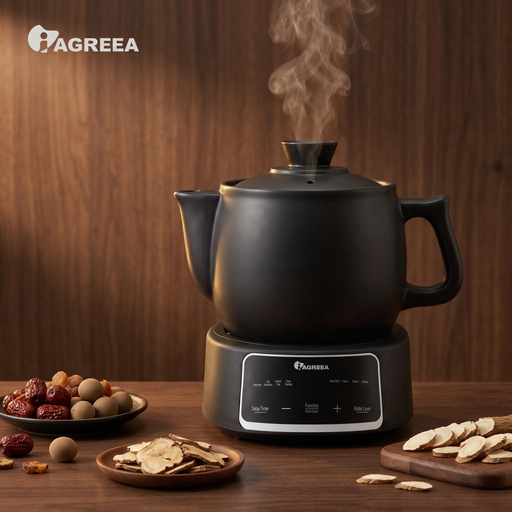
IAGREEA JYC3060 3.5 L electric herbal decoction pot

IAGREEA JYC3060 3.5 L electric herbal decoction pot

Consider this pot if you want a larger batch and a programmed herbal-tea mode, rather than an appliance chosen primarily for one mug.

The listed configuration includes a detachable ceramic pot, four preset modes, segmented boil-and-simmer heating, a 24-hour delay timer and a 600 W rating.

Check how loose herbs are contained and removed, whether the pot and lid fit your available space, and the product-specific electrical documentation for your location.

View on Joybuy

Common questions

Do I need temperature control for herbal tea?

Not necessarily: a kettle and separate infuser can work for herbal tea if you manage the steeping yourself. Porter Hill Tea Company suggests 95–100°C for 3–5 minutes for fruit and herbal infusions, but follow the directions for your particular blend; lower-temperature controls may matter more if you also make other kinds of tea.

How do I use an automatic tea maker with loose herbs?

Use its herbal programme if the model has one, while following the appliance instructions and your blend maker’s directions for quantity and steeping time. Sage states that the basket in its full-size Tea Maker descends into and rises out of the water automatically; check other models’ infusion mechanisms individually.

What cleaning should I plan for?

Plan to clean the parts that touch the tea and descale the appliance according to its manufacturer’s instructions. Check which parts can be removed: Judge, for instance, specifies a removable limescale filter for its Electricals kettle.

What should I check before buying an electrical tea appliance?

Confirm the exact model, its instructions and a power arrangement suitable for your location, and keep enough purchase information to identify it later. Government product-safety alerts can help you check a particular model; an alert about one appliance should not be taken to apply to every tea maker or kettle.