
24/7 Customer Support

Free returns

Same-day & Next-day Delivery

Quality Guaranteed

Unlock Your Welcome Offers: FREE Delivery | Up to 80% OFF | Free 30-day JoyPlus trial
Download the APP
As a Joybuy Product Recommendation Officer, my role is to help you navigate the crowded market of home tech. Hexagon light panels have become a go-to for transforming a space, but not all kits are created equal. Many buyers find their exciting new purchase becomes a source of frustration due to overlooked flaws.
Before you invest in creating the ultimate gaming room or a dynamic living room feature wall, let's look at the common pitfalls. Understanding these issues is the first step to choosing a set of smart RGB light panels that you will enjoy for years to come.
To avoid disappointment, focus on the core specifications that determine performance and longevity. These are the details that matter far more than hyped marketing claims.
How the panels connect to each other and to the power source is critical. Some systems use small, rigid USB-style connectors that protrude from the sides of each panel. These require precise alignment and can limit your design flexibility. Others use small, flexible linking cables, which can make assembly easier, especially for more complex shapes.
Crucially, check the maximum number of panels supported by a single power supply. A standard USB-powered kit might only handle up to 10 or 12 panels before the brightness and performance start to degrade. If you plan on creating a large installation, you may need a kit with a more robust power adapter or plan to use multiple power sources.
Consider how you want to interact with your lights. Most kits come with a basic infrared remote, but the real customisation happens through a smartphone app.
The heart of any gaming room lights is the LED itself. The specification to look for is RGBIC (Red, Green, Blue - Independent Control). This technology allows each panel to display multiple colours at once, enabling flowing, dynamic effects that standard RGB cannot produce. It is the key to creating the smooth, gradient-like animations seen in professional gaming setups and is a clear indicator of a higher-quality product.
Based on these practical criteria, here are some options matched to different user needs.
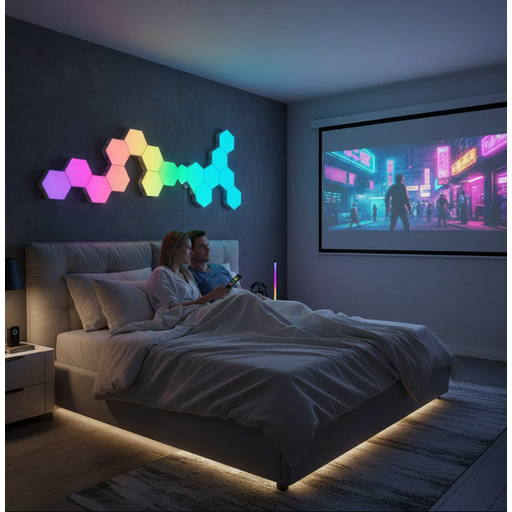
Why This Fits Their Persona: This kit is ideal for someone building a gaming or streaming setup. The music sync feature creates a reactive background that enhances content, and the classic honeycomb light shape is instantly recognisable as a staple of modern gaming setup accessories. The 8-panel starter pack is enough to create a meaningful design without a huge initial outlay.
The product description explicitly mentions warming the adhesive tape before mounting for improved stability, directly addressing the common pitfall of panels falling off the wall.
Features a dedicated music sync mode that changes colour, speed and brightness with the beat. The modular design with protruding USB connectors allows for easy expansion.
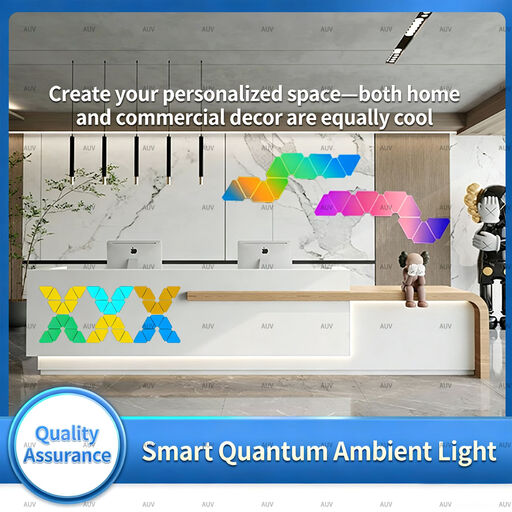
Why This Fits Their Persona: For those seeking unique wall decor for a living room or bedroom, the triangular shape offers more creative freedom than hexagons. You can create arrows, stars and more abstract geometric art. This kit is for the user who sees these panels as a form of dynamic art, not just a tech accessory.
This system avoids the trap of unreliable controls by offering both a mobile app and a physical remote, ensuring you can always change scenes or turn the lights off even if your phone isn't handy.
Offers a huge range of customisation with 16 million colours and over 210 pre-set scene modes accessible via the app. The triangular shape allows for more intricate and artistic layouts.
We have compiled a complete, real-time list of products that fully satisfy these strict selection criteria and UK safety regulations.
How many hexagon light panels can you connect together? This depends entirely on the product's power supply. Most starter kits that are powered by a standard 5V USB adapter can typically support between 8 and 12 panels. For larger installations, you will need a kit with a dedicated mains power adapter, which can often support 20 panels or more. Always check the manufacturer's specifications before purchasing additional panels.
Do LED wall panels use a lot of electricity? Generally, no. LED technology is highly energy-efficient. A single panel consumes a very small amount of power, often just 1-2 watts. A full set of 8-10 panels running at maximum brightness will use less electricity than a single traditional 40W incandescent light bulb. Your total energy consumption will depend on the number of panels, their brightness and how often you use them.
Can you mount honeycomb lights on textured walls? It is generally not recommended. The double-sided adhesive pads included with most kits are designed for smooth, clean and non-porous surfaces like painted plasterboard, glass or smooth wood. On textured or wallpapered surfaces, the adhesive has less surface area to grip and is much more likely to fail. For these walls, you may need to investigate stronger, third-party mounting solutions.