Who this is for

Weekly shoppers increasing fibre intake

For adults choosing a repeat breakfast cereal who want to compare fibre per 100g and per usual serving rather than relying on a front-of-pack impression. The NHS advises adults to increase dietary fibre intake to 30g a day as part of a healthy balanced diet.

Shoppers balancing fibre with sugars

For buyers who want high fibre but do not want to assume that an oat, fruit or nut granola has low listed sugars. Nutrition panels for named products show meaningful differences per 100g.

Shoppers with dietary or nut-related requirements

For buyers whose ingredient and allergen requirements can rule out an otherwise suitable granola, particularly where recipes include honey, tree nuts, oats, rye, barley or wheat.

What to check before buying

For a like-for-like weekly-shop comparison, start with fibre per 100g, then read the serving size, sugars and ingredient statement on the same pack.

Priority What to check Your needs
Fibre amount Compare fibre per 100g first. Then check the stated serving size and calculate what one bowl contributes. Keep the same measurement basis across products. I want to see how much fibre my usual bowl provides, not just a prominent pack claim. Eat Natural lists 12.8g per 100g and 6.4g per 50g portion; Dorset lists 7.0g per 100g and 3.2g per 45g serving.
Sugars alongside fibre Read the fibre and sugars lines together per 100g. Check whether the product suits your preference for a lower-sugar recipe, a sweeter flavour or a nut-led cluster. A high-fibre claim alone is not enough if listed sugars matter to me. The named examples range from 4.4g sugars per 100g for Eat Natural Low Sugar Granola to 15.2g for Jordans Super Nutty Granola.
Ingredients and allergens Read the full ingredient list and precautionary statement on the exact flavour and pack size. Check honey, tree nuts, peanuts, milk, soya, sesame and cereals containing gluten where relevant. I need a granola that fits the people eating it at home. Dorset Honey Granola contains honey, oats, rye, almonds and pecans, while Eat Natural Low Sugar Granola contains oats and almonds and carries additional may-contain statements.

Common buying mistakes

  • Assuming every oat-and-nut granola has the same fibre level

    Current labels for comparable examples differ: Eat Natural Low Sugar Granola lists 12.8g fibre per 100g, Dorset Honey Granola 7.0g, and Jordans Super Nutty Granola 6.7g.

    Compare fibre per 100g first, then use the stated bowl portion to judge how it fits your usual breakfast.

  • Treating a high-fibre claim as proof of lower sugars

    Verified examples with high-fibre positioning list different sugar values, from 4.4g to 15.2g per 100g.

    Read fibre and sugars side by side on the nutrition panel, then choose according to whether fibre, lower listed sugars or flavour is your main priority.

  • Skipping ingredient and may-contain statements because the brand is familiar

    Granola often combines oats or other cereals with tree nuts, and individual recipes may also carry statements for peanuts, milk, soya or sesame.

    Check the exact pack whenever you change flavour, pack size or retailer listing, particularly where allergens or vegan suitability matter.

  • Assuming a previously seen Joybuy listing is still available

    Product availability and pack details can change between browsing and checkout.

    Confirm the live stock status, exact product identity and pack label immediately before placing a weekly-shop order.

Relevant brand references

Eat Natural

Relevant when you want a specifically labelled low-sugar, high-fibre granola rather than relying on a general wholegrain claim.

  • Eat Natural UK lists 12.8g fibre and 4.4g sugars per 100g for its Low Sugar Granola, which is described as vegan.
  • It contains oats and almonds and may contain other nuts, peanuts, soya, sesame and cow's milk.

Dorset Cereals

Relevant for shoppers wanting a traditional wholegrain oat granola with nuts, seeds and flavour-led recipes.

  • Dorset Honey Granola lists 7.0g fibre per 100g and is described as high in fibre.
  • Its label lists 13g sugars per 100g, and its honey content means it is not vegan.

Jordans

Relevant for familiar oat-cluster granola, including nut-forward recipes and a broad UK range.

  • Jordans Super Nutty Granola is labelled high in fibre and lists 6.7g fibre per 100g.
  • The nut-forward recipe and its listed 15.2g sugars per 100g may not suit nut avoidance or a lower-sugar priority.

Lizi's

Relevant for vegan and vegetarian shoppers looking for a fibre-focused range with high-protein and low-sugar variants.

  • Lizi's states that each granola recipe is high in fibre and suitable for vegans and vegetarians.
  • Check the nutrition panel for the selected flavour, as fibre and sugar values vary between recipes.

Rude Health

Relevant for shoppers who prefer organic, wholegrain granola and an ingredient-led nut-and-grain recipe.

  • The Ultimate Granola is labelled high fibre and whole grain, with oats, spelt, barley, almonds and hazelnuts.
  • It contains honey and may contain milk, soya and other nuts.

Nature's Path

Relevant for an organic granola range with gluten-free, grain-free and protein-oriented options.

  • The UK range includes Pumpkin Seed + Flax and Love Crunch granola products.
  • Check the individual pack label for fibre, sugars and dietary information before choosing a flavour.

Joybuy granola options

These Joybuy options are granolas for repeat breakfast use, with fibre, sugars and ingredient suitability shown where stated in the product information.
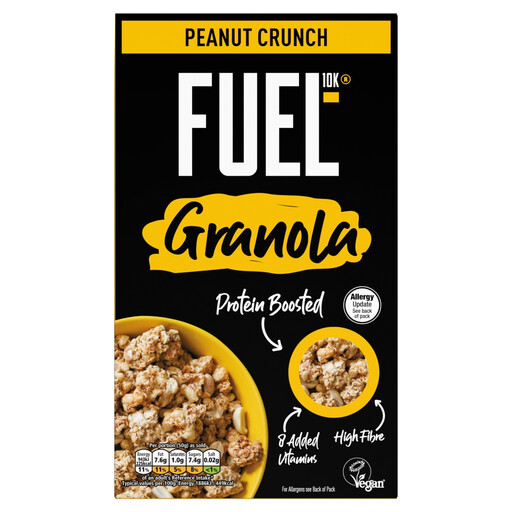
Fuel10K Peanut Granola 400g

Fuel10K Peanut Granola 400g

A vegan peanut granola for a repeat breakfast routine, with a stated 50g portion providing 3.1g fibre.

Lists 6.1g fibre and 14.9g sugars per 100g. Contains peanuts, oats and wheat, and may contain milk, nuts, sesame and soya.

Joybuy
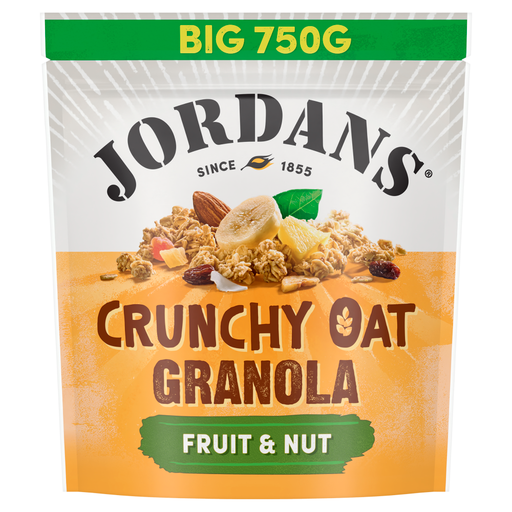
Jordans Crunchy Oat Granola Fruit and Nut 750g

Jordans Crunchy Oat Granola Fruit and Nut 750g

A fruit-and-nut oat granola for regular breakfasts, supplied in a resealable 750g pack.

Lists 66% wholegrain oats, 6.1g fibre and 24g sugars per 100g. Contains honey, oats and almonds, and may contain peanuts, cereals containing gluten and other tree nuts.

Joybuy

Frequently asked questions

How should I compare high-fibre granola for a weekly shop?

Start with fibre per 100g for a like-for-like comparison, then check the stated serving and sugars. Eat Natural Low Sugar Granola lists 12.8g fibre per 100g, Dorset Honey Granola lists 7.0g, and Jordans Super Nutty Granola lists 6.7g.

Can one bowl of granola provide all the fibre I need?

No. The NHS advises adults to increase dietary fibre intake to 30g a day as part of a healthy balanced diet. A serving of granola can contribute, but fibre also comes from other foods across the day.

Does high fibre automatically mean low sugar?

No. Check both lines on the same nutrition panel. The named examples list 4.4g sugars per 100g for Eat Natural Low Sugar Granola, 13g for Dorset Honey Granola and 15.2g for Jordans Super Nutty Granola.

What allergen checks matter most for granola?

Check the exact ingredients and precautionary statement for the chosen product. Tree nuts such as almonds, hazelnuts, cashews and pecans, plus cereals including wheat, rye, barley and oats, can be relevant depending on your requirements and the recipe.

Is oat granola automatically gluten-free?

No. The Food Standards Agency states that food labelled gluten-free must contain no more than 20mg/kg gluten. Choose a specifically gluten-free labelled product where that requirement applies.