Who this is for

People with diabetes choosing regular granola

For shoppers comparing carbohydrate, sugars, fibre and their usual bowl size instead of assuming that granola is automatically suitable. Diabetes UK notes that carbohydrate amount and portion size are relevant considerations.

High-fibre shoppers seeking lower-sugar granola

For people who want to compare clearly stated fibre figures while recognising that products with more fibre can still differ substantially in sugars and carbohydrate.

Buyers with gluten or nut-related dietary restrictions

For shoppers who need product-specific gluten-free and allergen checks alongside nutrition comparisons for a diabetes-conscious breakfast.

Buying priorities

Compare products per 100g first, then translate the figures to the bowl you usually serve and check the current ingredient and allergen information.

Priority What to check Your needs
Carbohydrate and portion size Compare carbohydrate per 100g and per stated serving. Check whether the pack portion matches the bowl you normally eat, especially if you use carbohydrate counting. I want to know the carbohydrate in my real serving, rather than treating the suggested bowl size as my own portion.
Clearly quantified fibre Compare fibre grams per 100g on the same basis. Use wholegrains, oats, seeds or chicory root fibre as ingredient clues, not as a substitute for the nutrition panel. I want a high-fibre comparison based on stated figures, not just a wholegrain ingredient list.
Sugars and sweeteners Check sugars per 100g and per serving, then read the ingredients for syrup, honey, sugar, nectar and sweetened dried fruit. Where present, traffic-light labelling can be a quick secondary comparison tool. I want to spot when an oat-based granola is sweetened, even if the pack looks natural or wholegrain.
Allergens and gluten Read the current allergen declaration and precautionary statements. Choose gluten-free only where the exact pack is labelled gluten-free; oats alone do not establish this. I need the exact product to fit my allergy, coeliac or gluten-related dietary requirements.

Common buying pitfalls

  • Assuming wholegrain oats mean the granola is low in sugar

    Wholegrain ingredients can contribute fibre, but recipes may still include syrup, honey, sugar or sweetened fruit. Dorset Cereals lists golden syrup as 22% of ingredients in Oaty Granola, with 16.5g sugars per 100g.

    Read both the ingredient list and the sugars line per 100g, then compare it with a lower-sugar option before choosing.

  • Choosing only by fibre while ignoring carbohydrate per bowl

    A product with a substantial fibre figure can still provide considerable carbohydrate. Eat Natural UK lists 33.0g carbohydrate per 100g for its Low Sugar Granola, while Jordans Cereals lists 55.7g per 100g for Low Sugar Granola Almond and Hazelnut.

    Use fibre as one factor, but work out the carbohydrate in your actual serving and fit it into your individual plan.

  • Treating no added sugar as the same as low total sugars

    No-added-sugar wording does not reveal total sugars or carbohydrate supplied by ingredients such as dried fruit. Jordans Cereals advises shoppers to check the current pack for its No Added Sugar Triple Nut granola.

    Compare total sugars and carbohydrate values, not only a front-of-pack claim, and check the label again after recipe changes.

  • Overlooking allergens in nut-and-seed granolas

    Lower-sugar and higher-fibre granolas can contain nuts, gluten-containing cereals or precautionary allergen warnings. Allergenic ingredients should be clearly emphasised in the ingredient list, as explained by the Food Standards Agency.

    For an allergy or coeliac requirement, choose only an exact product whose current allergen declaration and any cross-contact warning are suitable for you.

Relevant granola brands

Eat Natural

A UK granola and breakfast brand with a Low Sugar Granola made with wholegrain oats, almonds and seeds.

  • Eat Natural UK lists 12.8g fibre, 4.4g sugars and 33.0g carbohydrate per 100g for its Low Sugar Granola.
  • The product contains oats and almonds and may contain other nuts, peanuts, soya, sesame and cow's milk; its pack also lists 31.4g fat and 495kcal per 100g.

Jordans

A broad UK granola range with conventional honey-baked fruit granolas alongside products labelled Low Sugar and No Added Sugar.

  • Jordans Cereals lists 2.9g sugars, 7.9g fibre and 55.7g carbohydrate per 100g for Low Sugar Granola Almond and Hazelnut.
  • Nutrition varies across the range: Diabetes UK previously listed 28.5g sugars per 100g for Jordans Crunchy Oat Granola Fruit and Nut. The low-sugar product contains oats, barley and nuts.

Lizi's

A granola range with vegan and vegetarian recipes, including options marketed as low sugar or high protein.

  • Lizi's states that every granola recipe in its range is high in fibre and that low-sugar options are available.
  • Compare the nutrition panel for the exact flavour and pack because the range page does not provide comparable sugar, carbohydrate and fibre figures for every variant.

Rude Health

A wholegrain granola range that includes Nutty Low Sugar Granola for shoppers looking for an oat-and-nut recipe.

  • The manufacturer describes Nutty Low Sugar Granola as high fibre and wholegrain, made with oats, almonds and hazelnuts.
  • It contains wheat, barley and nuts and may contain milk, soya, mustard and other nuts; check the current pack for its full nutrition panel and allergen information.

Dorset Cereals

A traditional premium-style granola range built around wholegrain oats, baked texture, seeds, fruit and nut varieties.

  • Dorset Oaty Granola provides 5.0g fibre per 100g according to the manufacturer's nutrition panel.
  • The same panel lists 16.5g sugars per 100g, and golden syrup accounts for 22% of ingredients, so it is not a lower-sugar-first choice.

Nature's Path

An organic granola range with gluten-free options, including the UK-listed Nice and Nobbly berry-and-yoghurt granola.

  • Nature's Path labels Nice and Nobbly gluten-free and describes it as made with gluten-free wholegrain rolled oats.
  • It contains milk through yoghurt chips and may contain traces of peanuts and tree nuts; check the current pack for nutrition and allergen details.

Joybuy product options

Joybuy product options for shoppers considering a traditional fruit-and-nut granola within a diabetes-conscious breakfast plan.
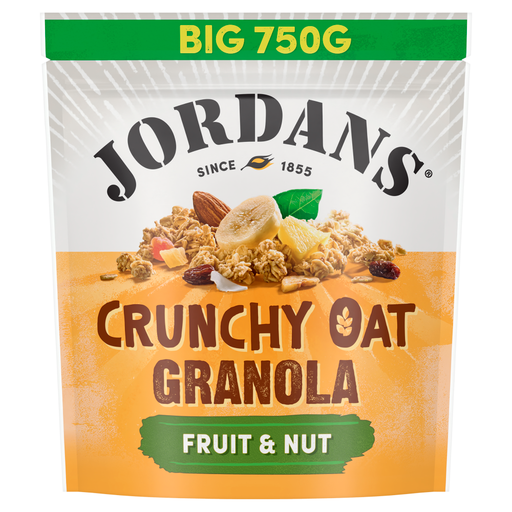
Jordans Crunchy Oat Granola Fruit and Nut 750g

Jordans Crunchy Oat Granola Fruit & Nut 750g

A traditional fruit-and-nut granola for shoppers who can account for its stated serving within an individual carbohydrate plan.

The pack lists a 45g portion with 29g carbohydrate, 11g sugars and 2.7g fibre; per 100g it lists 65g carbohydrate, 24g sugars and 6.1g fibre.

It contains oats and almonds and may contain peanuts, other nuts and cereals containing gluten. Sweetened dried fruit, added sugar and honey mean it is not a lower-sugar-first option.

Joybuy

Frequently asked questions

Is high-fibre granola automatically suitable for people with diabetes?

No. Fibre is only one part of the comparison: granola also contains carbohydrate and may contain sugars from syrup, honey, sugar or dried fruit. Check carbohydrate, sugars and fibre on the current nutrition panel, then use a serving that fits your individual meal plan.

Should I compare granola labels per 100g or per serving?

Use per 100g to compare products on the same basis, then calculate the figures for your usual bowl using the per-serving information or by weighing it. Diabetes UK notes that a larger-than-suggested portion increases the carbohydrate and calories consumed.

Does a low-GI claim remove the need to watch portion size?

No. Diabetes UK explains that GI does not account for portion size, which can have a greater effect on blood glucose. Treat GI as one consideration, not a replacement for checking the carbohydrate in your serving.

Do I need to count granola carbohydrate if I use insulin?

If you use basal-bolus insulin or have been taught carbohydrate counting, use the product's carbohydrate figure with your own insulin-to-carbohydrate guidance. Insulin ratios differ between people, so another person's calculation is not a suitable substitute.

How should I handle nut, gluten or milk allergies?

Check the exact current pack rather than relying only on a brand page or older listing. For example, Jordans Low Sugar Granola contains oats, barley and nuts; Eat Natural Low Sugar Granola contains oats and almonds with several cross-contact warnings; Nature's Path Nice and Nobbly is gluten-free but contains milk and may contain peanut and tree-nut traces.