Who this is for

High-fibre breakfast planners

You want granola that makes a meaningful contribution to fibre intake at a relaxed weekend breakfast, and are willing to compare fibre per 100 g rather than relying only on front-of-pack wording. UK nutrition-claim rules set a defined threshold for “high fibre”.

Lower-sugar granola shoppers

You want a recipe with fibre while also comparing sugars. Check both figures on the same per-100-g basis and take account of the serving you actually pour.

Dietary-restriction shoppers

You need a vegan or gluten-free option, or must avoid particular allergens such as nuts and cereals containing gluten. Confirm the exact pack, as recipes and precautionary allergen statements can differ.

Buying priorities

Compare labels on a common per-100-g basis first, then use the ingredient list and allergen declaration to narrow down suitable recipes.

Priority What to check Your needs
Fibre content Check fibre per 100 g. Under legislation.gov.uk guidance, “high fibre” requires at least 6 g per 100 g or 3 g per 100 kcal. Compare the exact recipe rather than relying on category wording. I want a weekend bowl with a clearly stated fibre figure, so I can compare recipes on the same basis.
Fibre and sugars Read fibre and sugars together per 100 g. Jordans Low Sugar Granola Almond & Hazelnut lists 7.9 g fibre and 2.9 g sugars per 100 g, while Dorset Nutty Granola lists 6.2 g fibre and 13.1 g sugars per 100 g. I want to compare the fibre figure without assuming that a fibre claim also says anything about sugars.
Dietary suitability Check the exact vegan or gluten-free claim, ingredients and allergen declaration. Gluten-free food must meet the applicable gluten limit, and oats remain an allergen, according to the Food Standards Agency. I need a recipe that fits my dietary requirements and does not rely on assumptions about oats, seeds or a plant-based appearance.

Common buying pitfalls

  • Assuming every wholesome-looking granola is high in fibre

    Granola is a product category, not a regulated fibre level. Fibre amounts can vary between recipes.

    Check fibre per 100 g first. Under UK nutrition-claim rules, 6 g per 100 g is the benchmark for a high-fibre claim.

  • Choosing by fibre alone and overlooking sugars

    Two granolas with notable fibre figures can have very different sugars figures. Dorset Nutty Granola lists 13.1 g sugars per 100 g, compared with 2.9 g per 100 g for Jordans Low Sugar Granola Almond & Hazelnut.

    Compare fibre and sugars on the same per-100-g label basis before choosing a flavour, then consider the portion you usually serve.

  • Treating oats, seeds or a plant-based appearance as proof of suitability

    Granolas often contain nuts or precautionary allergen statements. A gluten-free claim also applies only to the specific finished product, while oats remain an allergen.

    If you need to avoid gluten or particular allergens, use only the exact current pack’s claim and allergen declaration rather than substituting a similar-looking recipe.

  • Comparing nutrition figures on different serving bases

    Serving sizes vary, so per-portion comparisons can make one product appear stronger or weaker simply because the stated bowl size is different.

    Use per-100-g figures to compare products, then work out the fibre and sugars in the amount you actually pour.

Relevant granola brand references

Lizi’s

A lifestyle-oriented granola range with manufacturer-stated high-fibre, vegan and vegetarian positioning, plus lower-sugar, protein and gluten-free product routes.

  • Lizi’s states that every granola recipe is high in fibre and suitable for vegans and vegetarians.
  • Compare the nutrition panel and allergen statement for the chosen recipe rather than assuming identical values across the range.

Jordans

A mainstream option for shoppers seeking a specifically lower-sugar granola recipe with disclosed nutrition and allergen information.

  • Jordans Low Sugar Granola Almond & Hazelnut lists 7.9 g fibre, 2.9 g sugars and 16.1 g protein per 100 g.
  • It contains oats, barley and nuts, may contain other gluten sources and other nuts, and the manufacturer advises people with a nut allergy not to eat it.

Dorset Cereals

A flavour- and texture-led granola range built around wholegrain oats, with nut-forward recipes for a weekend bowl.

  • Dorset Nutty Granola lists 6.2 g fibre per 100 g, which meets the UK threshold for a high-fibre claim.
  • The same recipe lists 13.1 g sugars per 100 g and contains oats, rye, almonds, hazelnuts and cashews.

Rude Health

An organic, wholegrain granola option for shoppers prioritising a manufacturer-labelled high-fibre recipe and ingredient-led flavours.

  • The Ultimate Granola and Wild Berry Granola are labelled high fibre and whole grain by the manufacturer.
  • Check the current pack nutrition panel before comparing fibre and sugars with other recipes; Wild Berry Granola may contain traces of milk, soya and nuts.

Eat Natural

A range with granola options positioned around nuts and seeds, lower sugar or protein alongside a general fibre-rich message.

  • Eat Natural identifies lower-sugar, protein, and nuts-and-seeds granola options within its range.
  • Use the label for the individual product when comparing fibre content or dietary suitability.

Nature’s Path

An organic granola range with gluten-free, grain-free and protein-oriented options for shoppers with specialised dietary priorities.

  • Its UK collection includes gluten-free options.
  • Nature’s Path states that fibre content depends on the grain and seed mix, so check grams per serving, ingredients and the exact product claim before purchase.

Joybuy product options

Joybuy product options for a fibre-focused weekend granola breakfast.
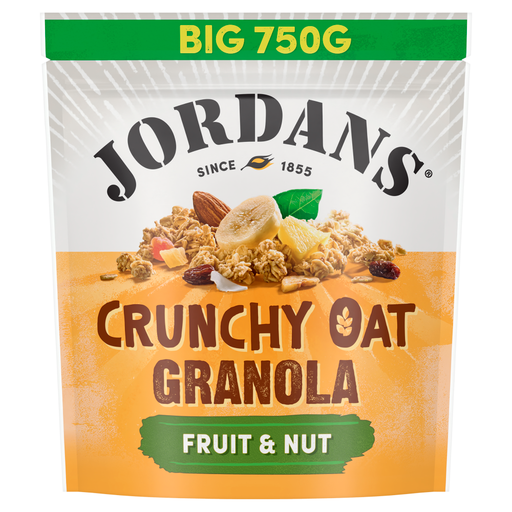
Jordans Crunchy Oat Fruit and Nut Granola 750 g

Jordans Crunchy Oat Fruit & Nut Granola 750 g

For a weekend breakfast where fibre is the main priority, the stated 6.1 g fibre per 100 g meets the UK benchmark for a high-fibre claim.

The nutrition information states 24 g sugars per 100 g and a 45 g serving basis. It contains oats and almonds, may contain peanuts, other nuts and cereals containing gluten, and contains honey.

Joybuy

Frequently asked questions

What does “high fibre” mean on a UK granola label?

A high-fibre claim may be used only when a food contains at least 6 g fibre per 100 g or at least 3 g fibre per 100 kcal, according to legislation.gov.uk. Compare the nutrition table because a package description alone does not show how one recipe compares with another.

How much fibre should a weekend granola breakfast provide?

There is no single required breakfast amount. GOV.UK and the Government Chemist state a 30 g daily dietary-fibre recommendation for the average adult population, so use the pack’s fibre figure and your actual serving size to see how much your bowl contributes.

Can I assume oat granola is gluten-free?

No. The Food Standards Agency states that gluten-free food may contain no more than 20 mg/kg gluten, and oats must still be emphasised as an allergen. Choose only a product specifically labelled gluten-free if you need that claim.

Is high-fibre granola suitable for someone with a nut allergy?

Not automatically. Jordans Low Sugar Granola Almond & Hazelnut contains almonds and hazelnuts and may contain other nuts; its manufacturer advises people with a nut allergy not to eat it. Read the exact current ingredient and precautionary allergen statement every time.

Which high-fibre option should I choose if I also want lower sugar?

Compare fibre and sugars per 100 g on the exact pack. Jordans Low Sugar Granola Almond & Hazelnut lists 7.9 g fibre and 2.9 g sugars per 100 g, while Dorset Nutty Granola lists 6.2 g fibre and 13.1 g sugars per 100 g; allergen and dietary requirements still need to be checked separately.