Full English breakfast eaters adding a cereal element
For people adding a small bowl or topping of granola alongside a cooked breakfast, where fibre, sugars and calories should be compared using the stated serving and per-100-g panel.


Start with the nutrition panel rather than assuming that oats, seeds or front-of-pack wording guarantee a high-fibre choice. Jordans Low Sugar Granola Almond and Hazelnut is the lower-sugar route among the compared products, while Eat Natural Protein Granola lists more fibre and protein per 100 g but also more sugars and energy. Check serving size and allergens before adding granola to a cooked breakfast.
For people adding a small bowl or topping of granola alongside a cooked breakfast, where fibre, sugars and calories should be compared using the stated serving and per-100-g panel.
For shoppers who want to prioritise lower sugars without overlooking fibre. Jordans Cereal lists 7.9 g fibre and 2.9 g sugars per 100 g for its Low Sugar Granola Almond and Hazelnut.
For people checking vegan suitability or ingredients such as cereals, nuts, soya and may-contain statements. Lizi's describes its granola range as vegan, but each pack still needs its own allergen check.
Compare the current pack on a like-for-like basis: fibre, sugars and energy per 100 g, then the stated bowl size and ingredient declaration.
| Priority | What to check | Your needs |
|---|---|---|
| Verified high-fibre claim | Check fibre per 100 g and the wording on the pack. Under UK nutrition-claim rules, a high-fibre claim requires at least 6 g per 100 g or 3 g per 100 kcal. | I want a granola that meets the high-fibre condition, rather than relying on wholegrain ingredients alone. |
| Sugars, energy and portion | Compare sugars and calories per 100 g as well as the stated bowl. A larger pour changes the contribution to the whole breakfast. | I want crunch alongside a cooked breakfast without losing track of the sugars and energy in the cereal portion. |
| Fibre in the wider diet | Use the serving figure to see what the bowl contributes. NHS guidance says adults should aim for 30 g of dietary fibre a day as part of a healthy balanced diet. | I want granola to contribute fibre at breakfast while keeping variety across the rest of the day. |
| Ingredients and allergens | Read the exact ingredient list, allergen declaration and may-contain statement. Check vegan claims on the individual product where this matters. | I need to avoid particular nuts, gluten-containing cereals or soya, or I am looking for a vegan option. |
Oats, seeds and wholegrains can contribute fibre, but they do not by themselves establish that a product qualifies for a high-fibre claim.
Check for at least 6 g fibre per 100 g or 3 g per 100 kcal, then compare the exact product label rather than relying on brand-level wording.
The compared products provide about 201 to 229 kcal in their stated 45 g portions, and a larger serving increases the energy, sugars and fat added to the meal.
Use the manufacturer’s stated portion as a starting point and compare per-100-g values if you normally pour more than one serving.
Eat Natural Protein Granola lists 11.8 g sugars per 100 g, while Jordans Low Sugar Granola Almond and Hazelnut lists 2.9 g per 100 g.
Decide whether protein or lower sugars is the priority, then compare products on the same per-100-g basis.
The compared products include cereals, nuts and, for Eat Natural Protein Granola, soya. Some product pages also carry may-contain warnings.
For allergy or coeliac requirements, use the current ingredient and allergen panel on the exact pack as the final check.
A route for shoppers looking for a lower-sugar granola with disclosed fibre, sugars and serving nutrition.
A range for comparing protein-enhanced, lower-sugar and nuts-and-seeds granola formats.
A wholegrain oat-and-rye granola option with nuts, seeds and honey.
A vegan and vegetarian granola range with high-fibre, lower-sugar and higher-protein format choices.
A wholegrain granola route with lower-sugar and more indulgent flavour options.
An organic granola range with gluten-free, grain-free and protein format options.
Joybuy granola options for adding a crunchy, fibre-led cereal element to a Full English breakfast, with different protein, fruit-and-nut and allergen considerations.
 No image available
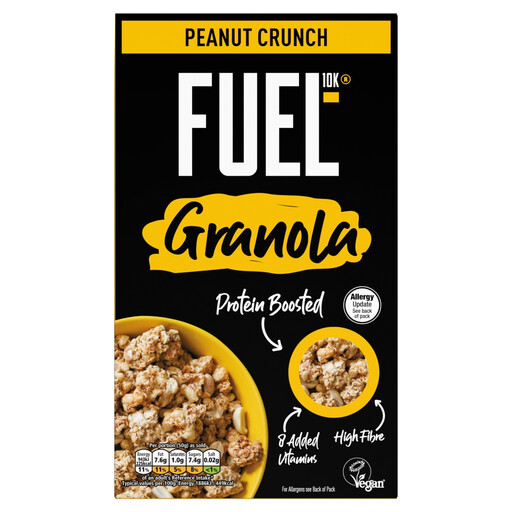
A higher-protein granola option for a fibre-led breakfast cereal element. The listing states 6.1 g fibre and 17.2 g protein per 100 g; its stated 50 g serving lists 3.1 g fibre and 225 kcal. Contains peanuts, oats and wheat, with possible milk, nut, sesame and soya cross-contact stated on the listing.
 No image available
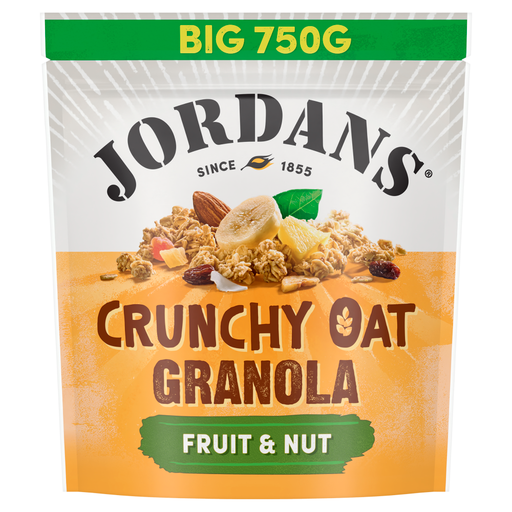
A fruit-and-nut granola for shoppers who prefer wholegrain oats, dried fruit, almonds and sunflower seeds. The listing states 6.1 g fibre and 24 g sugars per 100 g, with 2.7 g fibre and 11 g sugars in a stated 45 g portion. Contains oats and almonds and may contain peanuts, other nuts and cereals containing gluten.
A food may make a high-fibre claim only when it contains at least 6 g fibre per 100 g or at least 3 g fibre per 100 kcal. Check the current product label because a source-of-fibre claim has a different threshold.
It can contribute, but it is one part of the day’s intake. NHS guidance says adults should aim for 30 g of dietary fibre daily as part of a healthy balanced diet and advises getting fibre from a variety of foods.
Among the specifically compared products, Jordans Low Sugar Granola Almond and Hazelnut lists 2.9 g sugars per 100 g, compared with 11.8 g for Eat Natural Protein Granola and 13 g for Dorset Cereals Honey Granola. Compare the current pack if recipes or pack sizes change.
Not automatically. The compared Jordans, Eat Natural and Dorset products contain cereals and nuts, while Eat Natural Protein Granola also contains soya. Read the current ingredient, allergen and may-contain statements on the exact pack before serving.
Lizi's states that its granola range is vegan and vegetarian and describes every recipe as high fibre. Confirm the particular flavour’s current pack and allergen label, because range-level information does not confirm every SKU’s nutrition panel.