What to check before buying
Decide whether your priority is lower sugars, additional protein or a traditional nutty recipe, then compare the label on the same per-100-g basis before checking the portion and allergens.
Fibre-first with lower sugars
Choose it when: You want a weekday granola with a clear high-fibre basis and comparatively low listed sugars.
Check first: These recipes contain cereals containing gluten and have allergen or cross-contact information to review.
Protein-prioritising breakfast
Choose it when: Protein is a meaningful part of your breakfast plan, such as after training.
Check first: Higher protein does not automatically mean lower sugars, lower energy or fewer allergens.
Traditional nutty granola
Choose it when: You prefer a nut-led, crunchy granola and are comfortable with a sweeter recipe.
Check first: Compare sugars and allergen information against your own breakfast requirements.
| Priority |
What to check |
Your needs |
| Fibre in a realistic bowl |
Check fibre per 100 g first. For a UK high-fibre claim, legislation.gov.uk sets a threshold of at least 6 g per 100 g or 3 g per 100 kcal. Then compare the stated serving. |
I want to know how much fibre my usual breakfast bowl contributes, not just whether the pack uses a fibre claim. |
| Sugars alongside fibre |
Compare sugars per 100 g on the same panel as fibre. Also check the serving size if your usual bowl is larger than the label portion. |
A high-fibre cereal can still have a sweeter recipe, so I want the sugar figure to fit my weekday routine. |
| Protein where useful |
Look at protein, fibre, sugars and energy together. Check whether protein is stated per 100 g or per serving before comparing products. |
Protein matters to me for some breakfasts, but I do not want it to override the rest of the nutrition panel. |
| Ingredients and allergens |
Read the current ingredient list and allergen declaration for cereals containing gluten, nuts, soya, milk and precautionary statements. |
I need the exact recipe to work with my dietary exclusions or allergy requirements. |
Granola options on Joybuy
Joybuy granola options for protein-prioritising and traditional fruit-and-nut weekday breakfast routines.
 No image available
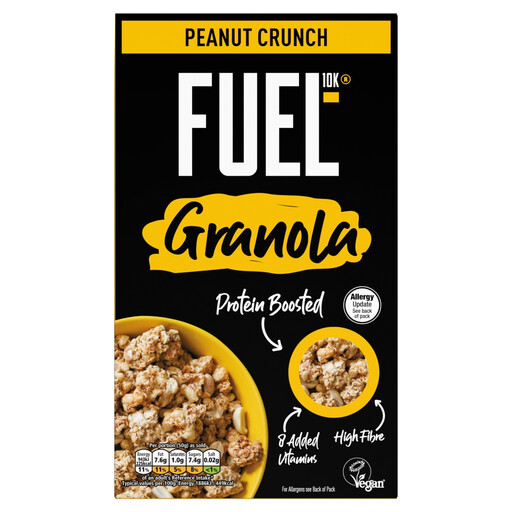
Fuel10K Peanut Granola 400g
A protein-prioritising option for busy weekday breakfasts, with a stated 50 g portion and resealable storage guidance.
Lists 6.1 g fibre, 17.2 g protein and 14.9 g sugars per 100 g. Contains oats, wheat and peanuts; may contain milk, nuts, sesame and soya. Check the current nutrition panel before relying on portion-level protein values.
Joybuy
 No image available
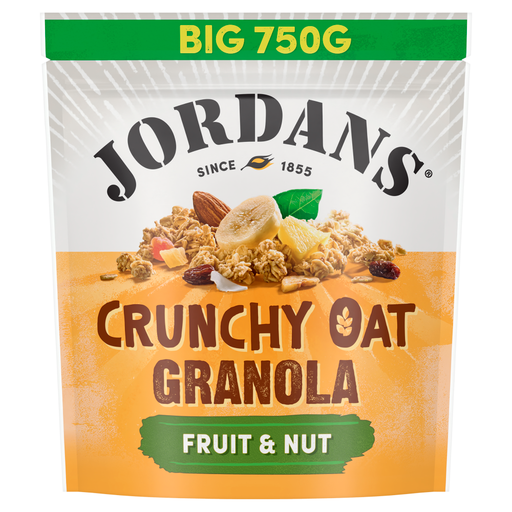
Jordans Crunchy Oat Granola Fruit & Nut 750g
A traditional fruit-and-nut granola for a crunchy breakfast, with wholegrain oats and a stated 45 g portion.
Lists 6.1 g fibre and 24 g sugars per 100 g. Contains oats and almonds and may contain peanuts, other nuts and cereals containing gluten; take care with the stated warning about occasional nut shell or fruit stone pieces.
Joybuy
Frequently asked questions
What counts as high-fibre granola in the UK?
A food may be described as high in fibre when it contains at least 6 g fibre per 100 g or at least 3 g fibre per 100 kcal, according to legislation.gov.uk. Compare granolas by their per-100-g value first, then check fibre in the stated bowl portion.
How much fibre should weekday breakfast contribute?
Government guidance says adults should aim for 30 g of dietary fibre a day as part of a healthy balanced diet, according to the NHS. Breakfast can contribute towards that total, but fibre can come from a variety of foods across the day.
Is high-fibre granola automatically low in sugar?
No. Dorset Cereals Nutty Granola lists 6.2 g fibre and 13.1 g sugars per 100 g, while Eat Natural Low Sugar Ancient Grains Granola lists 9.4 g fibre and 3.2 g sugars per 100 g. Compare both figures on the same per-100-g basis.
Can I choose granola if I avoid gluten or nuts?
Only after checking the exact pack. Several reviewed recipes contain oats alongside other cereals containing gluten and nuts, and some carry may-contain warnings. Nature's Path lists a gluten-free granola option in its UK range, but gluten-free status does not confirm fibre content or nut suitability.
Can a granola label claim that it treats a health condition?
No. GOV.UK guidance states that food businesses cannot claim or imply that food can treat, prevent or cure a disease or medical condition. Treat fibre and protein wording as nutritional information rather than medical treatment advice.


