Older shoppers wanting a quick hot breakfast
Useful for people comparing fibre per portion, preparation effort and allergen information rather than relying on a front-of-pack fibre claim alone.


Start with the fibre declaration per 100g, then compare the fibre in the portion you are likely to eat and the preparation method. In the compared products, Tesco lists Flahavan's pot at 12g fibre per 100g and 5.4g per pot, while dry instant formats from Sainsbury's and Quaker offer different portion sizes and preparation requirements.
Useful for people comparing fibre per portion, preparation effort and allergen information rather than relying on a front-of-pack fibre claim alone.
For shoppers aged 65 or over who may also wish to compare protein, calcium, folate and vitamin B12. Guidance from the Royal United Hospitals Bath NHS Foundation Trust notes that fibre, carbohydrate, sugar, fat and salt needs are not automatically higher solely because of age.
For people deciding between a boiling-water porridge pot and an instant cereal or sachet that needs milk and microwave or hob preparation.
Compare the nutrition panel and portion size before choosing the format that fits the kitchen routine.
| Priority | What to check | Your needs |
|---|---|---|
| Fibre per portion | Compare fibre per 100g and per stated portion. Check whether the serving is a sachet, pot or measured amount. | I want to know what one breakfast portion contributes, not just compare pack claims. Tesco lists 5.4g per Flahavan's 45g pot, 3.6g per 40g serving of Sainsbury's Ready Oats and 2.4g per 27g Quaker Original sachet. |
| Preparation method | Check whether boiling water is enough. Confirm whether milk, a microwave, hob or bowl is required. | A hot-water pot can suit a simple routine, while sachets and instant cereal may suit a kitchen where milk and heating equipment are available. |
| Protein and nutrients | Check the protein declaration. Look for declared fortification only if those nutrients matter to the shopper. | I want fibre to be one part of breakfast choice. Sainsbury's Ready Oats declares calcium, iron, vitamin D, folic acid and vitamin B12, while Quaker Protein Original declares 22g protein per 100g. |
| Allergens and tolerance | Read the current ingredients and allergy statement. If increasing fibre, introduce changes gradually and consider drinks alongside breakfast. | I need a product that matches my dietary restrictions. Some compared products contain milk or have wheat, barley, soya, nut or peanut-related warnings, and M&S states its Traditional Porridge Pot is not suitable for coeliacs. |
A smaller sachet can provide less fibre at breakfast than a larger pot. In the compared products, Quaker Original declares 2.4g per 27g sachet, while Flahavan's declares 5.4g per 45g pot.
Compare both fibre per 100g and the fibre in the amount you expect to eat.
For some people over 65, protein, calcium, folate and vitamin B12 may also be relevant considerations. Fibre content alone does not describe the whole breakfast.
Check protein and declared micronutrients where they matter, and seek individual professional advice for medically complex dietary needs.
Several compared products contain milk or carry allergen-related warnings. M&S states that its Traditional Porridge Pot is not suitable for coeliacs.
Read the current pack label before buying, particularly for coeliac disease or allergies to milk, wheat, barley, soya, peanuts or nuts.
University Hospitals Dorset NHS Foundation Trust notes that a sudden increase in fibre can cause wind, bloating or stomach cramps.
Introduce higher-fibre breakfasts gradually and maintain adequate drinks unless a clinician has set a fluid restriction.
Relevant for a high-fibre instant porridge pot made with wholegrain oats, seeds and oat bran, prepared with boiling water.
Relevant for own-label instant formats including Ready Oats and an Original Porridge Pot.
Relevant for microwaveable or hob-cooked oat sachets, including a plain original product and a higher-protein range.
Relevant for a Traditional Porridge Pot prepared with hot water and ready in minutes.
Joybuy options for quick instant-oat breakfasts, including larger sachets, single-serve cups and a hot-water oatmeal bag.
 No image available
A larger instant sachet option for a quick microwave breakfast.
Declared fibre is 9g per 100g and 3.5g per 38.5g sachet; declared protein is 11g per 100g. The ingredient list states wholegrain rolled oats only.
Microwave preparation is stated as 2½ minutes. Check the current pack statement if coeliac or gluten-free suitability is required.
 No image available
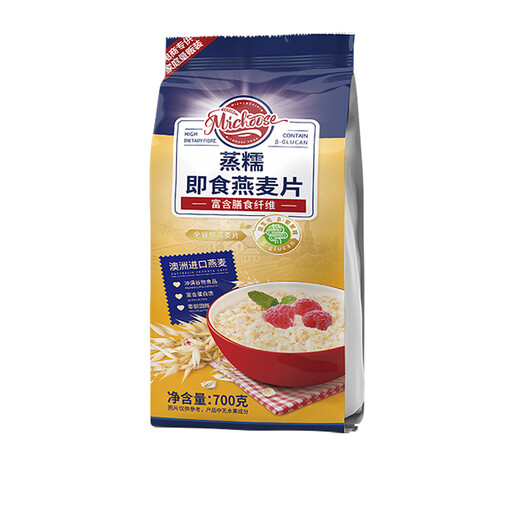
A hot-water oatmeal option for kitchens without microwave or hob access.
The listing describes single-ingredient oatmeal with one-minute preparation, 9.9g dietary fibre per 100g and 12.2g protein per 100g.
This is a 700g bag rather than pre-portioned sachets, so check serving guidance and the current allergen statement before buying.
 No image available
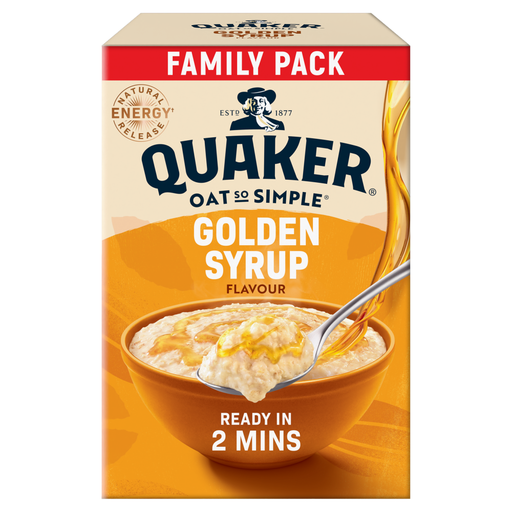
A pre-portioned microwave sachet for a routine with milk and a microwaveable bowl.
The listing declares 7.3g dietary fibre per 100g, 2.6g per 36g sachet and 9g protein per 100g.
Preparation calls for milk and two minutes at 900W. It contains sugar and may contain barley, wheat and soya.
 No image available
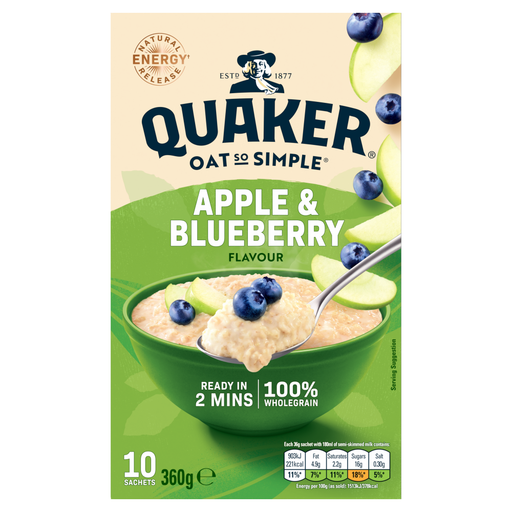
A fruit-flavoured single-serve oatmeal option described as ready in two minutes.
The nutrition information declares 7.2g fibre per 100g, 2.6g per 36g serving and 8.6g protein per 100g.
It contains sugar and may contain wheat, barley and soya. Check the pack instructions for the required liquid and appliance.
 No image available
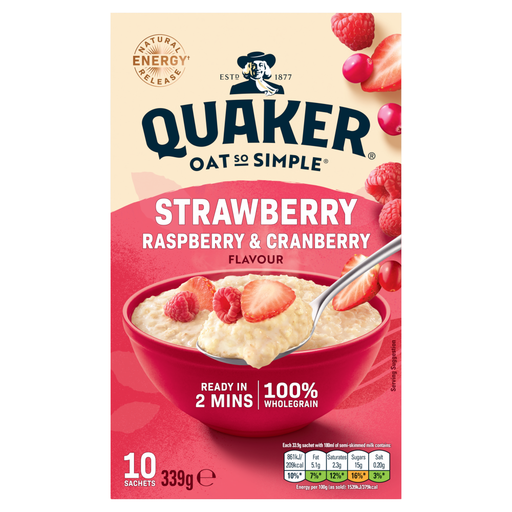
A flavoured sachet option for a breakfast routine with milk, a bowl and microwave access.
The listing declares 7.2g fibre and 8.8g protein per 100g, with a two-minute microwave method.
It contains sugar and may contain barley, soya and wheat. Check the current nutrition panel if fibre per sachet is important.
Under the applicable condition in Regulation (EC) No 1924/2006, a food may make a “high fibre” claim when it contains at least 6g of fibre per 100g or at least 3g per 100 kcal. Compare the nutrition panel as well as front-of-pack wording.
NHS guidance says adults should increase dietary fibre intake to 30g a day as part of a healthy balanced diet. An instant oat breakfast can contribute to that total, but it is not the only possible source of fibre.
No. Guidance from the Royal United Hospitals Bath NHS Foundation Trust says people over 65 may need particular attention to protein, calcium, folate and vitamin B12 as well. Someone with low weight, poor appetite, swallowing problems, bowel disease or a prescribed diet should seek individual clinical or dietetic advice before changing breakfast solely for fibre.
Increase fibre gradually and drink enough fluid. University Hospitals Dorset NHS Foundation Trust notes that a sudden increase can cause wind, bloating or stomach cramps, and that fibre absorbs water.
Do not assume they are. M&S states that its Traditional Porridge Pot is not suitable for coeliacs, and Quaker Original may contain wheat and barley. Choose a product that is specifically suitable for your dietary requirement and check the current pack label.