Full English breakfast eaters seeking more fibre
For adults adding a measurable cereal component to a cooked breakfast and comparing fibre per 100g and per serving rather than assuming every muesli provides the same amount.


Choose a muesli with at least 6g of fibre per 100g when a high-fibre claim matters, and compare the nutrition table rather than relying on front-of-pack wording. Tesco lists Bio&Me Super Nutty at 12g fibre per 100g, while Jordans Natural Muesli, Alpen No Added Sugar and Dorset options offer different ingredient, sugar and allergen considerations.
For adults adding a measurable cereal component to a cooked breakfast and comparing fibre per 100g and per serving rather than assuming every muesli provides the same amount.
For shoppers looking for a high-fibre muesli with no added sugar who also want to check sugars from dried fruit on the nutrition panel.
For people who need to screen for cereals containing gluten, milk, tree nuts, vegan suitability or organic certification before adding muesli to breakfast.
Start with a like-for-like fibre comparison, then check the serving size, sugars and ingredients that matter for the rest of your breakfast.
| Priority | What to check | Your needs |
|---|---|---|
| Comparable fibre | Compare fibre per 100g first. UK nutrition-claim rules allow a high-fibre claim from 6g per 100g; then check the pack's serving size. | I want to see how much fibre a bowl contributes, not just rely on a claim on the front of the pack. NHS guidance says adults should aim for 30g of fibre a day. |
| Sugars and recipe | Read total sugars per 100g and per serving alongside any no-added-sugar statement. Check whether dried fruit is part of the recipe. | I want a no-added-sugar recipe without mistaking that wording for sugar-free. |
| Allergens and dietary fit | Check ingredients, bold allergen declarations and precautionary may-contain statements. Confirm vegan or organic claims on the current pack where relevant. | I need to know whether the muesli contains gluten-containing cereals, milk or nuts before it goes on the breakfast table. |
| Place in the meal | Use the stated serving as a starting point and consider the fibre sources in the wider meal and day. Drink enough fluids when increasing fibre intake. | I want muesli to sit alongside a cooked breakfast rather than be the only source of fibre in it. |
The labelled products considered here range from 7.2g to 12g of fibre per 100g. A high-fibre claim meets a minimum threshold, but it does not mean every serving has the same fibre content.
Compare fibre per 100g first, then use the pack's stated serving size to understand the likely breakfast contribution.
Fruit-containing muesli can still contain naturally occurring sugars even where no sugar has been added. Alpen No Added Sugar, for example, lists 18g sugars per 100g.
Read the total sugars line per serving as well as the no-added-sugar claim, especially when muesli is paired with other sweet breakfast items.
Many mueslis contain oats, wheat, barley, rye, milk or tree nuts, and some packs also carry precautionary cross-contact statements.
Check the current pack label each time you buy, including any may-contain wording.
A serving of muesli is only one part of daily fibre intake. NHS guidance recommends getting fibre from a variety of foods.
Consider other suitable fibre-containing parts of the meal and day, such as beans, vegetables, fruit and wholegrain bread.
A mainstream UK muesli brand with Original and No Added Sugar recipes; its No Added Sugar product is wholegrain and labelled high in fibre.
A muesli range based on lightly toasted wholegrain flakes with fruit, nuts and seeds, including organic and no-added-sugar recipes.
A wholegrain-focused muesli range including Natural, Fruit & Nut and Berry Burst recipes.
An organic, plant-based and wholegrain-oriented muesli brand with The Ultimate Muesli and Soft & Fruity Bircher Muesli.
A UK breakfast-cereal brand offering granola and muesli, with toasted oats, seeds and nuts across its range.
Joybuy options for adding a high-fibre oat-based cereal or muesli alongside a Full English breakfast.
 No image available
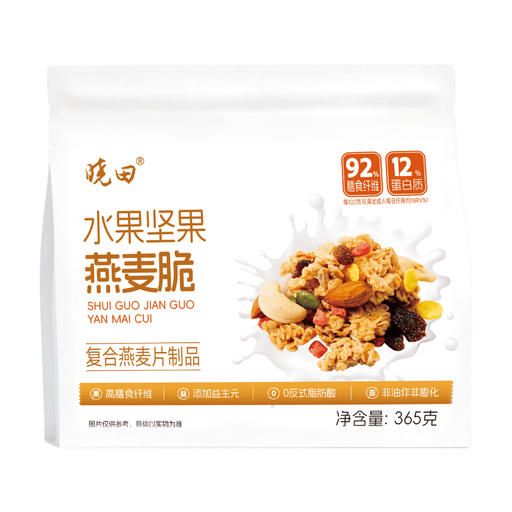
A ready-to-eat fruit-and-nut oat cereal for breakfast with milk or yoghurt alongside a cooked meal.
The nutrition table states 22.9g dietary fibre per 100g. It contains at least 47% oat flakes, fruit, pumpkin seeds and nuts.
It is not explicitly labelled as muesli and contains gluten-containing oats, almonds and cashews. Check the current pack for total sugars per 100g.
 No image available
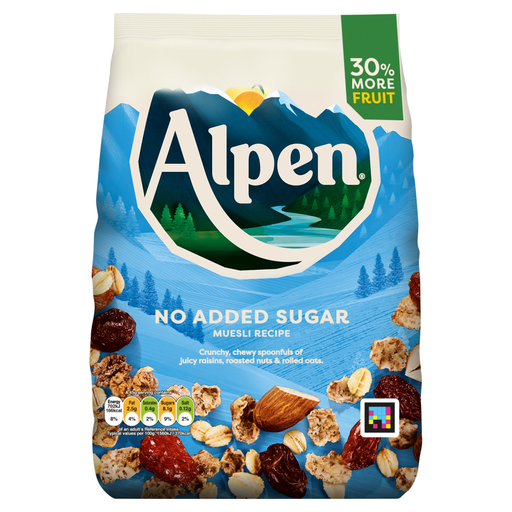
An explicitly labelled muesli option for a familiar wholegrain cereal addition beside a cooked breakfast.
The pack states 8.0g fibre per 100g and includes wholegrain wheat flakes, rolled oats, raisins and roasted nuts.
It contains wheat, oats, milk, almonds and hazelnuts, and may contain other nuts. The nutrition table lists 18g sugars per 100g.
Under UK nutrition-claim rules, a food may be described as high fibre when it contains at least 6g of fibre per 100g or 3g per 100 kcal. Compare the nutrition table too, because products can differ substantially above that threshold.
NHS guidance says adults should aim for 30g of fibre a day as part of a healthy, balanced diet. A muesli serving can contribute, but other sources include wholegrains, fruit, vegetables, beans and pulses.
No. Dried fruit can still contribute naturally occurring sugars. Alpen No Added Sugar lists 18g sugars per 100g, so check the total sugars line as well as the no-added-sugar wording.
Only after checking the current pack's ingredients and precautionary allergen information. Several options contain nuts directly, while Jordans Natural Muesli and Dorset Delicious Fruit & Nut include information relevant to nut cross-contact.
If your usual fibre intake is low, increase it progressively and drink enough fluids. Worcestershire Acute Hospitals NHS Trust guidance notes that fluids are important when increasing fibre intake.