What to check before buying
Start with the fibre claim, then compare the nutrition panel, ingredients and allergen information on the exact pack you intend to buy.
| Priority |
What to check |
Your needs |
| Fibre content |
Look for a high-fibre claim or compare fibre per 100g. Also check the labelled serving size and fibre per serving. |
I want a fibre claim with a defined meaning, then a realistic view of what one breakfast portion contributes alongside the rest of my day. |
| Sugars and dried fruit |
Compare the no-added-sugar claim with the total sugars line on the nutrition panel. Check the same serving basis across products. |
A no-added-sugar option may still contain sugars from raisins or other dried fruit, so I want to see the total sugars figure before choosing. |
| Allergens |
Read emphasised allergen ingredients and any precautionary statement on the current pack. Do not infer gluten-free status from an oat-based recipe. |
I need the exact product to work with my dietary requirements, particularly where wheat, barley, oats or nuts matter. |
| Changing fibre intake |
Use the labelled serving as a starting point. If increasing fibre intake, make the change gradually and drink plenty of fluid. |
I want a weekday breakfast routine that is practical without making a sudden large change to my usual fibre intake. |
Joybuy muesli options
Joybuy product options for a straightforward weekday muesli breakfast, including a no-added-sugar route and a traditional Original muesli option.
 No image available
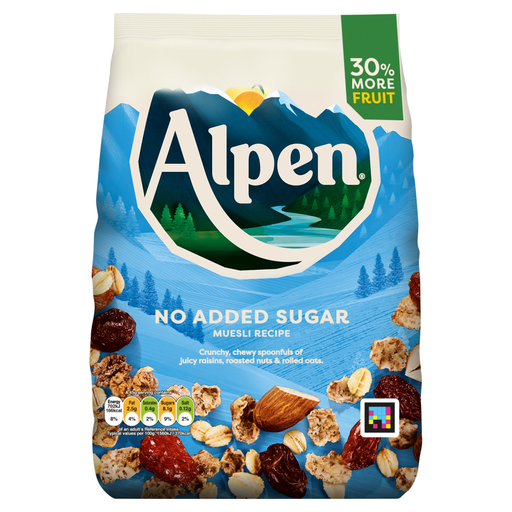
Alpen No Added Sugar Muesli 950g
A high-fibre, no-added-sugar muesli option for a quick weekday bowl.
Contains wheat, oats, milk, almonds and hazelnuts, and may contain other nuts. The listing states 18g sugars per 100g, including sugars from raisins.
Joybuy
 No image available
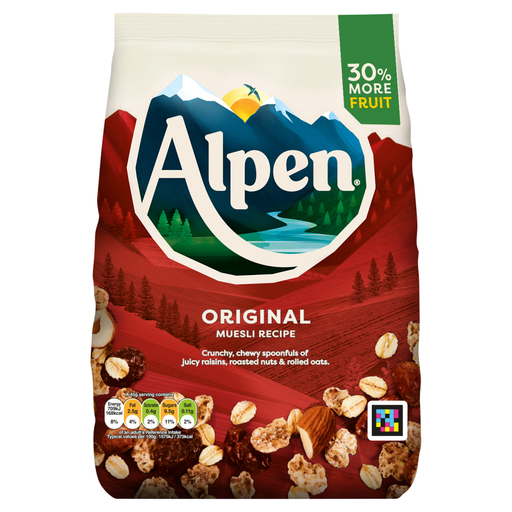
Alpen Original Muesli 950g
A traditional muesli option intended to be served cold with milk for a simple weekday breakfast.
Contains added sugar and 21g sugars per 100g. It also contains wheat, oats, milk, almonds and hazelnuts, and may contain other nuts; check the current pack's fibre panel before comparing portions.
Joybuy
Frequently asked questions
What does “high fibre” mean on a UK muesli label?
Under food-claim rules published on legislation.gov.uk, a high-fibre claim may be made only where a food contains at least 6g of fibre per 100g or 3g per 100kcal. Use this as a first filter, then compare the actual grams per serving.
How much fibre do adults in the UK need?
NHS guidance says government guidelines recommend 30g of dietary fibre a day as part of a healthy balanced diet. A high-fibre muesli can contribute to that total, but one bowl is not intended to provide the whole day's amount.
Does no added sugar mean a muesli has no sugar?
No. A no-added-sugar muesli can still contain naturally occurring sugars, particularly from dried fruit. Compare the “of which sugars” value and serving size on the exact product nutrition panel.
Can an oat-based muesli be assumed gluten-free?
No. Food Standards Agency information states that a gluten-free claim is limited to foods containing no more than 20mg/kg gluten, and oats remain an allergen that must be emphasised even in gluten-free or very-low-gluten foods. Choose only a product explicitly labelled for your dietary requirement and check the current allergen statement.
Should I switch to a high-fibre breakfast all at once?
No. NHS inform advises increasing fibre gradually and drinking plenty of fluid because a sudden increase can cause bloating or stomach cramps.


