Who this is for

Weekly-shop households seeking a high-fibre breakfast staple

For shoppers comparing large packs and repeat-use muesli, where fibre per 100 g, serving size and storage practicality matter. Current product pages from Tesco Groceries, Alpen and other manufacturers provide the useful pack and nutrition checks.

Shoppers reducing added sugar without excluding dried fruit

For people who want a no-added-sugar recipe but need to distinguish that claim from total sugars on the nutrition panel, particularly where raisins and other dried fruit are included.

Ingredient- and allergen-conscious muesli buyers

For shoppers who need to check wheat/gluten, milk and tree-nut ingredients or precautionary statements before buying. These ingredients occur in several of the compared conventional mueslis.

What to check before buying

Compare the nutrition panel on a per-100-g basis first, then check the serving size, ingredients and pack format that suit your household.

Priority What to check Your needs
Fibre content Compare fibre per 100 g before comparing bowl sizes. For a UK “high fibre” claim, the food must contain at least 6 g per 100 g or 3 g per 100 kcal under the applicable nutrition-claim rules. I want to compare like with like, even when one pack uses a 45 g serving and another uses a 50 g serving.
No-added-sugar wording Read the claim alongside total sugars per 100 g and per serving. Dried fruit can contribute to the sugars figure without meaning sugar has been added. I want a recipe with no added sugar, but I also want to see the total sugars in the bowl I am buying.
Allergens and ingredients Check the exact pack for wheat, oats, barley, milk and named nuts. Read any precautionary allergen statement as well as the ingredient list. I need a breakfast cereal that fits an allergy, coeliac requirement or another necessary dietary exclusion.
Weekly-shop practicality Compare pack size with likely household use and storage instructions. Check the current label and retailer listing when comparing products. I want enough cereal for regular breakfasts without buying a pack that will not suit the household or be used in time.

Common buying pitfalls

  • Treating “high fibre” as a vague marketing phrase

    The compared products declare between 8.0 g and 9.8 g fibre per 100 g, and their serving sizes are not identical.

    Use 6 g fibre per 100 g as the UK benchmark for a high-fibre claim, then compare fibre per 100 g before looking at the stated serving amount.

  • Assuming no added sugar means sugar-free

    Dried fruit contributes to total sugars. The verified no-added-sugar examples declare between 8.3 g and 18 g sugars per 100 g.

    Check both the front-of-pack claim and the sugars line on the nutrition panel, then choose according to your own dietary priorities.

  • Buying a nut-and-grain muesli without checking the precise allergen wording

    Several leading choices contain almonds, hazelnuts, cashews, wheat, oats, barley or milk, and some carry precautionary cross-contact statements.

    For an allergy, coeliac requirement or medically necessary exclusion, use the current physical pack label as the deciding evidence rather than relying on familiarity with a brand or variant.

  • Choosing a large pack only because its price per kg looks lower

    A large pack can suit a weekly shop, but it may not work if the household will not use it or if its ingredients do not fit dietary needs.

    Compare pack value only after confirming the same product’s fibre, sugars, allergens and likely household use. Recheck the current price and label at checkout or on the pack.

Relevant muesli brands

Alpen

A conventional UK wholegrain muesli brand with Original and No Added Sugar mueslis. Alpen’s No Added Sugar recipe combines wholegrain wheat, rolled oats, raisins, milk ingredients, almonds and hazelnuts.

  • Alpen declares 8.0 g fibre per 100 g and 3.6 g per 45 g serving for No Added Sugar; this meets the UK high-fibre threshold.
  • It contains wheat, milk, almonds and hazelnuts, while Alpen declares 18 g sugars per 100 g, so no added sugar should not be read as sugar-free.

Dorset Cereals

A muesli range built around wholegrain flakes with fruit, nuts and seeds, including no-added-sugar variants such as Gloriously Nutty and Delicious Fruit & Nut.

  • Tesco Groceries lists Gloriously Nutty No Added Sugar at 9.8 g fibre per 100 g, the highest verified figure in this comparison.
  • Its recipe includes almonds, cashews and hazelnuts, with cross-contact information that matters for nut-allergic shoppers.

Jordans

A muesli line offering Natural, Fruit and Nut, and Berry Burst variants. Natural Muesli is based on wholegrain oats, wheat flakes and barley with dried fruit and nuts.

  • Jordans declares 9.2 g fibre per 100 g for Natural Muesli and describes the recipe as having no added salt or sugar.
  • It contains gluten-containing cereals and nuts, may contain other nuts and gluten sources, and Jordans advises care because hard nut-shell or fruit-stone fragments can occasionally occur.

Rude Health

An organic, plant-based and wholegrain-focused muesli range that includes The Ultimate Muesli and Soft & Fruity Bircher Muesli.

  • Rude Health labels The Ultimate Muesli as high fibre, organic, plant based and whole grain, with oats, barley, rye, fruit, nuts and seeds.
  • The ingredient list includes gluten-containing grains and tree nuts, and the brand notes possible milk, soya and other-nut traces. Check the pack nutrition panel before comparing fibre figures.

Lizi’s

A specialist cereal brand with Super Muesli variants alongside high-protein, digestive-health and low-sugar ranges.

  • Lizi’s says its Super Muesli range has four blends and is low sugar, high fibre and fortified.
  • These are Lizi’s own product claims, so check the nutrition panel for the particular blend before comparing fibre, sugars or fortification.

Tesco

A UK supermarket own-label option with Swiss Style No Added Sugar Muesli in a 1 kg pack.

  • Tesco Groceries lists 8.5 g fibre per 100 g and 4.3 g per 50 g serving for its Swiss Style No Added Sugar Muesli.
  • It includes oats, wheat, barley malt extract, milk, hazelnut and almonds, and may contain peanuts and other nuts. Check the physical pack because product information can change.

Joybuy breakfast-cereal options

Joybuy product options for this topic include high-fibre breakfast-cereal alternatives for shoppers who are also open to oat crunch or granola rather than muesli.
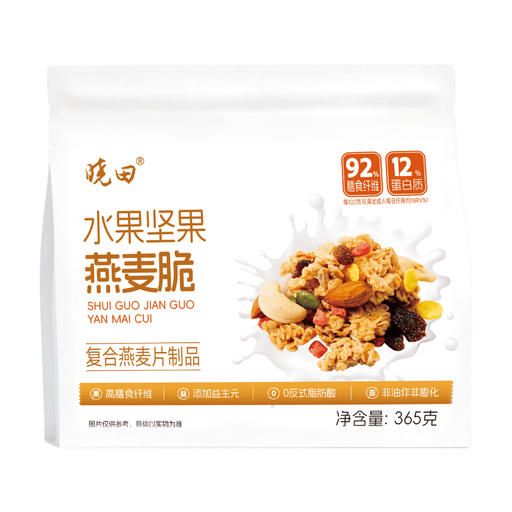
Xiao Tian Fruit and Nut Oat Crunch, 365 g

Xiao Tian Fruit & Nut Oat Crunch, 365 g

A fruit-and-nut oat cereal for a crunchy breakfast alternative, with declared dietary fibre of 22.9 g per 100 g. It contains at least 47% oats, fruit, seeds, almonds and cashews; check the current pack nutrition panel if sugars are a priority. This is oat crunch rather than muesli.

Joybuy
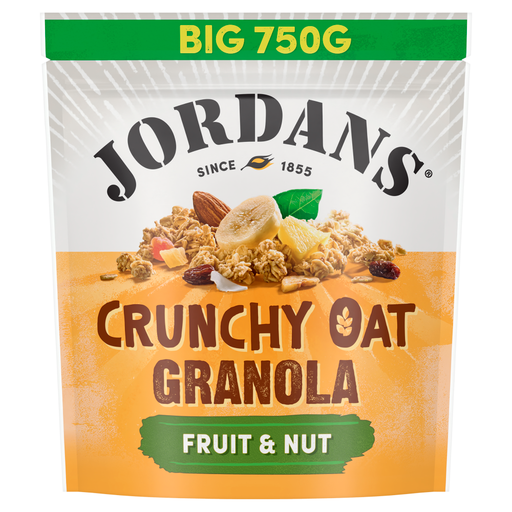
Jordans Crunchy Oat Granola Fruit and Nut, 750 g

Jordans Crunchy Oat Granola Fruit & Nut, 750 g

A 750 g resealable granola for regular household breakfasts, with 6.1 g fibre per 100 g and a stated 45 g portion. It contains oats and almonds, may contain peanuts, other nuts and gluten-containing cereals, and declares 24 g sugars per 100 g. This is a baked granola rather than muesli.

Joybuy

Questions about high-fibre muesli

What counts as “high fibre” muesli in the UK?

For the regulated “high fibre” claim, Regulation (EC) No 1924/2006, published on legislation.gov.uk, requires at least 6 g fibre per 100 g or 3 g per 100 kcal. Compare the nutrition panel per 100 g when choosing between packs with different serving sizes.

Does “no added sugar” mean that the muesli has no sugar?

No. A no-added-sugar recipe can still declare total sugars from ingredients such as dried fruit. Alpen declares 18 g sugars per 100 g for its No Added Sugar Muesli, while Tesco Groceries lists 13.3 g per 100 g for Tesco Swiss Style No Added Sugar Muesli.

Are high-fibre mueslis suitable for someone avoiding gluten or nuts?

Do not assume so. The compared products commonly contain wheat, oats or barley, and several contain named tree nuts. Check the exact pack’s ingredients and precautionary allergen statement: Jordans Natural may contain other nuts and gluten sources, while Dorset Gloriously Nutty includes several named nuts and cross-contact wording.

How much fibre should a bowl contribute to an adult diet?

The Government Chemist states that the average population intake target for adults is 30 g dietary fibre per day, measured using AOAC methods. A bowl of muesli can contribute to this total, but it should be considered alongside the rest of the day’s food.

Should I rely on a supermarket page for ingredients and nutrition?

Use an online page to shortlist products, but check the physical pack before eating or buying for a medical dietary need. Tesco states that food products can be reformulated and that ingredients, nutrition content and allergens may change.