Weekend breakfast shoppers seeking declared fibre
For shoppers who want to compare nutrition labels and choose muesli using a declared fibre figure rather than general wellbeing wording.


Start with the nutrition panel: under the UK high-fibre claim condition cited by legislation.gov.uk, a product needs at least 6 g of fibre per 100 g or 3 g per 100 kcal. Among the comparable manufacturer-labelled recipes here, Jordans Natural Muesli has the highest declared fibre figure at 9.2 g per 100 g, while fruit, toasted texture, organic ingredients, sugars and allergen information can change which bowl suits your breakfast.
For shoppers who want to compare nutrition labels and choose muesli using a declared fibre figure rather than general wellbeing wording.
For people who want to compare declared sugars from dried fruit and recipe formulation alongside the fibre value.
For shoppers who need to check wheat, oats, barley, milk, nuts or precautionary allergen statements before choosing muesli.
Compare labels on the same per-100-g basis first, then use the ingredient and allergen information to decide whether the recipe fits your usual weekend bowl.
| Priority | What to check | Your needs |
|---|---|---|
| Declared fibre | Compare fibre per 100 g across recipes. For a UK high-fibre claim, legislation.gov.uk states a food must contain at least 6 g per 100 g or 3 g per 100 kcal. Check the nutrition panel rather than relying on wholegrain or wellness wording. | I want a comparable fibre figure for the muesli itself, so I can see whether it meets the stated high-fibre condition. |
| Sugars and dried fruit | Compare the sugars row per 100 g. Read no-added-sugar wording alongside the nutrition panel, because dried fruit can contribute naturally occurring sugars. | A fruitier bowl may appeal to me, but I still want to see the declared sugars before choosing it. |
| Allergens and ingredients | Read bolded allergens and any precautionary statement on the exact pack. Check for gluten-containing cereals, milk ingredients, nuts and possible traces where relevant. | I need the current ingredients statement to fit my requirements, not just a broad plant-based or wholegrain description. |
A high-fibre claim does not establish the sugars level, allergen suitability or how the muesli fits with milk, yoghurt and toppings.
Verify fibre per 100 g first, then compare sugars and ingredients on the exact pack.
Dorset Cereals lists 18 g and 19 g sugars per 100 g respectively for its Wonderfully Organic and Tasty Toasted no-added-sugar recipes, reflecting naturally occurring sugars in ingredients.
If sweetness matters, compare the sugars row per 100 g and read the ingredient list rather than treating no-added-sugar wording as a total-sugars claim.
Several reviewed recipes contain nuts and gluten-containing cereals; Alpen Original also contains milk ingredients, while some recipes carry precautionary statements.
For an allergy or medically necessary avoidance, check the physical pack every time, including any may-contain wording.
Jordans product pages list Natural Muesli at 9.2 g fibre per 100 g and Berry Burst Muesli at 8.3 g per 100 g, making them relevant for comparing declared fibre figures.
Alpen Original is a wholegrain fruit-and-nut muesli with 7.7 g fibre per 100 g on Alpen’s manufacturer specification.
Dorset Cereals offers fruit, nut and toasted-flake mueslis, including Wonderfully Organic at 7.6 g fibre per 100 g and Tasty Toasted at 7.1 g per 100 g.
Rude Health presents The Ultimate Muesli as an organic, plant-based wholegrain muesli with grains, fruit, nuts and seeds.
Tesco’s grocery category listing includes Tesco Swiss Style No Added Sugar Muesli alongside Alpen no-added-sugar products.
These Joybuy muesli options provide declared fibre figures for comparing a weekend breakfast bowl, alongside sugars and ingredient information.
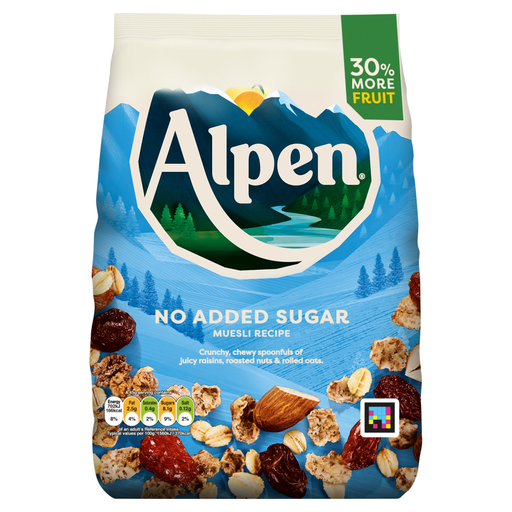 No image available
A no-added-sugar muesli option for a weekend breakfast where you want to compare fibre and sugars on the label.
Declared fibre: 8.0 g per 100 g. Declared sugars: 18 g per 100 g. Contains milk, wheat, oats, almonds and hazelnuts; it may contain other tree nuts.
Check the physical pack, including precautionary allergen statements, if you have a specific allergy-management requirement.
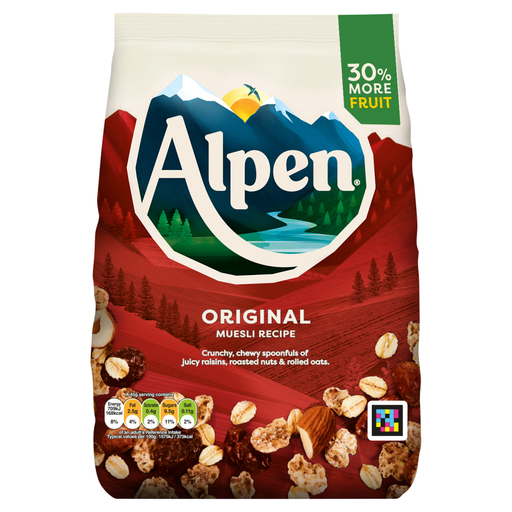 No image available
A classic fruit-and-nut muesli option for a relaxed weekend bowl with a declared high-fibre figure.
Alpen’s matching manufacturer specification declares 7.7 g fibre per 100 g and 21 g sugars per 100 g. The recipe contains milk, wheat, oats, almonds and hazelnuts, and may contain other nuts.
Compare its sugars and allergen information with other recipes if sweetness, milk or nuts are important considerations.
For the UK claim condition cited by legislation.gov.uk, a food may be described as high in fibre only if it contains at least 6 g fibre per 100 g or at least 3 g fibre per 100 kcal. Compare per-100-g nutrition values when choosing between mueslis.
No. Dorset Cereals Wonderfully Organic and Tasty Toasted are labelled no added sugar, but their nutrition panels declare 18 g and 19 g sugars per 100 g respectively because ingredients can contain naturally occurring sugars. Compare the sugars line on the exact recipe rather than assuming the label describes total sugars.
Only if the current pack’s ingredients and precautionary statement suit that requirement. The reviewed recipes commonly contain wheat, oats, barley and nuts; Alpen Original additionally contains milk ingredients, while Rude Health The Ultimate Muesli says it may contain traces of milk, soya and other nuts.
Use fibre per 100 g to compare products fairly because stated portions may differ. Then use the serving figure to understand how much fibre your usual bowl provides; Jordans Natural Muesli, for example, lists 4.1 g fibre for its stated 45 g portion.