Who this is for

Home bakers seeking genuinely high-fibre oats

For flapjacks, biscuits, crumbles or baked oats where you want to distinguish a product carrying a high-fibre claim from an ordinary oat product. Under UK rules, a high-fibre claim requires at least 6 g of fibre per 100 g or 3 g per 100 kcal; verified examples include 9 g per 100 g for Quaker Jumbo Oats and 19.4 g per 100 g for Mornflake Oat Bran.

Texture-led flapjack and crumble bakers

For recipes that need visible flakes and a chewy bite rather than a fine, absorbent oat ingredient. Whole jumbo rolled oats suit a more defined oat texture, while fine oatmeal and oat bran suit recipes where a less distinct texture is acceptable.

Gluten-free home bakers

For bakers who need a specifically labelled gluten-free oat product rather than assuming standard oats are interchangeable. Gluten-free oats are still oats for allergen-labelling purposes, and clean preparation practices matter during baking.

Buying priorities

Start with the texture your recipe needs, then compare fibre per 100 g and check the ingredient and allergen statement for the chosen pack.

Priority What to check Your needs
Verified fibre density Compare fibre per 100 g on the nutrition panel. A UK high-fibre claim requires at least 6 g per 100 g or 3 g per 100 kcal, according to legislation.gov.uk. Check whether bran or added wheat bran changes the ingredient format. I want an oat ingredient that meets the high-fibre threshold rather than relying on broad wellbeing wording.
Baking texture and recipe fit Choose jumbo rolled oats for distinct flakes. Use fine oatmeal where a finer crumb is wanted. Treat oat bran as a different, more absorbent ingredient rather than a like-for-like flake replacement. For flapjacks or crumble toppings, I want recognisable oat pieces. For biscuits, oatcakes or blended mixes, a finer texture may suit the recipe better.
Gluten and cereal-allergen suitability When gluten-free suitability is required, choose an explicitly labelled gluten-free product. Read ingredients and allergen statements for oats, wheat and barley, and use clean utensils and surfaces for gluten-free baking. I need to avoid treating standard oats as interchangeable with gluten-free oats, while remembering that gluten-free oats are still an oat allergen.
Pack suitability Choose a pack size that fits how often you bake. Store oats in a cool, dry place and keep them in an airtight container after opening where the pack instructions advise this. I want enough oats for regular baking without choosing a format that is unsuitable for the recipe or dietary requirement.

Common buying pitfalls

  • Assuming all plain porridge oats are high fibre

    Wholegrain or natural wording does not by itself establish a high-fibre claim. In the UK, that claim has a defined threshold of at least 6 g of fibre per 100 g or 3 g per 100 kcal.

    Compare fibre per 100 g on the nutrition panel. Examples in the supplied product information range from 9 g per 100 g for Quaker Jumbo Oats to 19.4 g per 100 g for Mornflake Oat Bran.

  • Replacing rolled oats with oat bran without adapting the recipe

    Oat bran can list much more fibre per 100 g, but it is not the same ingredient format as rolled oats. A bake designed around chunky flakes may lose texture or need changes to its liquid balance.

    Use oat bran in fibre-led recipes or as a partial substitution, and keep jumbo or rolled oats where visible flakes and chew are important. Test a small batch before changing a full recipe.

  • Treating gluten free as the same as allergen free

    Gluten-free foods may still contain oats, and oats remain an allergen in their own right. Standard oat products can also carry may-contain warnings for barley or wheat.

    For gluten-free baking, select explicitly labelled gluten-free oats, then read the full ingredients and allergen statement for that product. Keep surfaces, utensils and shared condiments clean to reduce cross-contamination at home.

Relevant brand references

Mornflake

A useful reference for home bakers comparing fine oatmeal, oat bran and specifically labelled gluten-free porridge oats.

  • Mornflake lists 9.1 g fibre per 100 g for Fine Oatmeal and describes it as suitable for home baking; its Oat Bran lists 19.4 g fibre per 100 g.
  • Oat bran is not a rolled-oat equivalent, and the Fine Oatmeal and Oat Bran pages state that they are not suitable for wheat or barley allergy sufferers due to manufacturing methods.

Waitrose

A reference point for both basic rolled oats and a wheat-bran oat blend.

  • Waitrose Porridge Oats with Wheatbran lists 13.8 g fibre per 100 g and contains 12% wheat bran.
  • The added wheat bran makes this blend unsuitable for gluten-free baking and for a wheat allergy.

Quaker

A mainstream whole jumbo-oat option for recipes that benefit from robust, visible flakes.

  • Quaker describes its Jumbo Oats as whole, uncut oats suitable for baking, with 9 g fibre per 100 g and 100% wholegrain jumbo rolled oats listed as the ingredient.
  • The product page states that the oats may contain barley and wheat, so they are not a substitute for a specifically labelled gluten-free oat product.

Flahavan's

A wholegrain rolled-oat brand with baking recipes shown on its UK product page.

  • Flahavan's Irish Porridge Oats list 100% wholegrain rolled oats and are shown in several baking applications.
  • Check the current pack nutrition panel if fibre per 100 g is central to your decision.

Jordans

An organic jumbo-oat option for shoppers looking for chunky whole rolled oats.

  • The Waitrose listing for Jordans Organic Jumbo Porridge Oats states “High in fibre”, lists 8.1 g fibre per 100 g and identifies organically produced wholegrain rolled oats as the ingredient.
  • The listing also states that it may contain other gluten sources and nuts, so check suitability for restricted diets.

Dorset Cereals

Relevant for oat-based breakfast cereals rather than as a direct plain porridge-oat reference for this guide.

  • Its range includes granola made with wholegrain oats, nuts, seeds and fruit.
  • Granola is not interchangeable with plain porridge oats because added ingredients can change baking texture, allergens and sweetness.

Joybuy product options

Joybuy product options for high-fibre home baking, covering gluten-free oat flakes, jumbo rolled oats and oat bran.

Morrisons Free From Gluten Free Oats 1kg

Morrisons Free From Gluten Free Oats 1kg

For gluten-free home baking where explicitly labelled gluten-free oat flakes are required.

Stated as 100% gluten-free oat flakes with 8.6 g fibre per 100 g and suitability for baking. Oats are declared as an allergen.

View on Joybuy
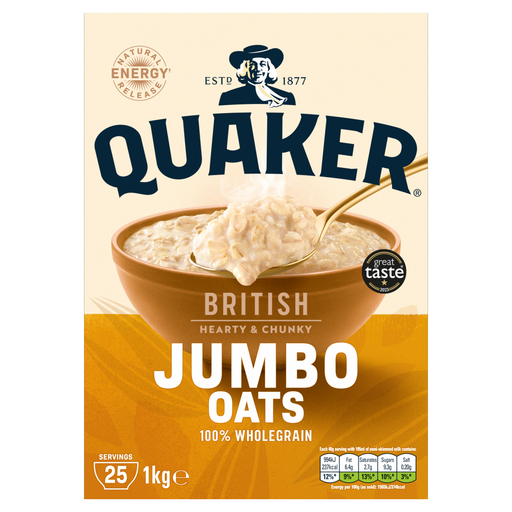
Quaker Jumbo Rolled Oats 1kg

Quaker Jumbo Rolled Oats 1kg

For flapjacks, crumble toppings and baked oats where larger flakes and visible oat texture matter.

Stated as jumbo wholegrain oat flakes with 9.0 g dietary fibre per 100 g and baking among its uses. It may contain traces of wheat, so it is not for a bake requiring specifically labelled gluten-free oats.

View on Joybuy
Mornflake Mighty Oats Original Heart Healthy Oatbran 800g

Mornflake Mighty Oats Original Oatbran 800g

For fibre-led baking or partial substitutions where the recipe can accommodate a finer, more absorbent oat ingredient.

Stated as 100% oat bran with 19.4 g fibre per 100 g. It is not rolled porridge oats, so test a small batch before replacing rolled oats; the product states it is not suitable for wheat or barley allergy sufferers due to manufacturing methods.

View on Joybuy

Frequently asked questions

What does “high fibre” mean on a porridge-oat pack in the UK?

Under the UK rule set out on legislation.gov.uk, a food can be described as high fibre only when it contains at least 6 g of fibre per 100 g or at least 3 g per 100 kcal. For dry oat ingredients, fibre per 100 g is usually the clearest like-for-like figure.

Are jumbo oats or fine oatmeal better for home baking?

Choose jumbo oats when you want distinct oat pieces and chew in a bake. Choose fine oatmeal where a finer, less flaky texture is preferable; both Quaker Jumbo Oats and Mornflake Fine Oatmeal are described by their manufacturers as suitable for baking.

Can ordinary porridge oats be used for a gluten-free bake?

Do not assume so. When a gluten-free product is required, select oats explicitly labelled gluten free; UK food labelling defines gluten free as no more than 20 mg/kg gluten in the food as sold, while oats must still be emphasised as an allergen.

How can gluten cross-contamination be reduced while baking at home?

Clean work surfaces, pots, pans and utensils with hot soapy water, and use clean cutlery for shared spreads. Separate bread boards or a separate toaster can also be relevant when the finished bake must remain gluten free.

How should opened porridge oats be stored?

Store oats in a cool, dry place and keep them in an airtight container after opening where the pack instructions advise this. Waitrose gives this instruction for its Porridge Oats with Wheatbran.