First-shop shoppers building a high-fibre breakfast staple
Choose an oat product you will use regularly, then compare its fibre figure per 100 g. Regulation (EC) No 1924/2006 sets the high-fibre threshold at 6 g per 100 g.


Compare fibre per 100 g rather than relying on front-of-pack wording: under Regulation (EC) No 1924/2006, a high-fibre claim requires at least 6 g per 100 g or 3 g per 100 kcal. Choose oatbran or bran-enriched oats when fibre density is the priority, plain rolled or jumbo oats for a versatile staple, and explicitly gluten-free oats where gluten contamination is a concern.
Choose an oat product you will use regularly, then compare its fibre figure per 100 g. Regulation (EC) No 1924/2006 sets the high-fibre threshold at 6 g per 100 g.
Oatbran porridge and oats with added wheat bran have higher declared fibre figures per 100 g than the plain rolled and jumbo oat examples considered here.
Choose a product explicitly labelled gluten free and read its exact allergen information. Coeliac UK notes that standard oats can be contaminated with wheat, barley or rye.
Start with the nutrition panel, then make sure the oat format, preparation and allergen information fit the breakfasts you plan to make.
| Priority | What to check | Your needs |
|---|---|---|
| Fibre density | Compare fibre per 100 g across packs. A high-fibre claim requires at least 6 g per 100 g or 3 g per 100 kcal under Regulation (EC) No 1924/2006. Check the dry-oat quantity before comparing serving figures. | I want a clear nutrition-panel figure that lets me compare like with like, rather than choosing from general wellness wording. |
| Format and preparation | Decide between oatbran, loose rolled or jumbo oats, and sachets. Check the pack instructions for hob or microwave preparation and consider the flake texture you prefer. | I need an everyday breakfast format that suits how much time I have in the morning and how I like my porridge to feel. |
| Gluten and allergens | Look for an explicit gluten-free label where required. Read the precise ingredient, allergen and may-contain statements on the current pack. | If I need to avoid gluten or particular cereals, I want suitability information that is specific to the product in my basket. |
Standard oats can be contaminated with wheat, barley or rye. Coeliac UK explains that terms such as “100% oats”, “pure oats” and “organic” do not establish that a product is gluten free.
Where gluten avoidance is necessary, choose an explicitly gluten-free oat product and read the exact allergen and suitability information on the pack.
High-fibre claims have a defined threshold, while portion sizes and preparation liquids vary. Bran and oatbran formats can have substantially more fibre per 100 g than plain rolled oats.
Use fibre per 100 g as the main comparison point, then check the figure for the dry-oat portion you expect to use and whether the texture suits you.
Organic describes production and jumbo describes flake characteristics; neither confirms gluten-contamination controls or fibre ranking. Different organic and jumbo products can have different declared fibre values and allergen statements.
Check three separate facts: fibre per 100 g, the ingredient and allergen statement, and an explicit gluten-free label where needed.
Mornflake offers both ordinary organic porridge oats and specialist oatbran products for shoppers comparing fibre density.
Waitrose provides a bran-enriched oat option, a basic porridge-oat staple and explicitly gluten-free oats.
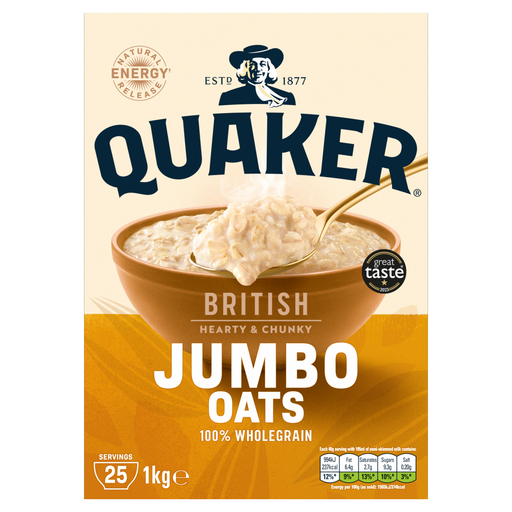
Quaker is relevant for standard rolled or jumbo wholegrain oats and a separate gluten-free sachet format.
Jordans is relevant for organic jumbo oats with a textured flake format.
Flahavan's offers traditional wholegrain rolled oats and oat-bran formats in the UK.
These Joybuy options cover oatbran, gluten-free oat flakes, loose jumbo oats, microwave sachets and an organic oat bundle for this first-shop decision.
 No image available
For a fibre-focused breakfast route when oatbran suits your preferred porridge texture.
100% oatbran; declared fibre of 19.4 g per 100 g; 800 g pack with a stated 45 g portion.
Not suitable for wheat or barley allergy sufferers due to the stated manufacturing methods. Check the pack for cooking directions before buying.
 No image available
For a regular porridge staple when an explicitly gluten-free oat-flake route is needed.
Gluten-free, wheat-free 100% oat flakes; declared fibre of 8.6 g per 100 g and 3.4 g per 40 g portion; 1 kg pack.
Check the current pack labelling and preparation instructions if gluten avoidance or a particular cooking method matters to you.
 No image available
For a loose-oat cupboard staple to use for porridge, overnight oats and baking.
100% wholegrain oat flakes; declared fibre of 9.0 g per 100 g; 1 kg pack.
The product states that it may contain traces of wheat, so it is not an explicitly gluten-free choice. Check the pack guidance for the texture and cooking method you prefer.
 No image available
For rushed mornings when a pre-portioned microwave porridge format is more practical than a loose bag.
Six sachets; 100% wholegrain rolled oats; stated 38.5 g portion; declared fibre of 9.0 g per 100 g; stated 2½-minute microwave preparation.
This is a sachet format rather than a loose oat bag. It is not explicitly labelled gluten free, so check the current allergen and suitability information where needed.
 No image available
For shoppers planning regular breakfasts who want a larger supply of organic wholegrain oat flakes.
Two 1 kg packs; 100% organic wholegrain oat flakes; declared fibre of 8.3 g per 100 g.
The product states that it contains oats (gluten), so it is not an explicitly gluten-free choice. Check the pack for recommended cooking methods and timings.
Under Regulation (EC) No 1924/2006, a food can make a high-fibre claim when it contains at least 6 g of fibre per 100 g or 3 g per 100 kcal. Compare the nutrition panel per 100 g because serving sizes vary between products.
Oatbran can suit you when fibre density is the main priority. Mornflake Fibreful Oatbran Porridge lists 25.6 g fibre per 100 g, compared with 8.1 g to 11.4 g per 100 g for the reviewed plain wholegrain rolled and jumbo oat products; it is also a different texture, so check the allergen statement and format.
No. Coeliac UK says standard oats may be contaminated with wheat, barley or rye, and labels such as “100% oats”, “pure oats” and “organic” do not establish that a product is gluten free. Choose an explicitly gluten-free product and read the current pack information.
For Waitrose Porridge Oats with Wheatbran, the stated hob method uses about 40 g oats with 300 ml cold water per person, then boiling and simmering for 4–5 minutes while stirring. The pack also permits microwave preparation, with timing dependent on microwave wattage.