What to compare before buying
Start with dry nutrition values per 100g, then check ingredients, allergens and the portion you are likely to prepare.
| Priority |
What to check |
Your needs |
| Fibre density |
Compare fibre per 100g across products. Under UK nutrition-claim rules, “high fibre” requires at least 6g per 100g or 3g per 100kcal. Check the fibre amount in your usual portion as well. |
I want a porridge base that makes a meaningful fibre contribution. Oat bran and oats with added wheat bran can have higher declared fibre than standard rolled oats. |
| Protein contribution |
Compare protein per 100g before looking at prepared-serving figures. Check whether the shown serving includes milk or another liquid, and identify the protein source. |
I need the oats themselves to provide protein, or I want room to add my own compatible protein food to the bowl. |
| Ingredients and allergens |
Read the full ingredient list and allergen statement. Check for soy or milk protein in fortified products, wheat bran in bran-enriched oats, and any wheat or barley warnings. |
I want an option that fits my ingredient preferences without assuming that plain-looking oats or a protein product will meet my allergen needs. |
| Fibre increase |
Check fibre per serving, especially when switching to oat bran. NHS guidance advises increasing fibre gradually and drinking adequate fluid. |
I am increasing fibre and want to make the change gradually rather than moving straight to a large high-fibre portion. |
Joybuy porridge-oat options
Joybuy product options for high-fibre porridge and high-protein breakfast planning, including oat bran, protein porridge and plain oats for adding your own protein food.
 No image available
Mornflake Mighty Oats Original Oatbran 800g
An oat-bran option for shoppers making fibre density the main priority while retaining protein from the oat base.
Contains oats and is stated to be unsuitable for wheat or barley allergy sufferers because of manufacturing methods. Check the current pack statement if an explicitly gluten-free product is required.
View on Joybuy
 No image available
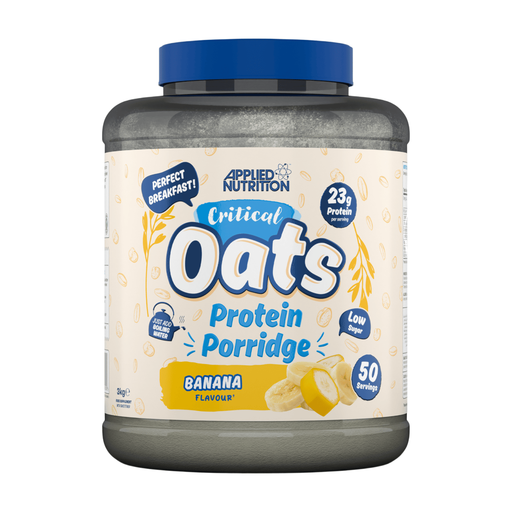
Applied Nutrition Critical Oats Protein Porridge Banana Flavour 3kg
A protein-porridge option for a protein-led breakfast or snack.
Contains oats, whey, milk and soy. It is described as a food supplement and states that it should not replace a varied, balanced diet; check the current pack for flavouring and sweetener details.
View on Joybuy
 No image available
Morrisons Free From Gluten Free Oats 1kg
A plain oat-flake route for porridge or baking when you want to choose a separate protein addition.
Oats remain an allergen despite a gluten-free claim. Check the current gluten-free and allergen statement on the pack, particularly for coeliac disease or allergies.
View on Joybuy
 No image available
Scotts Porage Oats Original Porridge Oats 1kg
A straightforward porridge-oat base for tailoring the liquid, toppings and protein source to your meal plan.
May contain wheat and barley, so do not assume it meets gluten-free or relevant cereal-allergy requirements. The protein in the finished bowl depends on what you add.
View on Joybuy
 No image available
Flahavan's Organic Porridge Oats 1kg
An organic wholegrain-oat option for a custom breakfast with a separately chosen protein food.
Contains oats and is described as containing gluten, so it should not be treated as an explicitly gluten-free option. Check the current pack for any additional allergen warnings.
View on Joybuy
Frequently asked questions
What does “high fibre” mean on a UK porridge-oats label?
Under UK nutrition-claim rules, a food may claim to be high in fibre only where it contains at least 6g of fibre per 100g or at least 3g per 100kcal. Compare nutrition panels on the same basis rather than assuming every wholegrain oat product has the same fibre content.
Should I choose protein porridge or high-fibre oat bran for a high-protein diet?
Choose protein porridge when you need the cereal product itself to contribute more protein quickly; Quaker UK lists 22g protein per 100g for Protein Original. Choose oat bran when fibre is the stronger priority while retaining protein from the oats: Mornflake lists 19.4g fibre and 16g protein per 100g for Beta³ Oat Bran. Plain oats can also work when you add a suitable protein food separately.
Can I move from ordinary oats to oat bran all at once?
Increase fibre gradually, particularly if your current fibre intake is low. NHS guidance recommends getting fibre from a variety of sources, while University Hospitals Sussex NHS Foundation Trust guidance advises gradual increases with adequate fluid intake to reduce bloating, gas and other digestive symptoms.
Are ordinary porridge oats suitable if I need gluten-free food?
Do not assume so. In the UK, food labelled gluten-free must contain no more than 20mg/kg gluten, but oats remain an allergen in their own right. If gluten-free suitability is necessary, select an explicitly gluten-free product and check the current pack statement.
Why can prepared porridge show more protein than dry oats?
The preparation liquid can change the nutrition shown for a serving. Quaker UK lists 8.1g protein in a dry 37.7g sachet of Protein Original and 15g in the serving prepared with 190ml semi-skimmed milk, so compare dry product values separately from recipes made with milk or other additions.


