
24/7 Customer Support

Free returns

Same-day & Next-day Delivery

Quality Guaranteed

Unlock Your Welcome Offers: FREE Delivery | Up to 80% OFF | Free 30-day JoyPlus trial
Download the APP
A high-performance desktop PC can handle demanding games, streaming, video editing and local AI workloads, but headline specifications do not always tell the full story. A tower with a powerful graphics card may still disappoint if it has limited memory, insufficient storage, unclear cooling information or a chassis that is difficult to place in a UK home office.
Before choosing a prebuilt gaming PC, check the complete specification rather than relying on phrases such as “gaming-ready” or “AI-powered”. The following points can help you compare systems more practically.
An RTX 5080 gaming PC, RTX 5070 gaming PC or RTX 5070 Ti gaming PC may suit different screens and games. A system intended for 4K gaming needs considerably more graphics capability than one aimed at 1080p esports.
Check:
A graphics card designed for higher-resolution gaming can also help with GPU-accelerated video editing and 3D applications. However, actual frame rates vary by game, settings, drivers and cooling.
A modern gaming system may run with 16GB of RAM, but simultaneous gaming, streaming, browser tabs, voice chat and creative software can use considerably more. A 32GB RAM desktop PC provides more working room for these combined tasks.
Storage is another frequent source of frustration. A 2TB NVMe SSD PC offers space for Windows, applications, games and active creative projects, while NVMe technology generally provides faster access than a traditional hard disk drive. Even so, large video libraries and raw project files can fill 2TB quickly, so check whether an additional drive can be installed or connected externally.
Prebuilt descriptions often emphasise the CPU and GPU while giving less detail about:
For example, a full tower may weigh more than 20kg and require two people to move safely. It also needs clear space around the intake and exhaust vents. Check these details before ordering, particularly if the computer will sit under a desk or in a compact room.
An AMD Ryzen 7 gaming desktop can provide a useful balance between gaming and multi-core tasks such as streaming, rendering and compiling. An Intel Core i7 gaming PC may also suit users who want strong gaming responsiveness alongside content creation and background applications.
For gaming alone, graphics capability is often the more influential specification at higher resolutions. For creators, streamers and users running several demanding applications together, core and thread counts become more important.
NVIDIA Blackwell graphics cards are designed for modern rendering features and supported AI-assisted applications. An RTX 5080 system can be appropriate for users prioritising 4K gaming, high-refresh 1440p play, ray tracing and GPU-accelerated creative work.
A dedicated gaming GPU is not automatically the same as an NVIDIA Blackwell AI workstation. Local AI development depends on software compatibility, memory capacity, precision, framework support and operating system. Users working with larger models may need a specialist platform with unified memory rather than a conventional Windows gaming tower.
For a general-purpose Windows 11 desktop PC, 32GB RAM and a 2TB NVMe SSD form a practical starting point for gaming, streaming and creative workloads. Confirm whether the memory is DDR4 or DDR5, as this affects platform characteristics and potential upgrade choices.
AI developers should check the operating system particularly carefully. The ASUS Ascent GX10 uses NVIDIA DGX OS rather than Windows, so it is aimed at Linux-based AI development, inference and experimentation. Its 128GB unified memory is integrated and cannot be upgraded by the user.
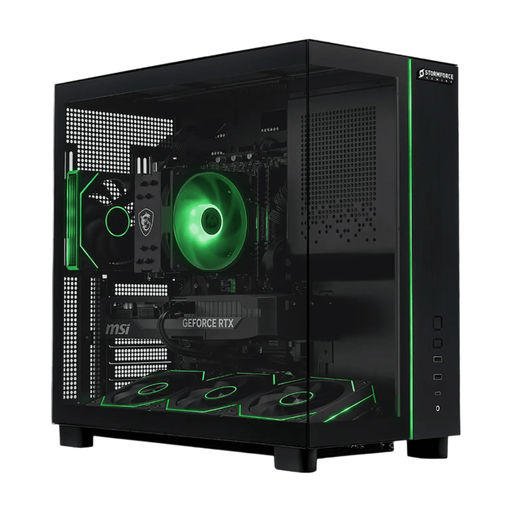
Why This Fits Their Persona: A ready-to-use Windows 11 tower for UK gamers who want 1440p capability, substantial storage and multitasking headroom without selecting individual components.
The listing specifies 32GB DDR4 RAM and a 2TB NVMe SSD, avoiding vague “high-spec” wording about memory and storage.
Ryzen 7 5700X, RTX 5070 with 12GB dedicated memory, 2TB NVMe storage and Wi-Fi/Bluetooth.
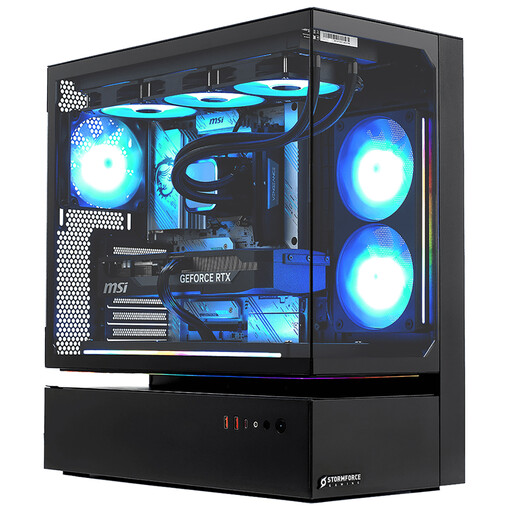
Why This Fits Their Persona: Suitable for users prioritising 4K gaming, ray tracing, high-refresh displays and demanding streaming or creative multitasking from one substantial tower.
The specification identifies the RTX 5080, 16GB GDDR7 graphics memory, 32GB RAM and 2TB NVMe SSD rather than only naming a gaming series.
Intel Core i7-14700F with 20 cores and 28 threads, RTX 5080 16GB GDDR7, Windows 11 Home and a 3-year collect, repair and return guarantee.
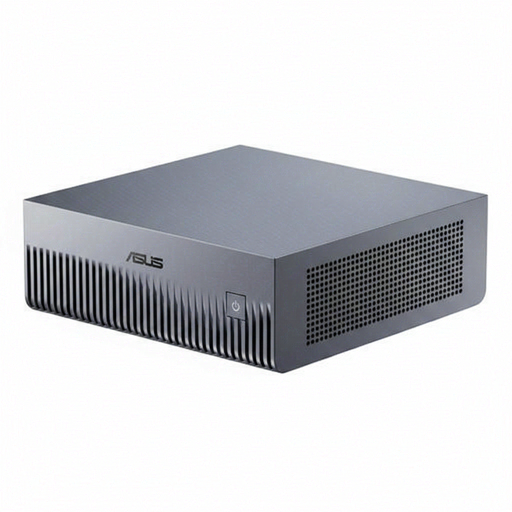
Why This Fits Their Persona: Designed for developers, data scientists and technical teams seeking a compact local AI development computer for compatible Linux-based workflows.
It clearly states that it runs NVIDIA DGX OS, not Windows, and that its 128GB unified memory is integrated and not user-upgradeable.
GB10 Grace Blackwell superchip, 128GB LPDDR5X coherent unified memory, 1TB NVMe SSD and 10G Ethernet in a 150 × 150 × 51mm format.
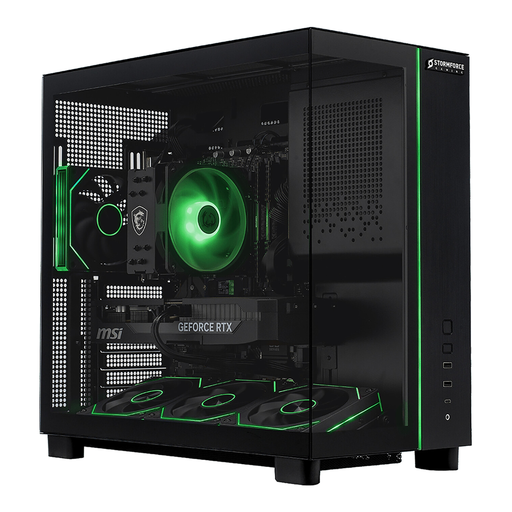
Why This Fits Their Persona: A larger Windows desktop for gaming, video editing, 3D rendering and sustained multitasking, provided the listed graphics specification matches your requirements.
The product title references RTX 5070 Ti, while the supplied description refers to RTX 5070. Confirm the exact GPU before purchase to avoid paying for an assumed specification.
Ryzen 7 5700X, 32GB DDR4, 2TB NVMe SSD, B550 chipset and a 3-year parts-and-labour guarantee; the tower weighs 24kg.
We have compiled a complete, real-time list of products that fully satisfy these strict selection criteria and UK safety regulations.
Before placing an order, confirm that:
A high-performance desktop PC can also draw substantially more power during demanding gaming or rendering than during idle use. A surge-protected socket, unobstructed airflow and regular dust removal are sensible precautions.
It can be, but suitability depends mainly on the graphics card, game settings and monitor refresh rate. An RTX 5080 configuration is aimed at higher-resolution gaming, while RTX 5070 systems may be more appropriate for 1440p and selected 4K titles with adjusted settings.
The useful lifespan depends on workload, airflow, software demands and upgrade options. A system with 32GB RAM, a 2TB NVMe SSD and a current graphics platform has more capacity for demanding applications than an entry-level configuration. Check motherboard compatibility, spare storage slots and warranty terms before buying.
Some can support AI tools, but gaming and AI workloads have different priorities. Check GPU memory, framework support, operating system and model requirements. A specialist system such as the ASUS Ascent GX10 runs DGX OS and offers 128GB unified memory, but it is not a conventional Windows gaming desktop.