People carrying lunch to work or elsewhere
If you want a snack that fits in a bag, a 30g pack gives you a defined portion. With a larger bag, decide how much to take before leaving.


For lunch on the go, compare the protein in the pack or portion you will actually eat. Marks & Spencer lists 10g protein in its 30g nut-and-seed mix; Sainsbury’s lists 9g per 30g serving for KP unsalted peanuts, with less than 0.01g salt, but the peanuts come in a 250g bag that you would need to portion yourself. Check salt, sugars and allergens as well as protein, particularly when comparing nuts with a bar.
If you want a snack that fits in a bag, a 30g pack gives you a defined portion. With a larger bag, decide how much to take before leaving.
Check salt for the portion you plan to eat. KP Nuts lists 0.51g salt per 30g dry-roasted snack pack, while Sainsbury’s lists less than 0.01g per 30g serving of KP unsalted peanuts.
Compare protein using the stated serving sizes, then check sugars, salt and allergens. A bar and a small nut pack need not have the same weight or ingredients.
Start with the amount you would eat at lunch, then read the nutrition and ingredient information for that portion.
| Priority | What to check | Your needs |
|---|---|---|
| Protein and portion | Compare protein per pack or chosen serving, alongside pack weight. Marks & Spencer lists 10g per 30g mix pack; KP Nuts lists 9g per 30g dry-roasted pack, and Sainsbury’s lists 9g per 30g serving of KP unsalted peanuts. | I want to know how much protein is in the amount I will carry and eat, rather than comparing per-100g figures alone. |
| Salt | Read the salt line for the same serving size. KP Nuts lists 0.51g per 30g dry-roasted pack; Sainsbury’s lists less than 0.01g per 30g of KP unsalted peanuts. | When salt matters to my choice, I want to compare the actual servings rather than rely on words such as “roasted”. |
| Ingredients and allergens | Read the current pack’s ingredients, highlighted allergens and any “may contain” statement. UK food-labelling guidance from GOV.UK covers ingredient and allergen information; the Food Standards Agency explains that precautionary wording signals possible unintended allergen presence. | I need to check the particular mix or peanut product against the allergens I avoid, including possible cross-contact warnings. |
| Pack format | Check whether the stated serving is the whole pack or part of a larger bag. The KP unsalted peanuts listed by Sainsbury’s come in a 250g bag, while the compared M&S mix and KP dry-roasted snack are 30g packs. | A single pack suits me when I want a ready-portioned snack; with a larger bag, I would take a separate portion for lunch. |
A 30g nut pack and a 46g bar contain different amounts of food, so per-100g figures alone do not show what you would get from either snack.
Compare protein per pack or intended portion first. Use per-100g figures when you want to compare the products on an equal-weight basis.
For the KP products listed by KP Nuts and Sainsbury’s, both stated 30g servings provide 9g protein, but the dry-roasted pack lists 0.51g salt and the unsalted peanuts list less than 0.01g.
If salt affects your choice, check the per-serving figure on the particular pack.
Serving sizes and ingredients differ. Tesco lists 10.9g protein, 9g sugars and 0.45g salt per 46g Pip & Nut Protein Peanut Butter Bar.
Compare the bar’s protein, sugars, salt and allergens with the nut portion you would otherwise eat.
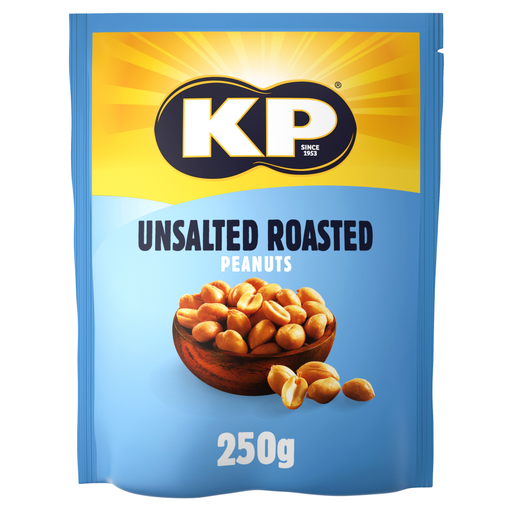
The KP unsalted peanut bag listed by Sainsbury’s weighs 250g, while its stated nutrition figures are for 30g.
Put your intended serving in a small container before packing lunch, or choose a single-serve format if that is more convenient.
KP offers the compared dry-roasted peanut snack pack and unsalted roasted peanuts in different pack formats.
Marks & Spencer describes its Protein Packed Nut and Seed Mix as a 30g snack for eating on the move.
Sainsbury’s provides the compared listing for KP unsalted roasted peanuts in a 250g bag.
These options cover a portioned peanut-and-chocolate bar and a larger bag of unsalted roasted peanuts. Compare their formats against the amount you intend to take for lunch.
 No image available
The bar format offers a portion to pack for lunch. The listed bundle contains four 40g bars; check the current label for protein, sugars, salt and allergens when comparing one bar with a portion of nuts.
 No image available
The 250g bag needs portioning if you want to take a defined amount for lunch. Sainsbury’s lists 9g protein and less than 0.01g salt per 30g serving for KP unsalted roasted peanuts; check the current pack label, including its allergen information.
Start with protein in the pack or portion you intend to eat. Then check its weight, salt, sugars, ingredients and allergens; a protein figure on its own does not describe the whole snack.
The compared KP products both list 9g protein per 30g. KP Nuts lists 0.51g salt for its dry-roasted snack pack, while Sainsbury’s lists less than 0.01g for a 30g serving of KP unsalted peanuts; the latter comes in a larger bag that you would need to portion.
Check the current physical pack before eating, including its ingredients, highlighted allergens and any “may contain” wording. GOV.UK guidance covers allergen information in ingredient lists, and the Food Standards Agency explains that precautionary wording concerns possible unintended allergen presence.
No. The Food Standards Agency identifies peanuts as legumes. That distinction does not establish whether a particular mixed snack is suitable for someone avoiding an allergen, so check the product’s full allergen statement.