People managing diabetes who need a portable snack
A bar can be convenient for work or travel, but compare carbohydrate for the amount you will actually eat rather than relying on the wording on the front of the pack.


Choose a high-protein snack bar by checking the carbohydrate in the portion you will eat and how it fits your own eating plan; a protein claim alone does not establish suitability. Diabetes UK advises fitting snacks into your overall diet. Compare protein and fibre alongside sugars, saturated fat, portion size and allergens, because these differ between bars.
The useful comparison depends on the portion, ingredients and nutrition figures that matter for your snack.
A bar can be convenient for work or travel, but compare carbohydrate for the amount you will actually eat rather than relying on the wording on the front of the pack.
If protein is your starting point, compare its per-bar figure with carbohydrate, sugars and saturated fat. A larger protein figure does not answer every question about the serving.
Check the exact recipe and allergen statement. Plant-based bars may contain peanuts, tree nuts or soya, while ingredients and warnings can differ between flavours.
Start with the carbohydrate for one bar, then check what else that serving contains. Per 100g figures help when comparing differently sized bars, but the per-bar figure describes the portion you may eat.
| Priority | What to check | Your needs |
|---|---|---|
| Carbohydrate and sugars | Read total carbohydrate and sugars per bar, not just per 100g. Check whether you plan to eat one bar or more than one from a multipack. | I want to know how much carbohydrate my snack portion contains before fitting it into my eating plan. |
| Protein and fibre | Compare grams of protein and fibre for the same serving size. Keep the carbohydrate figure alongside them: neither protein nor fibre removes the need to check it. | For a protein-focused snack, I want to see what the whole bar provides, not just its front-of-pack claim. |
| Saturated fat and energy | Read both values per bar; compare per 100g values when bar sizes differ. Nut-and-chocolate recipes can have different figures despite similar names. | If this is a regular snack for me, I want the saturated fat and energy figures in view as well as the protein. |
| Ingredients and allergens | Check the current ingredient list, allergen statement and any ‘may contain’ warning for the exact flavour. A vegan claim does not establish carbohydrate content or suitability for every allergy. | I need to know whether this particular bar meets my ingredient restrictions, rather than assuming every flavour in a range is alike. |
Nature Valley UK lists 11.2g carbohydrate per 36g Protein + Fibre Coconut & Almond bar and 11.0g per 40g Peanut & Chocolate bar. Their protein figures do not replace the carbohydrate figures.
Read carbohydrate for the bar you intend to eat and compare it with your own eating plan.
Eat Natural UK lists 5.6g saturated fat per 40g Dark Chocolate & Peanut Protein Bar. A protein figure on its own leaves out this part of the nutrition panel.
Compare saturated fat and energy per bar when deciding whether a recipe suits the snack occasion.
nākd. describes its bars as having no added sugar, but its fruit-and-nut ingredients can still contribute naturally occurring sugars and carbohydrate.
Use the exact bar’s total carbohydrate and sugars figures to compare it with other options.
The Nature Valley and Eat Natural recipes discussed here have different ingredient and allergen statements; Nature Valley Protein + Fibre Coconut & Almond also lists wheat and barley ingredients.
Read the current label for each flavour and multipack, including ‘may contain’ warnings.
A brand name is a starting point, not a substitute for the nutrition panel and ingredient list of a particular bar.
Its Protein + Fibre and Protein bars offer different per-bar balances.
TREK offers plant-based protein-bar and protein-flapjack ranges.
Its Dark Chocolate & Peanut Protein Bar is a nut-led option with a published per-bar nutrition panel.
Its fruit-and-nut bars include plant-based protein variants.
Graze sells a range of snacks rather than one bar with a uniform nutrition profile.
If comparing an Alpen bar, use its current pack rather than figures from an older protein-bar listing.
These Nature Valley nut-flavoured protein-bar multipacks offer two portable snack options. Check the nutrition and allergen information for the exact pack when deciding whether either fits your needs.
 Image unavailable
For a portable nut-flavoured snack, compare the carbohydrate figure for one 40g bar with the portion you intend to eat. Check the current pack’s nutrition and allergen statements, particularly if you avoid peanuts, almonds, soya or milk.
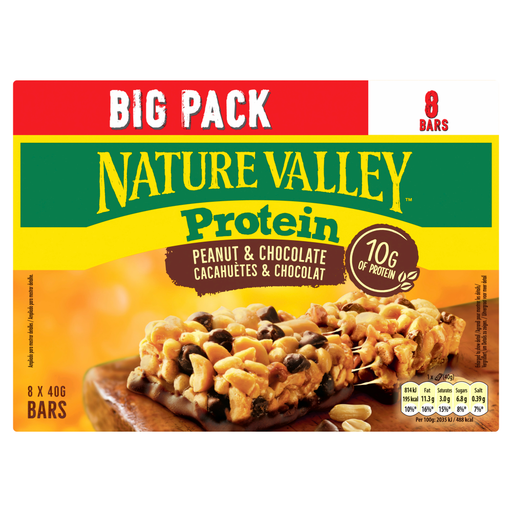 Image unavailable
For this Peanut & Chocolate recipe, Nature Valley UK lists 10.2g protein, 4.4g fibre, 11.0g carbohydrate and 6.9g sugars per 40g bar. Compare those figures with the current multipack label and check its peanut, soya, milk and other nut warnings.
No. Diabetes UK advises fitting snacks into your overall eating pattern. Check carbohydrate for the portion you will eat, then compare sugars, protein, fibre, saturated fat and ingredients against your needs.
Use both: per 100g figures help compare bars of different sizes, while per-bar figures show what one serving contains. Check the pack size so you do not mistake a multipack’s contents for a single portion.
Only the exact product’s current ingredient and allergen statement can answer that. Nature Valley Protein + Fibre Coconut & Almond lists wheat and barley ingredients, while the Nature Valley Peanut & Chocolate and Eat Natural Dark Chocolate & Peanut recipes have different allergen statements and warnings.