Day-trippers packing a portable snack
An individually portioned bar can be easier to take on a walk, journey or visit than a multipack left open in a bag. Check the wrapper and storage instructions for the bar you choose.


For a summer day out, choose a bar whose portion, ingredients and storage instructions work for your plans; if a UK “high protein” claim is important, the legislation published on legislation.gov.uk requires protein to provide at least 20% of the food’s energy. Tesco Groceries lists 10.4g protein per 40g Eat Natural Salted Caramel bar, while Nature Valley UK describes its Peanut & Chocolate 40g bar as providing around 10g; both are nut-containing choices, so check the exact pack’s allergens. For a plant-based alternative, TREK states that its High Protein range provides 15g protein per bar, but compare the nutrition and allergen label of the flavour you intend to pack.
An individually portioned bar can be easier to take on a walk, journey or visit than a multipack left open in a bag. Check the wrapper and storage instructions for the bar you choose.
Vegan suitability and protein content are separate checks. A plant-based bar can contain protein without meeting the UK criterion for a “high protein” claim.
Check the ingredients and precautionary allergen statement on the exact flavour and pack. The bars considered here include products made with peanuts, tree nuts, soy or milk.
Start with the protein and energy figures for one bar, then check whether its ingredients, portion format and storage instructions fit the outing.
| Priority | What to check | Your needs |
|---|---|---|
| High-protein claim | Compare protein and energy for the same serving. Under the UK criterion published on legislation.gov.uk, at least 20% of the food’s energy must come from protein for a “high protein” claim; protein grams alone do not establish this. | “High protein” matters to me, so I want to distinguish a qualifying bar from one that simply contains protein. |
| Nutrition per bar | Read protein, sugars, fibre and energy per bar, rather than mixing per-100g and per-serving figures. Tesco Groceries lists 10.4g protein and 198 kcal per 40g Eat Natural Salted Caramel bar. | I want to compare the portion I will actually pack, including its sugar and fibre figures, not choose on protein alone. |
| Ingredients and allergens | Read the exact flavour’s ingredients, emphasised allergens and any “may contain” statement. Vegan or gluten-free wording does not answer every allergen question; the Food Standards Agency explains that precautionary wording signals possible unintended allergen presence. | If I need to avoid nuts, soy, milk or gluten, compatibility comes before a higher protein figure. |
| Heat and packing | Follow the bar’s cool, dry storage instructions and keep chocolate-containing bars out of direct sun. For picnic foods that require chilling, the Food Standards Agency’s heatwave advice recommends a separate cool bag kept closed until needed. | I need a portion I can carry for a day out without leaving it in a hot car or treating its wrapper as protection for chilled food. |
A protein amount on the front of a pack does not, by itself, establish whether the bar meets the UK high-protein claim criterion.
Use protein and energy values for the same serving. The UK criterion published on legislation.gov.uk is at least 20% of energy from protein; multiplying protein grams by 4 kcal and dividing by the serving’s total kcal gives an approximate share.
A gluten-free or vegan description does not rule out other ingredients or possible cross-contact. Some bars considered here contain peanuts, tree nuts, soy or milk.
Read the current ingredients and precautionary allergen wording for the exact flavour and pack size before buying.
Heat can affect a bar’s condition. Chilled picnic food needs a different packing approach from an ambient bar.
Follow the bar’s storage instructions and keep it out of direct sun. The Food Standards Agency advises using a separate cool bag for picnic food that needs cooling and keeping the bag closed until it is needed.
A product listing is a useful starting point for comparison, but the pack you receive is the one whose nutrition, ingredients and allergen wording matter.
Confirm the current label for your chosen variant, along with availability, before ordering for a particular trip.
Its UK range includes Protein and Protein + Fibre bars in portioned formats.
TREK offers plant-based Protein Flapjacks and High Protein bars.
Its Protein range includes fruit-and-nut-style bars made with ingredients such as peanuts and almonds.
Its fruit-and-nut range includes vegan protein bars.
Graze makes snacks and flapjacks with a range of nutrition-led descriptions.
Alpen’s cereal-bar range includes a Protein Bar Chocolate 5 x 34g format listed by Tesco Groceries.
These Nature Valley and Grenade multipacks offer portioned protein bars for taking on summer days out. Compare the current label of the exact variant for nutrition, allergens and storage before choosing.
 No image available
The four-bar pack offers 40g portions to take on separate outings. The listed ingredients include peanuts, almonds, soy and milk; check the exact pack’s nutrition and storage instructions.
 No image available
This four-bar pack provides separate 40g portions for days out. Nature Valley UK describes the bar as gluten-free, with around 10g protein and 4g fibre per portion; it contains peanuts, soy and milk. Store it in a cool, dry place away from direct sunlight.
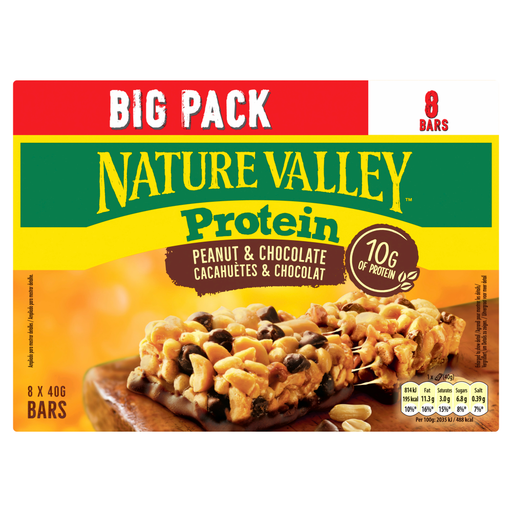 No image available
The 8 x 40g format provides more portions of the Peanut & Chocolate bar to pack across outings. Its listed allergens include peanuts, soy and milk, with possible other-nut cross-contact; check the current pack and keep the bars cool and dry.
 No image available
The 12 x 50g pack can be divided into portions for several trips. The product information lists milk, soy and maltitols; check the wrapper for the complete allergen and polyol wording, and keep the chocolate-coated bars cool and dry.
 No image available
This 12 x 50g format provides portions to pack for multiple days out. Its listed ingredients include milk, soy and maltitols; read the current wrapper for full allergen and polyol information, and store the white-chocolate-coated bars in a cool, dry place.
Under the UK claim criterion published on legislation.gov.uk, at least 20% of the food’s energy must come from protein. For an approximate check, multiply protein grams per bar by 4 kcal and divide by the total kcal for that same bar.
No. A bar can contain protein without meeting the UK 20%-of-energy criterion for a “high protein” claim. The listed figures for nākd. Cocoa Hazelnut, for example, are 7.2g protein and 191 kcal per 45g bar, putting its approximate protein-energy share below that criterion.
Nature Valley UK describes Protein Peanut & Chocolate as gluten-free, and Tesco Groceries describes the Eat Natural Salted Caramel multipack as gluten-free. Neither description establishes suitability for someone avoiding nuts, soy or milk; read the full label of the pack you buy.
Follow the pack’s storage instructions rather than leaving bars in direct sun or a hot car, particularly when they contain chocolate. Chilled picnic food needs separate care: the Food Standards Agency’s heatwave guidance advises a cool bag kept closed until the food is needed.
It signals possible unintended presence of the named allergen, rather than an ingredient deliberately added to the recipe. The Food Standards Agency explains this purpose of precautionary allergen labelling; if you need to avoid an allergen, check both the ingredients and that wording on the exact pack.