
24/7 Customer Support

Free returns

Same-day & Next-day Delivery

Quality Guaranteed

Unlock Your Welcome Offers: FREE Delivery | Up to 80% OFF | Free 30-day JoyPlus trial
Download the APP
A high-speed hair dryer can shorten your morning routine, but headline figures do not always tell the whole story. Motor speed, ion counts and claims such as “five times faster” may look impressive, yet they are not directly comparable between manufacturers.
For UK shoppers, the practical choice depends on airflow, temperature control, weight, attachments, noise and safe everyday use. This guide explains the specifications worth checking before you buy, highlights common marketing traps and matches several options to different hair types and routines.
A 110,000 RPM motor sounds powerful, but revolutions per minute describe motor rotation rather than the amount of air reaching your hair. Airflow speed, nozzle design and the distance between the motor and outlet also influence drying.
A brushless motor may offer a compact design and high rotational speed, but compare the stated airflow speed where available. For example, the Uniorange H6 lists airflow of up to 25 m/s, while other models specify different airflow figures or only quote motor speed.
An ionic hair dryer, plasma ion hair dryer or dual-ion model may be designed to reduce static and help hair feel smoother. However, ion counts are presented in different units and under different measurement conditions, so “millions” or “billions” should not be treated as a universal performance scale.
Look instead for useful controls such as cool air, circulating temperature, constant-temperature monitoring and a diffuser. These features give you more practical control, particularly if your hair is fine, coloured, dry, curly or textured.
A concentrator is useful for directing airflow along a brush, while a diffuser spreads air more gently around curls and waves. A dryer with several attachments may sound versatile, but check whether the accessories are included, securely fitted and easy to store.
Also consider cleaning. A removable filter helps you clear lint and hair, which is important for maintaining airflow and reducing overheating risk. Attachments and filters should only be removed or washed when the appliance is unplugged and cool.
For quick drying, compare the stated airflow speed, not only wattage. Many modern fast-drying hair dryers use brushless motors around 110,000 RPM, while traditional models may use a higher wattage motor with a different airflow design.
Wattage indicates electrical power consumption rather than guaranteed drying speed. A 1,600W high-speed dryer may dry efficiently through focused airflow, whereas an 1,800W or 2,100W model may suit users who prefer strong conventional airflow.
A useful dryer should provide separate heat and fan settings. Two fan speeds and several temperature levels are adequate for basic drying, while four heat and four speed options allow finer adjustment.
Temperature monitoring is particularly useful when drying frequently. The ZHIBAI S1 specifies intelligent temperature control at approximately 57°C, with temperature monitoring stated at 100 times per second. The Dreame Glory Combo lists NTC temperature detection and four temperature settings. These are product specifications, not guarantees that hair damage will be prevented, so keep the dryer moving and avoid holding hot air close to the scalp.
Weight matters if you have thick hair or spend considerable time styling. Lightweight options in this guide range from approximately 280g to 600g, although the final hand-held weight may change with an attachment.
Noise is usually stated in decibels. Models listing around 56–59dB may be more suitable for early-morning or late-evening use, but perceived noise also depends on pitch and room acoustics.
For use in Britain, check that the appliance is suitable for 220–240V, 50Hz UK mains electricity, has the correct UK plug or an approved compatible plug and includes clear safety instructions. No hair dryer is waterproof. Keep it away from baths, showers, sinks and wet hands, and unplug it after use.
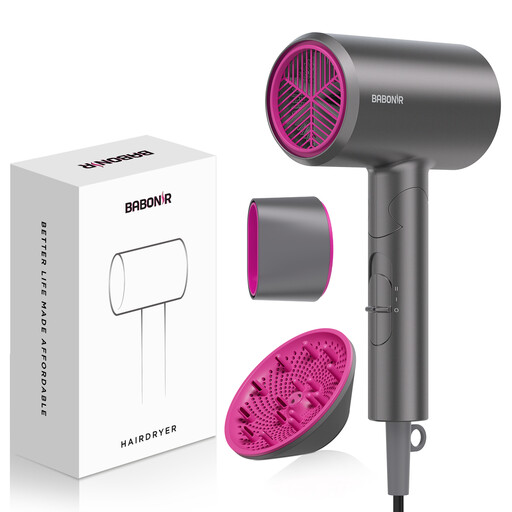
Why This Fits Their Persona: A practical option for everyday home drying and occasional short trips, especially when you want a straightforward ionic hair dryer without a large body.
It lists six drying combinations, rather than relying on one high-power setting, and includes a removable filter for routine cleaning.
1800W output, approximately 330g weight, foldable handle, diffuser and concentrator included.
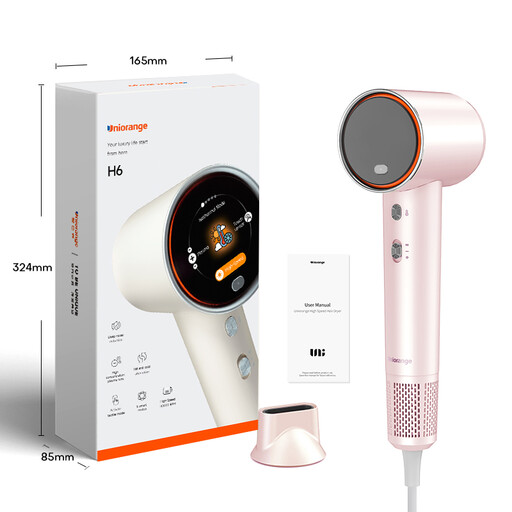
Why This Fits Their Persona: Suits shoppers seeking a technology-focused professional hair dryer for controlled home styling and a more interactive interface.
Its five smart modes, LCD screen and grip sensor provide visible controls instead of leaving the user to judge one fixed heat setting.
110,000 RPM brushless motor, airflow up to 25m/s, 1600W power and a precision concentrator.
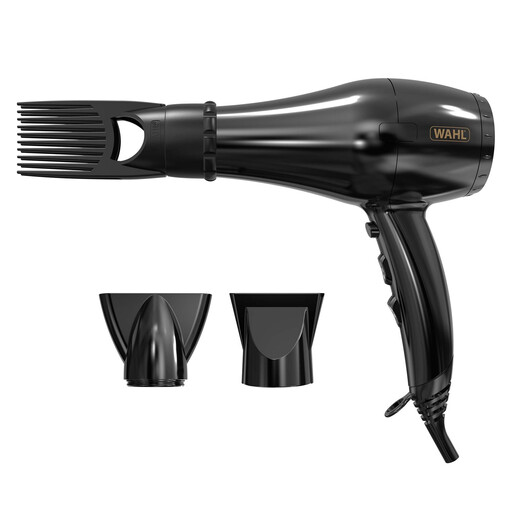
Why This Fits Their Persona: Designed for users who need to reach roots and manage afro, curly or textured hair with a pik attachment.
The attachment is purpose-built for root access, while the instructions specify adjusting heat when accessories are fitted.
1800W motor, three heat settings, two speeds, OnePik attachment, two concentrators and a 3m cord.
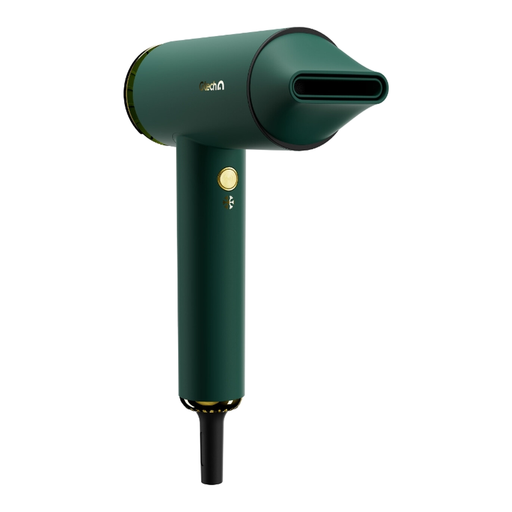
Why This Fits Their Persona: A compact choice for UK homes and travel, with multiple controls for adapting drying to different hair textures.
It provides four heat and four airflow settings, rather than making portability dependent on limited styling control.
110,000 RPM brushless motor, approximately 600g weight, magnetic concentrator and diffuser, memory function and cool shot.
For a lightweight hair dryer with a low stated noise level, the ZHIBAI S1 lists a weight of 378g, approximately 56dB operation, dual ions, two fan speeds and four temperature modes. The Laifen Premium lists a 110,000 RPM brushless motor, 22m/s airflow, approximately 59dB noise and a travel bag.
If hands-free drying appeals to you, the PINSSLE A1D uses a stand, dual air outlets, five speed settings and a wireless remote. This format takes more storage space than a conventional dryer, so measure your dressing table or bathroom cupboard first.
We have compiled a complete, real-time list of products that fully satisfy these strict selection criteria and UK safety regulations.
Not necessarily. Running cost depends mainly on wattage and usage time. A 1,600W dryer used for a shorter period may consume a similar amount of electricity to a 2,000W dryer used for longer. To estimate cost, multiply the appliance’s kilowatt rating by hours used and your electricity tariff.
Lifespan varies according to motor construction, filter maintenance and frequency of use. Keep the intake clear, avoid wrapping the cord tightly around the body and stop using the appliance if it becomes unusually hot, smells of burning or makes abnormal noises. Always follow the manufacturer’s care instructions.
Choose a diffuser if you regularly dry curly, wavy or textured hair and want to distribute airflow. Choose a concentrator if you create smooth blow-dries or need focused airflow. If you switch between both routines, confirm that the dryer includes both attachments rather than treating them as optional extras.