
24/7 Customer Support

Free returns

Same-day & Next-day Delivery

Quality Guaranteed

Unlock Your Welcome Offers: FREE Delivery | Up to 80% OFF | Free 30-day JoyPlus trial
Download the APP
A high-speed plasma hair dryer can make morning routines easier, particularly if you have thick hair, a busy household or limited time before work. However, impressive-looking specifications do not always tell the whole story. Airflow control, heat management, electrical safety and everyday handling can matter just as much as motor speed.
This guide explains which features deserve attention, which marketing shortcuts to question and how to match an ionic hair dryer to your routine in the UK.
A 110,000 RPM hair dryer sounds powerful, but motor speed alone does not determine how quickly hair dries. Airflow speed, nozzle design, inlet filtration, temperature control and hair density all influence real-world performance.
Be cautious with claims such as “dries five times faster” unless you can see the comparison conditions. Drying time may vary depending on hair length, thickness, starting moisture and the selected mode.
Plasma and ionic systems are designed to influence static and the interaction between airflow and moisture. They may appeal to people who want an anti-frizz hair dryer, but they cannot replace heat protection, suitable brushing technique or sensible temperature settings.
Look for clearly stated specifications rather than relying on broad promises about “repair”, “health” or permanent frizz removal. The Uniorange H6 listing specifies a plasma output of up to 1 billion plasma ions; this is a product feature, not a guarantee of a particular cosmetic or health outcome.
A dryer can have a powerful motor yet still be inconvenient if the buttons are difficult to reach, the handle becomes uncomfortable or the filter is awkward to clean. A grip sensor may reduce unnecessary running when you put the appliance down, but it should not replace unplugging the dryer after use.
For UK homes, check that the listing provides suitable UK plug and voltage information, clear instructions and relevant conformity details. When using any hair dryer near a bathroom, keep it away from water and consider the protection provided by the household electrical installation, such as an RCD.
The Uniorange H6 is listed with a 110,000 RPM brushless motor and airflow of up to 25 m/s. RPM describes how quickly the motor rotates; airflow speed gives a more practical indication of how forcefully air moves towards the hair.
For a fast-drying hair dryer, assess both figures where available. Also check whether the product offers multiple speed settings. High airflow is useful for removing excess moisture, while a gentler setting can give better control around the roots and face.
This model is specified as a 1600W hair dryer. Wattage indicates electrical power consumption, but a higher number does not automatically mean better styling or safer heat distribution.
Useful features include several heat and speed combinations, a cool-air option and visible operating information. The H6 has five smart modes and an HD LCD colour screen that displays working status. These controls can help users avoid relying on maximum heat for every session.
A hair dryer with concentrator nozzle is useful when directing airflow along a brush for straighter styles or targeted shaping. The nozzle should fit securely and allow enough room to work without forcing the airflow too close to the hair.
A hair dryer with grip sensor can start when the handle is held and stop when it is released. This may be convenient during styling and can limit idle operation. Nevertheless, allow the appliance to cool, unplug it after use and keep the air inlet and outlet uncovered.
Regularly cleaning the inlet filter is also important. Dust and hair accumulation can restrict airflow and increase heat build-up, so check how accessible the filter is before buying.
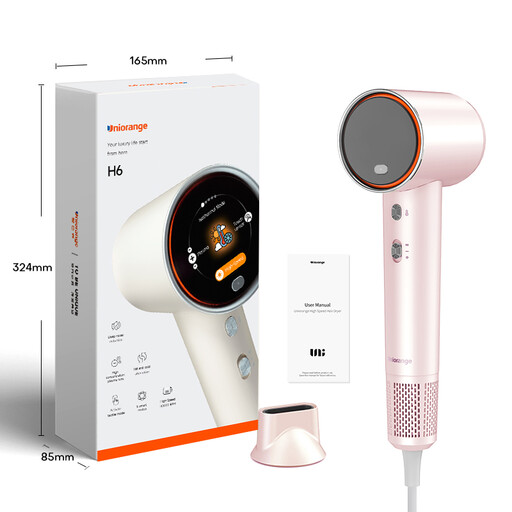
Why This Fits Their Persona: A practical option for users moving from a basic dryer to a model with faster airflow, selectable modes and a display without adding separate styling attachments.
Its listing provides specific motor, power, mode and airflow information instead of relying only on general speed claims.
1600W power, five smart modes, HD LCD colour screen and a concentrator nozzle.
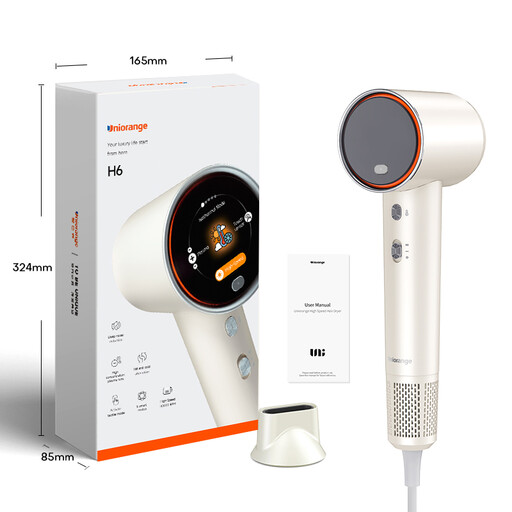
Why This Fits Their Persona: Suitable for style-conscious shoppers who value visible controls, a coordinated finish and more precise airflow for regular home styling.
The screen makes the selected mode and operating status visible, helping reduce guesswork when changing heat or speed.
HD LCD colour display, plasma-ion feature, 25 m/s listed airflow and precision concentrator.
Why This Fits Their Persona: A family or frequent-use choice for households where drying speed, hands-free pauses and repeatable controls are useful.
The grip sensor can stop airflow when released, while the stated 1600W rating and 110,000 RPM motor are clearly identified for comparison.
Grip sensor, five modes, brushless motor specification and removable-filter cleaning guidance.
We have compiled a complete, real-time list of products that fully satisfy these strict selection criteria and UK safety regulations.
It can be a useful option because strong airflow may remove moisture more quickly than a basic dryer. Results still depend on hair length, density and technique. Use a lower heat setting when hair is nearly dry and keep the concentrator moving rather than holding hot air in one place.
Ionic or plasma features are intended to help manage static, which may make hair feel smoother or look less flyaway for some users. They are not a permanent treatment for frizz. Hair condition, humidity, products and brushing technique also affect the finish.
Running cost depends on the appliance’s actual power draw, the time used and your electricity tariff. A 1600W dryer uses 1.6 kilowatt-hours if operated continuously for one hour. A ten-minute session would use approximately 0.267 kWh at full rated power, although actual consumption can vary with settings and motor behaviour. Check your tariff for the current unit price and unplug the dryer after use.