If your phone handles the scenes you expect and you value travelling light, a separate camera may not be worth carrying. Consider a compact for optical zoom without a lens kit, a mirrorless camera when changing lenses matters enough to justify the extra gear, or a bridge camera for a defined need to photograph distant subjects. Compare each option with your actual itinerary, particularly difficult light, reach and day-bag weight.
Who might need a separate camera?
A dedicated camera is most relevant when a particular type of holiday photo matters enough to justify another item in your bag.
Travellers photographing after dark
If indoor or evening scenes are important and your phone's results do not satisfy you, compare cameras and lenses for the light and subjects you expect. Which? identifies low-light photography as one reason to consider a dedicated camera; the result still depends on the equipment and how it is used.
Travellers photographing distant subjects
Wildlife, landmarks and details across a landscape may call for optical reach when you cannot move closer. Check the lens range you would actually carry rather than assuming every dedicated camera has a long zoom.
Travellers who want to change lenses
An interchangeable-lens camera offers a way to choose lenses for different scenes, but the fitted lens and any spares become part of your daily load. This route makes more sense if those choices are central to your holiday photography.
What should you check before choosing?
Start with the scenes you expect to photograph, then decide how much equipment you are willing to carry for them.
Your smartphone
Consider it when: Photos are mainly casual daytime records and keeping another device out of your bag matters most.
Trade-off: Which? points to low-light photography and optical or interchangeable-lens options as reasons a dedicated camera may be worth considering.
Compact camera
Consider it when: You want a separate camera with a built-in lens, particularly for optical zoom without carrying spare lenses.
Trade-off: Its fixed lens sets the available framing range, so compare that range with your likely subjects.
Mirrorless camera
Consider it when: Choosing lenses for different scenes is important enough to make the camera a planned part of each day.
Trade-off: The body specification alone does not describe the weight or reach of the lens kit you will carry.
Bridge camera
Consider it when: Distant wildlife or scenery details are a defined priority and you prefer one built-in lens to a lens system.
Trade-off: Check the complete camera's size and handling before committing to it for general sightseeing.
| Priority |
What to check |
Your needs |
| Difficult light |
Compare the camera and fitted lens for the indoor or evening scenes you expect. Check lens aperture and focusing needs at the focal lengths you will use; a sensor specification alone cannot establish the result. |
I expect to take photos indoors or after dark, and my phone's results are not enough for those scenes. |
| Distant subjects |
Check optical zoom or the lens's focal-length range, not just digital zoom. At longer focal lengths, consider stabilisation and how you will hold the camera steady. |
Wildlife or architectural details will be too far away for me to approach, so framing them matters more than travelling with only my phone. |
| Day-bag burden |
Compare the equipment you would actually take: camera, fitted lens, any spare lens, batteries and charging gear. Check whether a fixed lens covers your planned scenes. |
On walking-heavy days, I want a camera I will be willing to take out with me. |
| Flight packing |
The UK Civil Aviation Authority says spare batteries and power banks belong in cabin baggage. Protect spares from damage and short circuits, and check your airline's current requirements. |
I will be flying with camera batteries or a power bank and need a packing plan that works for my journey. |
What is easy to overlook?
-
Confusing digital zoom with optical reach
Enlarging a distant subject digitally is not the same as choosing a lens that frames it more closely. The optical ranges stated for compact and bridge cameras also vary substantially by model.
Think of the farthest subject you expect to photograph, then compare the exact optical focal-length range of each camera or lens.
-
Comparing body weight with an entire fixed-lens camera
A mirrorless body still needs a lens. Canon lists the EOS R50 at approximately 375 g with battery and card, before a lens is added, so that figure is not its complete carry weight.
List the body, fitted lens and anything else you would take each day before judging whether the kit suits your itinerary.
A second lens, card, spare battery or protective bag also adds to what you need to pack.
-
Putting spare batteries in checked baggage
The UK Civil Aviation Authority warns that incorrectly packed lithium-powered items can present a fire risk and directs passengers to take spare batteries and power banks into the cabin.
Pack spares in cabin baggage, protect their terminals and check your airline's battery and hand-luggage requirements before departure.
-
Assuming photography rules are the same everywhere
Rules can depend on the destination and the particular place you visit. GOV.UK provides country-specific travel advice, including information on legal differences.
Check the relevant country advice and any rules at attractions or protected sites where you plan to take photographs.
Which brands illustrate the options?
These model examples show how differently a travel camera can balance lens choice, zoom and carrying requirements; a brand name alone does not settle the decision.
Canon
The EOS R50 is an example to examine if you want an APS-C mirrorless camera and are prepared to choose a lens for it.
- Canon lists the EOS R50 at approximately 375 g with battery and card.
- That figure excludes the lens, so assess the weight of the complete kit you would take on holiday.
Sony
The fixed-lens RX100 VII illustrates a compact-camera choice for travellers weighing optical zoom against a smaller camera setup.
- Sony specifies an 8x optical zoom with a 24–200 mm-equivalent range for the RX100 VII.
- Check whether its 200 mm-equivalent long end is enough for the distant subjects on your itinerary.
Panasonic
The TZ99 travel compact and FZ82D bridge camera illustrate two fixed-lens approaches to holiday zoom.
- Panasonic lists a 24–720 mm-equivalent range for the TZ99 and a 20–1200 mm-equivalent range for the FZ82D.
- The stated lens range does not, by itself, establish handling or image results for your trip.
Nikon
The COOLPIX P1100 is a bridge-camera example for a trip centred on very distant subjects.
- Nikon specifies 125x optical zoom and a 24–3000 mm-equivalent range for the P1100.
- Consider its complete size and handling rather than choosing such a long range for general sightseeing alone.
Joybuy camera options
These options cover compact cameras and a mirrorless kit for holiday photography. Compare their stated lens arrangements with your plans; this selection does not include a bridge camera.
 No image available
Sony ZV-1 II 1-inch compact camera
A separate compact camera to consider for everyday holiday scenes; check whether its wide-angle zoom gives you enough reach for distant subjects.
The product name lists a 1-inch stacked sensor, 20MP stills and 4K video. Check the complete carry weight and battery endurance if you expect long days out.
View on Joybuy
 No image available
Sony Alpha ZV-E10 II K with 16–50 mm kit lens
This interchangeable-lens option suits a traveller who wants to plan around a lens kit rather than rely on a fixed-lens compact.
The product name specifies an APS-C camera, 26 megapixels and a 16–50 mm f/3.5–5.6 Power Zoom kit lens. Check whether that lens reaches your expected subjects and whether the complete kit is comfortable to carry.
View on Joybuy
 No image available
Sony ZV-1F 1-inch compact camera
Its ultra-wide lens is a choice to examine for nearby people and broad scenes, not for a holiday centred on distant wildlife or details.
The product name identifies a 1-inch sensor. Its fixed wide-angle framing does not provide optical zoom, so consider whether it fits the still photographs you want to take.
View on Joybuy
 No image available
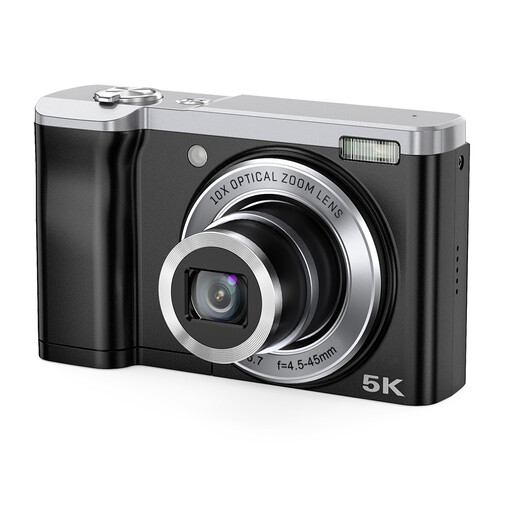
Songdian 56MP digital camera, 10x optical zoom, black
The stated 10x optical zoom makes this an option to examine if distant subjects are part of your trip; that figure alone does not establish image quality.
The product name also lists front and rear cameras and 5K video. Check the camera's dimensions and suitability for difficult light against your plans.
View on Joybuy
Holiday camera questions
Is a separate camera worth taking if I already have a good phone?
It is worth considering when your trip regularly involves photographs your phone does not handle well enough, such as difficult light, distant subjects or scenes for which you want to choose a lens. If convenience and carrying less matter more, using your existing phone remains a sensible choice.
Should I choose a compact, mirrorless or bridge camera for holiday zoom?
Choose by the reach and carrying setup your itinerary calls for: a compact has a built-in lens, a mirrorless camera lets you choose lenses, and a bridge camera may offer a long built-in zoom. Compare exact focal-length ranges and complete carry weight, including the fitted lens where applicable.
Can spare camera batteries go in checked baggage?
No: the UK Civil Aviation Authority directs passengers to carry spare batteries in the cabin. Protect them from damage and short circuits, and check your airline's current requirements for the batteries you plan to take.
Do photography rules change between holiday destinations?
They can. Check the relevant GOV.UK country travel advice for legal differences, then look at the rules for particular attractions or protected sites you intend to photograph.


