Sightseeing travellers who want more reach than a phone
If you want to photograph landmarks, family moments and distant details without packing separate lenses, start by checking the zoom range and size of a fixed-lens compact.


For sightseeing without a lens kit, consider a compact with a built-in zoom; choose mirrorless if interchangeable lenses justify carrying the complete kit. An action camera makes more sense for mounted, movement-led video than as an automatic replacement for a general travel camera. If you are flying, the UK Civil Aviation Authority advises carrying spare batteries in the cabin; protect them against short circuits and check your operating airline’s rules.
If you want to photograph landmarks, family moments and distant details without packing separate lenses, start by checking the zoom range and size of a fixed-lens compact.
A mirrorless camera gives you a choice of lenses for different subjects, but that choice also means planning what to carry and protect each day.
For cycling, point-of-view clips or other footage that calls for a mounted camera, an action camera and compatible mounts deserve a closer look.
Choose the camera format around the shots you plan to make, then assess the complete kit you would take out each day.
Choose it when: You want one camera with a built-in lens for ordinary sightseeing and do not plan to change lenses.
Trade-off: A fixed lens limits you to that model’s available focal lengths; Sony lists a 24–200 mm equivalent zoom for the RX100 VII, not for every compact.
Choose it when: You will use interchangeable lenses to cover different subjects on the trip.
Trade-off: As MPB’s travel-camera guidance notes, lens flexibility brings a kit-planning decision; judge the body and chosen lenses together.
Choose it when: Mounted or hands-free footage is an important part of the itinerary.
Trade-off: The mounts and other accessories you need depend on the activity and the exact bundle; GoPro says its HERO13 Black HB-Series lenses are sold separately.
| Priority | What to check | Your needs |
|---|---|---|
| Day-to-day carry | Compare the space needed for the complete camera kit, not just the body. For a compact, check its built-in lens range against the subjects you expect. | I want a camera I will carry all day, with enough framing flexibility for the sights I plan to photograph. |
| Photos and video | Check the exact model’s still-photo features and the video resolution and frame rate in the recording modes you would use. Check audio connections if spoken clips matter. | Holiday photos matter to me, but I may also film short clips; slow motion is useful only if it fits my plans. |
| Lenses and accessories | For mirrorless, confirm the lens mount and any adapter needed. For action footage, check mount compatibility and what the selected bundle contains. | I would rather know which lenses, mounts, memory cards and charging accessories I need before choosing the camera. |
| Flying with batteries | Check each spare battery’s watt-hour rating and your operating airline’s current rules. The UK Civil Aviation Authority says spares belong in the cabin and batteries from 100 Wh to 160 Wh need airline approval; the International Air Transport Association advises covering exposed terminals. | If I fly, I need a way to keep spare batteries protected and accessible in my cabin bag. |
The lens, charger, batteries and protective bag also affect what you carry. Canon’s approximately 328 g figure for the EOS R50, for example, is for the body only.
List the body, lens, memory card and charging items you would actually pack, then decide whether that kit suits your day bag.
Mounted footage or a particular field of view may depend on accessories that differ between bundles.
Check the selected bundle for the mounts, lens accessories, batteries, case and memory card your planned activity calls for.
GoPro says HB-Series lenses for the HERO13 Black are sold separately.
The UK Civil Aviation Authority says spare batteries must travel in the cabin. It also says batteries from 100 Wh to 160 Wh require airline approval, while those over 160 Wh are prohibited in passenger baggage.
Keep spares in your cabin bag and protect their terminals with original packaging, tape or individual protection, as advised by the International Air Transport Association. Check the operating airline’s rules for your journey.
Resolution alone does not tell you which frame rates, audio arrangements or stabilisation options apply to the clips you want to make.
Compare the exact recording modes and required accessories for walking footage, talking-to-camera clips or slow motion.
The RX100 VII illustrates Sony’s fixed-lens compact route for travellers considering a built-in zoom.
The EOS R50 illustrates an APS-C mirrorless camera for building a travel kit around interchangeable lenses.
The HERO13 Black illustrates the action-camera route for mounted holiday footage.
The X-T5 is a mirrorless travel-camera example for photographers considering a weather-sealed body.
These options cover action footage, fixed-lens compact shooting and a pocket gimbal camera for moving video. If interchangeable lenses are central to your decision, assess a mirrorless body and its lenses as a complete kit.
 No image available
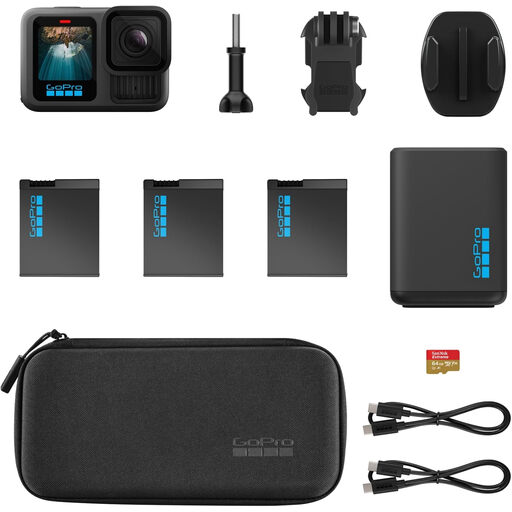
Consider this HERO13 Black bundle for mounted holiday footage when extra power accessories fit your plans. The Joybuy UK bundle description identifies batteries and charging accessories; check its contents against the mounts and other items you intend to take.
 No image available
For activity clips, the product name specifies 4K recording, 6-axis EIS, a 154° wide angle and 16MP photos. Its stated 30 m waterproofing requires the case; confirm the case is included. The stated 437-minute runtime depends on a handle and auxiliary battery, so check which power accessories this bundle contains.
 No image available
Its built-in wide-angle zoom offers framing choices without a separate lens kit. The product name specifies a 1-inch stacked sensor, 20MP stills and 4K video. The listing describes the camera as not water-resistant, so plan protection if wet conditions are likely.
 No image available
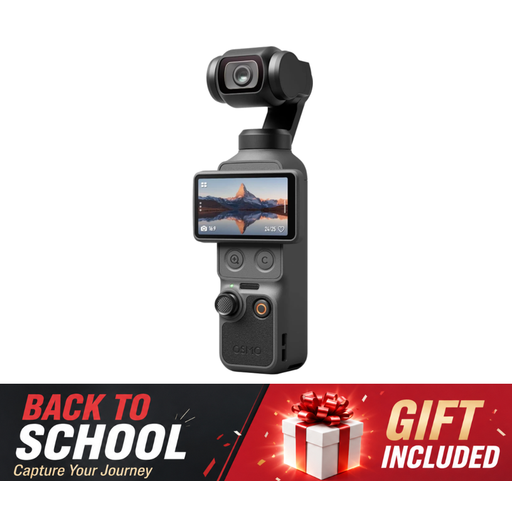
This pocket gimbal camera is a video-focused option for moving travel clips. Its product name specifies 3-axis stabilisation, 107 GB of built-in storage and a 2-inch rotatable screen. The stated 4K/240fps mode is for slow motion; check ordinary recording modes, battery life and water resistance for your plans.
 No image available
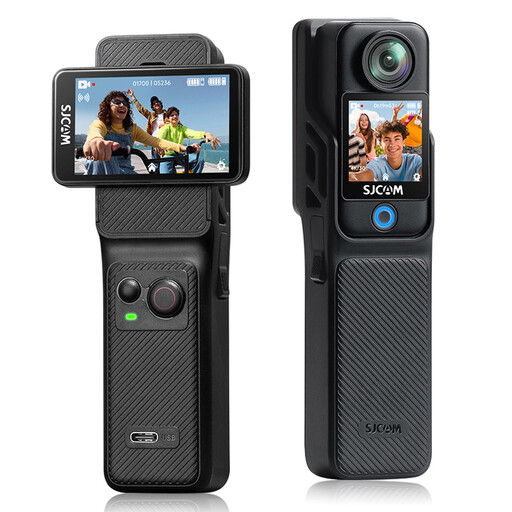
The wide fixed lens makes this a compact option to consider for selfie and talking-to-camera clips. It does not offer optical zoom for distant subjects. Check the supplied charging accessories and protect the camera from moisture as directed in the listing.
Choose a compact if you want a built-in lens without a separate lens kit; choose mirrorless if you will use interchangeable lenses and carry the resulting kit. An action camera is the more relevant format when mounted or movement-led footage is a main goal, rather than a substitute for every kind of holiday photograph.
Yes, but carry spares in the cabin and check the operating airline’s rules. The UK Civil Aviation Authority says batteries from 100 Wh to 160 Wh require airline approval and those over 160 Wh are prohibited in passenger baggage; the International Air Transport Association advises protecting spare-battery terminals against short circuits.
Remove spare batteries before the bag goes into the hold so they remain with you in the cabin, in line with the UK Civil Aviation Authority’s cabin-carriage guidance. Keep their terminals protected and follow instructions from your operating airline.
Plan around the shooting time and charging opportunities on your trip, then check the operating airline’s allowance for the batteries you intend to carry. The UK Civil Aviation Authority’s guidance distinguishes batteries by watt-hour rating, so check the marking on each one rather than assuming every camera battery has the same conditions.