Owners without a practical water inlet
For light dish loads, a manually filled model avoids a permanent inlet connection. Check how it drains and whether there is a stable worktop position and suitable socket.


A manually filled mini dishwasher suits light loads where a practical water inlet is unavailable; a six-place-setting connected model is a starting point for routine guest crockery when supply and drainage are available. Consider an eight-place-setting model for larger loads only after checking its height, water connection and waste route. Place-setting capacity does not guarantee that the cottage's largest dishes will fit.
For light dish loads, a manually filled model avoids a permanent inlet connection. Check how it drains and whether there is a stable worktop position and suitable socket.
If plates, bowls, mugs and cutlery need washing after everyday meals, compare six-place-setting models where the kitchen can provide water and drainage. Check the actual basket against the cottage's dishes.
An eight-place-setting countertop model offers more rated capacity than a six-place model, but its height and connection requirements need particular attention beneath cupboards.
Settle the water connection and usual dish load before comparing programmes; then measure the space available for the appliance and hoses.
Choose when: A permanent inlet is impractical and one or two guests produce light daily loads.
Trade-off: The Cookology MCDW2WH has two place settings, so larger meals may mean another cycle or some hand-washing.
Choose when: Routine guest crockery calls for more capacity and the kitchen has a compatible supply and drain route.
Trade-off: A model such as the Cookology CTTD6WH needs a tap or fixed-mains connection rather than manual filling.
Choose when: Shared meals regularly produce larger loads and a taller appliance fits the kitchen.
Trade-off: Cookology specifies its CTTD8WH at 595 mm high and requires a cold-water supply with a ¾-inch threaded connection and suitable drainage.
| Concern | What to check | Who this matters to |
|---|---|---|
| Water connection | Check the model's inlet method and wastewater route; manual filling is model-specific. | If the cottage has no practical inlet, I need a tank model with a workable way to drain it. Around 42% of consumers put connection flexibility first. |
| Everyday capacity | Compare place settings with usual occupancy, then check basket layout and maximum plate size. | When several guests eat together, I want their plates and mugs washed without repeated small cycles. Around 33% of consumers put everyday load capacity first. |
| Fit and guest use | Measure width, depth, height and hose space; consider stated noise and how guests will operate the controls. | With cupboards above the worktop and guests sharing the kitchen, I need a unit that fits and is straightforward to use. Roughly 25% of consumers make fit and guest use their main concern. |
Manual filling is a feature of specific models, not the whole category. Cookology describes the MCDW2WH as manually filled, while its CTTD6WH connects to a tap or fixed supply and its CTTD8WH needs a cold-water inlet and drainage.
Decide whether the cottage can accommodate an inlet and waste route before shortlisting models; check the exact model's instructions for both.
Cookology specifies the CTTD6WH at 438 mm high and the CTTD8WH at 595 mm high. Similar countertop widths therefore do not mean both will fit beneath the same cupboards.
Measure the available width, depth and height, including the space needed behind the appliance for connections, and check that the surface is stable and level.
A place-setting rating does not establish the fit of large plates or cookware. The product information lists a maximum plate diameter of 25 cm for the Russell Hobbs RHTTDW6B.
Measure the cottage's largest dinner plates and compare them, along with commonly used cookware, against the exact model's basket information.
Oversized dishes may still need hand-washing or a separate cycle.
GOV.UK guidance dated 2 October 2026 addresses self-catering holiday homes in England and tells owners to follow HSE electrical-safety guidance. It does not establish requirements for a cottage elsewhere.
Check the requirements for the property's nation, local authority and insurance arrangement before installing an appliance for guest use.
Its named countertop models illustrate the choice between manual filling and connected six- or eight-place-setting capacity.
The RHTTDW6B is a six-place-setting tabletop option for a kitchen with suitable water, waste and electrical connections.
The CP 6E51LW-80 offers a six-place-setting comparison point when quick and smaller-load programmes matter.
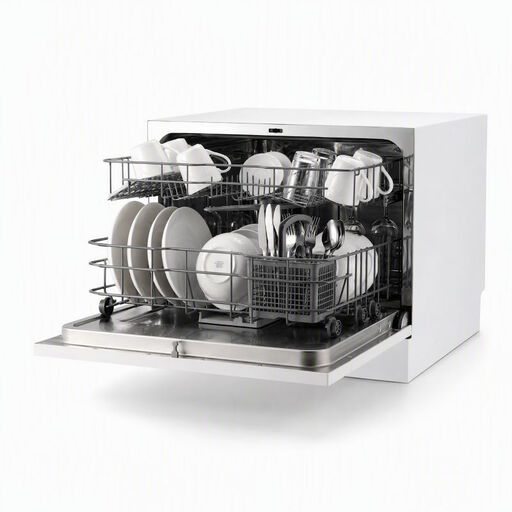
This six-place-setting tabletop option is relevant to routine cottage crockery. Check its inlet, drainage and physical fit against the kitchen before choosing it.
 No image available
Consider this tabletop model for routine guest plates, mugs and cutlery when a six-place-setting load suits the cottage.
The listing states a 30-minute quick wash, a 24-hour delayed start and eight functions.
Check the water inlet, wastewater route, dimensions, hose space and maximum plate size against the kitchen and its tableware. If guests will run it near a living area, check the stated operating noise too.
Yes, if the exact model is designed for manual filling. Cookology specifies its two-place MCDW2WH as needing no permanent inlet connection; follow the model's wastewater instructions and check the worktop and socket before use.
A six-place-setting model is a starting point for routine plates, bowls, mugs and cutlery when the kitchen has suitable connections. Check the basket and maximum plate diameter against the cottage's dishes; the rating alone does not establish that serving dishes or pans will fit.
Check the exact model's inlet and waste requirements against the available connections. Cookology specifies a cold-water supply with a ¾-inch threaded connection and suitable drainage for its CTTD8WH; seek competent installation advice if the existing connection or backflow-protection requirements are uncertain.
Requirements need to be checked for the property's location and circumstances. For self-catering holiday homes in England, GOV.UK guidance dated 2 October 2026 tells owners to follow HSE electrical-safety guidance; also check the applicable local and insurance requirements rather than assuming the England guidance covers every UK property.
No; choose a programme according to the crockery and how soiled it is, following the model's instructions. The product information lists both a 35-minute wash-and-dry programme and a separate intensive 75°C programme for the Candy CP 6E51LW-80, so the quick option should not be treated as suitable for every load.