Hosts with occasional workwear loads
If washable cleaning clothes, uniforms or maintenance garments add only intermittent loads to your holiday-let laundry, compare domestic machines on the programmes and capacity you will actually use.


For intermittent loads of ordinarily soiled, washable workwear at a holiday let, start with a domestic machine whose programmes, usable load capacity and installation requirements suit the job. Consider a professional machine when repeated loads and turnaround are central to the operation. If workwear may be biologically contaminated, assess its handling and laundering separately rather than relying on a quick wash or steam refresh.
If washable cleaning clothes, uniforms or maintenance garments add only intermittent loads to your holiday-let laundry, compare domestic machines on the programmes and capacity you will actually use.
When clothing needs to be ready between stays or maintenance visits, check the duration and permitted load of the intended wash programme, not just the machine’s headline capacity.
If workwear may carry biological contamination, the Health and Safety Executive’s guidance makes handling and an appropriate laundering process relevant alongside machine choice. Keep this distinct from washing ordinary dirt.
Decide whether the workwear calls for an ordinary wash or a risk-assessed laundering process, then compare the load frequency, programmes and installation needs.
Consider it when: Workwear loads are intermittent and the exact model offers suitable washes within the available laundry space.
Keep in mind: A domestic programme is not, by itself, a process for handling biologically contaminated clothing.
Consider it when: Frequent loads and predictable turnaround make business-oriented equipment worth assessing.
Keep in mind: Confirm the model’s usable capacity, installation requirements and servicing arrangements; professional positioning alone does not settle its suitability.
| Concern | What to check | Who this matters to |
|---|---|---|
| Soil and hygiene | Check the garment label, suitable wash temperatures and the exact model’s prewash or stain options. If contamination is possible, establish a risk-assessed handling and laundering process. | When workwear may be heavily soiled or contaminated, I need a wash and handling process suited to the garment and the risk, rather than a refresh cycle. Around 36% of consumers put soil and hygiene suitability first. |
| Turnaround and capacity | Compare the permitted load and duration of the programmes you would use, particularly shorter cycles, against your expected number of loads. | If clothing must be ready between property changeovers, I need enough usable capacity without assuming a quick programme takes a full load. Turnaround is the primary concern for around 29% of consumers. |
| Energy information and fit | Read the exact model’s energy label and product information sheet; measure space for the machine, hoses and door opening, and confirm its connections. | With a limited laundry bay near guest rooms, I need a machine that fits and whose stated energy and noise figures I can assess. Around 21% of consumers prioritise these practical constraints. |
| Fabric care and disruption | Match available programmes and spin settings to garment-care labels, and check stated spin noise if guests may be nearby. | For washable garments that need gentler treatment, I want suitable settings without disturbing nearby guests unnecessarily. Fabric care and low-disruption operation come first for around 14% of consumers. |
AEG says its ProSteam programme does not exceed 40°C. That refresh function should not replace washing visibly soiled clothing or a process for potentially contaminated workwear.
Follow garment-care instructions and assess the contamination risk before choosing how to handle and launder the items. The Health and Safety Executive advises washing potentially contaminated non-clinical laundry at the highest temperature recommended for the fabric.
A machine’s headline capacity does not establish the permitted load or duration of a particular short cycle.
Check the manual for the programmes you expect to use, including their load limits, temperatures, spin settings and cycle times.
Hoses, door access and connections affect fit, while spin noise matters if the laundry area is close to guest rooms.
Measure the full laundry bay and access route, then confirm the exact model’s dimensions, electrical and plumbing requirements, and stated noise level.
Miele positions the PWM 1108 SmartBiz for settings including hotels and small businesses, but that does not mean every holiday let needs a professional machine.
Compare your weekly load frequency, turnaround needs and tolerance for downtime with each model’s programmes, capacity, installation requirements and service arrangements.
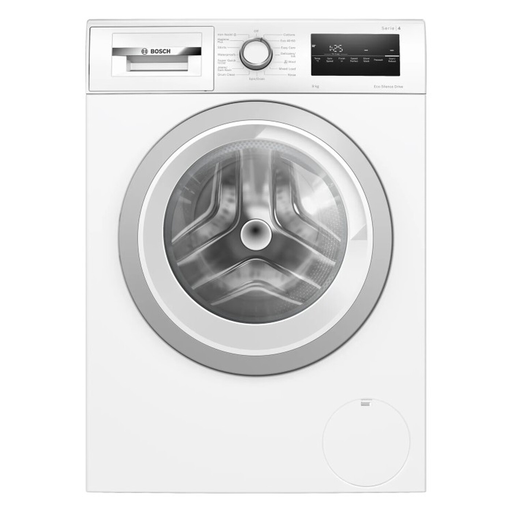
A reference for the domestic front-loader route, based on the Bosch UK WAN28255GB rather than the brand’s entire range.
A reference for comparing model-specific workwear programmes on domestic machines.
A reference for the professional route when frequent, business-style laundry merits consideration.
This domestic machine is a starting point for intermittent loads of washable workwear. Check its programmes against the garments and your expected turnaround before choosing it.
 No image available
Consider this domestic model for intermittent loads of washable workwear if its programmes suit the garment-care labels. Its stated capacity is 9 kg, spin speed is 1400 rpm and energy class is A. Check the permitted loads and durations of the washes you would use, along with fit and connections, before ordering.
Not automatically: a domestic machine can suit intermittent loads of ordinarily soiled, washable workwear if its programmes and capacity meet your needs. Assess professional equipment when frequent repeated loads and turnaround are central, and check the exact model’s installation and servicing requirements.
No, not when the workwear needs soil removal or decontamination. Steam refresh may be relevant to suitable lightly worn garments, but AEG says its ProSteam programme does not exceed 40°C; follow the garment label and use an appropriate laundering process for the condition of the clothing.
Assess the handling and laundering risk rather than choosing a machine by its programme name alone. For potentially contaminated non-clinical laundry, the Health and Safety Executive advises washing at the highest temperature recommended for the fabric; keep its handling separate from ordinary laundry as appropriate to the risk.
Check the exact machine’s height, width and depth against the access route and laundry space, allowing for hoses and door opening. Confirm its water, drainage and electrical requirements, and consider its stated spin noise if guests are nearby.
Use the exact model’s energy label and product information sheet to compare the stated figures and their conditions. An energy class alone does not tell you how a particular workwear programme will meet your load or turnaround needs.