
24/7 Customer Support

Free returns

Same-day & Next-day Delivery

Quality Guaranteed

Unlock Your Welcome Offers: FREE Delivery | Up to 80% OFF | Free 30-day JoyPlus trial
Download the APP
Bringing the café experience into your kitchen is an appealing thought, but the journey to finding the right home espresso machine is often filled with confusing specifications and over-hyped marketing. Many aspiring home baristas in the UK invest in a machine only to find it gathers dust because it’s too complicated, too bulky for the countertop or fails to produce a decent cup.
Before you commit, it’s crucial to understand the common pitfalls that lead to buyer's remorse. By sidestepping these traps, you can select a machine that genuinely suits your space, budget and coffee ambitions.
To make a confident choice, focus on the technical details that directly impact your daily coffee ritual. Here are the non-negotiable parameters to check.
As mentioned, don't be swayed by the highest number. Look for a machine with a 15 bar coffee machine pump. This industry standard ensures the pump has sufficient power to force hot water through finely-ground coffee at the optimal pressure. A stable pump is the foundation of good crema—the reddish-brown foam that sits atop your espresso shot.
If you dream of making your own flat whites or cappuccinos, an espresso machine with milk frother is essential. Look for a manual stainless steel steam wand. This gives you the control to heat and texturise milk to create everything from the stiff foam for a traditional cappuccino maker to the silky microfoam needed for latte art. It’s a skill that’s rewarding to learn and gives you far more control than automatic frothers.
Consider how you prefer to make your coffee. Using freshly ground beans offers the most control over flavour and freshness. However, on busy mornings, the convenience of an ESE pod machine is undeniable. ESE (Easy Serving Espresso) pods are paper-wrapped portions of coffee that are fully compostable and not tied to a single brand. A machine that accommodates both gives you the flexibility to switch between craft and convenience.
We've filtered the market based on these practical criteria. Instead of a simple list, we've matched our recommendations to specific user needs, helping you find the right fit for your lifestyle.

Why This Fits Their Persona: Perfect for those with limited counter space in a typical UK kitchen or flat. Its stylish, modern design doesn't sacrifice the core features needed for authentic espresso and milk-based drinks.
It directly counters the "bigger is better" fallacy with its compact footprint. It also avoids the pod-only trap by being compatible with both ground coffee and ESE pods.
Reliable 15-bar pressure from a trusted brand. The stainless steel boiler and manual steam wand are durable and offer great control for learning to froth milk.
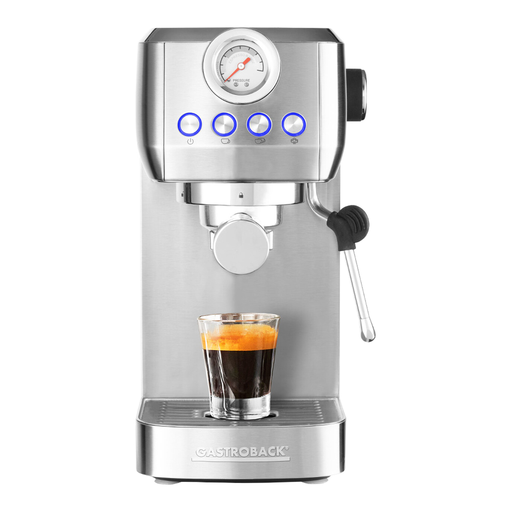
Why This Fits Their Persona: For the user who appreciates precision engineering and sleek aesthetics. The built-in pressure gauge (manometer) provides real-time feedback, turning every brew into a more controlled, engaging experience.
The manometer helps demystify the "pressure myth" by showing you the actual pressure during extraction. Its ultra-slim 15cm design is the ultimate answer to the "bulky machine" problem.
The professional ULKA pump and pressure gauge offer superior control. It also features a dual-circuit thermoblock for rapid heat-up times and is compatible with ESE pods.

Why This Fits Their Persona: An excellent starting point for anyone new to home espresso. It provides all the essential features—15-bar pressure and a steam wand—in a straightforward package without an intimidating price tag.
This machine focuses on the proven 15-bar standard rather than an inflated pressure number, ensuring beginners can achieve good results without the complexity of a professional setup.
The large, visible 1.2-litre water tank reduces the frequency of refills, which is convenient for daily use. Its simple controls make the learning process less daunting for a first-time user.
While you perfect your espresso, explore our curated ranges of appliances that help complete your home café experience.
While a 20-bar machine sounds more powerful, it doesn't necessarily produce better coffee. The ideal pressure for espresso extraction is around 9 bars. A 15 bar coffee machine provides a stable and sufficient level of pressure to achieve this consistently. A 20-bar pump can sometimes force water through the coffee grounds too quickly, leading to a weak or bitter shot if your grind and tamp aren't perfect. For home use, consistency from a 15-bar pump is more valuable than the higher number.
The lifespan of a home espresso machine depends on its build quality and how well it is maintained. Models with stainless steel boilers, like the De'Longhi Stilosa, are generally more durable than those with thermoblock systems, though thermoblocks heat up faster. With regular cleaning and descaling (especially important in the UK's hard water areas), a quality manual machine can provide reliable service for 5 to 10 years.
No, the grind size is critical. For a manual coffee machine, you need a fine, consistent "espresso grind." If the grind is too coarse, water will pass through too quickly, resulting in a weak, under-extracted shot. If it's too fine, it can choke the machine, leading to a slow, bitter, over-extracted shot. You can buy pre-ground espresso coffee or, for the freshest flavour, grind your own beans just before brewing.