
24/7 Customer Support

Free returns

Same-day & Next-day Delivery

Quality Guaranteed

Unlock Your Welcome Offers: FREE Delivery | Up to 80% OFF | Free 30-day JoyPlus trial
Download the APP
Bringing the rich aroma and complex flavours of a café-quality coffee into your own kitchen is a rewarding experience. For many in the UK, moving on from instant or pod coffee is the next logical step. However, the world of the home espresso machine can seem complex, with a vast array of features and price points. This guide is designed to cut through the clutter, offering practical advice to help you select a machine that fits your space, skill level and passion for great coffee.
We'll explore what truly matters in a barista coffee machine for home and highlight a few standout models that deliver on performance and value.
Choosing the right machine comes down to understanding a few core principles of espresso making. Keeping these points in mind will help you make a more informed decision.
You will often see machines advertised with high pump pressures like 15 or 20 bars. While a powerful pump is necessary, the ideal pressure for extracting espresso is consistently around 9 bars at the group head. More important than the maximum pressure is the machine's ability to maintain it steadily throughout the shot. Similarly, precise temperature control is crucial. Machines with a PID (Proportional Integral Derivative) controller actively manage water temperature, preventing the bitterness that comes from water that is too hot or the sourness from water that is too cool.
Your coffee is only as good as the beans and the grind. You have two main paths: a bean to cup coffee machine UK model with an integrated grinder, or a standalone manual espresso machine paired with a separate grinder.
If you enjoy a flat white, cappuccino or latte, the quality of your espresso machine with steam wand is paramount. A basic milk frother simply injects air, creating large, stiff bubbles. A proper steam wand, however, heats and textures the milk, creating a silky-smooth microfoam that integrates perfectly with the espresso and is essential for pouring latte art. Look for a machine with a powerful, articulating steam wand for greater control.
Here are a few models that cater to different needs, from compact convenience to pro-level performance.
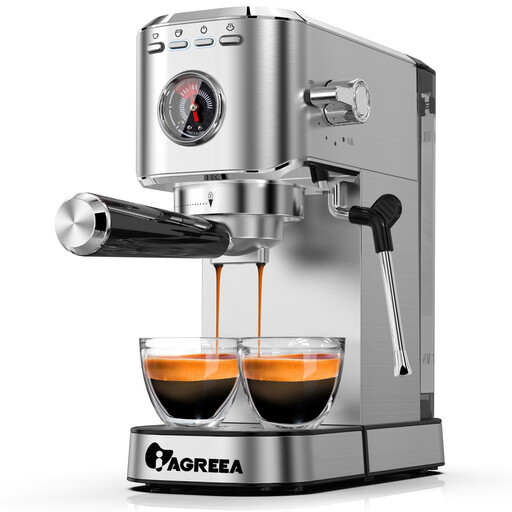
Why It Stands Out: This machine packs impressive functionality into a remarkably compact and stylish stainless steel body. The front-facing pressure gauge provides real-time feedback on your extraction, a feature typically found on more expensive models, helping you to dial in your technique. It’s a fantastic starting point for anyone serious about making proper espresso.
Pros:
Who is it for? The aspiring home barista with limited space or someone looking for their first serious manual espresso machine without a steep learning curve.
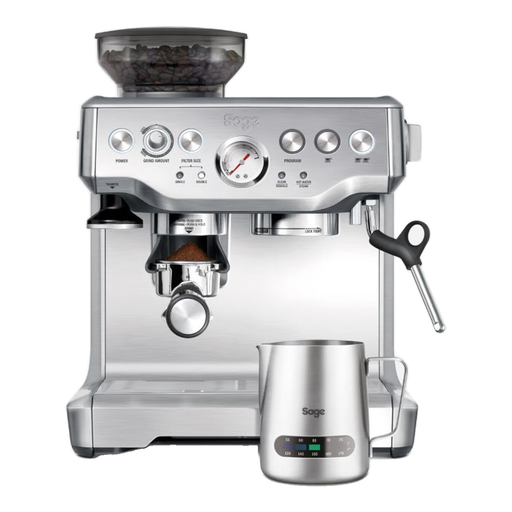
Why It Stands Out: The Sage Barista Express has become a benchmark for home espresso for good reason. It integrates all the essential elements into one cohesive unit. With its built-in conical burr grinder, precise dose control and PID temperature regulation, it guides the user from bean to cup, offering a balance of automation and manual control that helps you develop your skills.
Pros:
Who is it for? The coffee enthusiast who wants an all-in-one solution that provides the tools and control to replicate the full café workflow at home.

Why It Stands Out: For those who want to eliminate waiting time and achieve near-commercial performance, the HiBREW H21 is a compelling option. Its dual-boiler and dual-pump system is the star feature, allowing you to pull an espresso shot and steam milk simultaneously. This is a significant step up in workflow efficiency, perfect for entertaining guests or busy mornings.
Pros:
Who is it for? The serious home coffee aficionado or high-volume user who values efficiency, precision and wants a machine that can handle simultaneous tasks without compromise.
If these models aren't quite what you're looking for, there is a wide world of espresso machines to discover. From fully automatic models to high-end manual levers, the perfect machine for you is out there.
Explore our full range of professional home espresso machines on Joybuy.co.uk
1. What is the real difference between a 15-bar and 20-bar pump? While a higher number sounds better, the optimal pressure for extracting espresso is universally recognised as 9 bars at the point of extraction. Both 15 and 20-bar pumps are more than capable of achieving this. The key is the machine's ability to regulate and sustain that 9-bar pressure consistently. A machine with a pressure gauge can help you visualise this.
2. Do I really need a bean-to-cup coffee machine? A bean to cup coffee machine UK model offers great convenience by combining grinding and brewing. It's a fantastic choice for those who want great coffee with less effort. However, a separate grinder and a manual espresso machine give you more control over the grind size and dose and allow you to upgrade components individually over time. The choice depends on whether you prioritise convenience or control.
3. How much should I expect to spend on a good home espresso machine? Prices in the UK can range from around ?100 for a basic entry-level machine to well over ?1,000 for prosumer models. A solid mid-range machine with key features like PID temperature control and a good steam wand typically falls in the ?300-?700 range. Your budget should reflect the features that are most important to you, such as an integrated grinder, dual boilers or commercial-grade components.