
24/7 Customer Support

Free returns

Same-day & Next-day Delivery

Quality Guaranteed

Unlock Your Welcome Offers: FREE Delivery | Up to 80% OFF | Free 30-day JoyPlus trial
Download the APP
Tired of the daily expense and variable quality of your local café? Bringing the art of coffee making into your own home is a rewarding experience, giving you the power to craft a perfect flat white or a rich, intense espresso whenever you wish. However, the sheer variety of machines on the market can be overwhelming.
As a Joybuy Product Recommendation Officer, my role is to help you navigate the options. This guide cuts through the marketing clutter to offer clear, practical advice, helping you find the right espresso machine for your kitchen, your budget and your coffee-drinking style.
Before diving into specific models, it helps to understand the key factors that will influence your decision. Considering these points will ensure you invest in a machine that you will enjoy using every day.
The first major decision is how involved you want to be in the coffee-making process.
automatic coffee machine, these models prioritise convenience. With the press of a button, the machine grinds the perfect dose of fresh beans, tamps, brews the espresso and often froths and dispenses the milk for you. They are ideal for busy mornings and for anyone who wants consistently great coffee with minimal effort.If your go-to drinks are lattes, cappuccinos or flat whites, the milk frothing capability is crucial. A coffee machine with milk frother can come in two main forms:
bean to cup coffee machine models, these systems draw milk from an integrated carafe or tube, heat and froth it automatically and dispense it directly into your cup. It’s the simplest way to make a cappuccino maker work for you.Based on features, user-friendliness and overall performance, here are our recommendations for a range of home coffee enthusiasts.
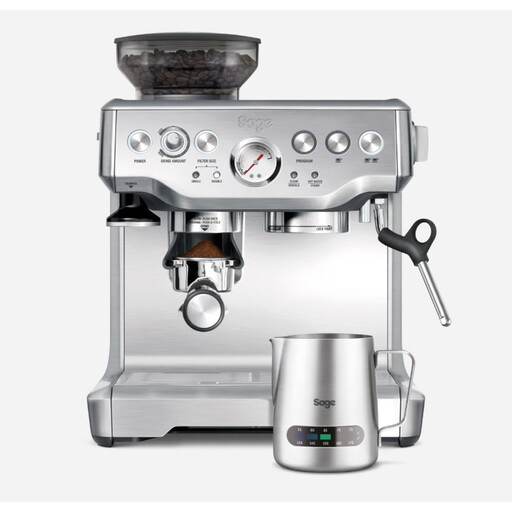
Why It Stands Out: The Sage Barista Express is a favourite among those who want to bridge the gap between a simple home espresso machine and a professional café setup. It integrates all the essential elements for third-wave speciality coffee into a single unit. Its design philosophy centres on dose control, precise water temperature, optimal pressure and the ability to create authentic microfoam, giving you all the tools to develop your skills.
Pros:
Who is it for? This machine is perfect for the coffee enthusiast who is excited by the process of making coffee, wants to experiment with grind size and shot timing and is keen to master the art of milk frothing.
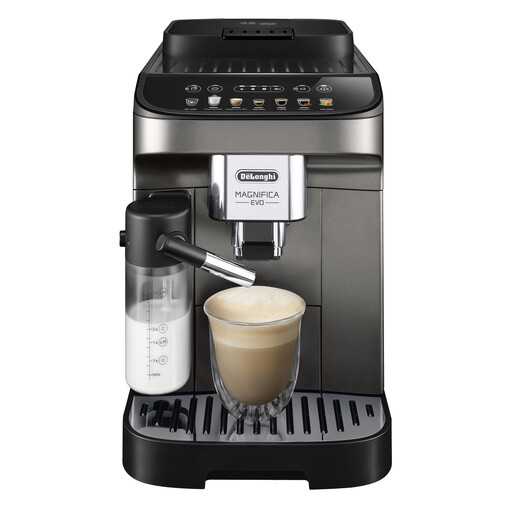
Why It Stands Out: The De'Longhi Magnifica Evo embodies the "set it and forget it" approach to high-quality home coffee. As a fully automatic bean-to-cup machine, it handles every step from grinding to milk frothing. Its intuitive touch display offers seven one-touch recipes, making it incredibly simple to get a perfect cappuccino or latte macchiato without any guesswork. The LatteCrema system is particularly noteworthy for producing dense, creamy foam automatically.
Pros:
Who is it for? Ideal for busy individuals or families who value convenience and consistency above all. If you want café-style drinks without the learning curve, this is an excellent choice.
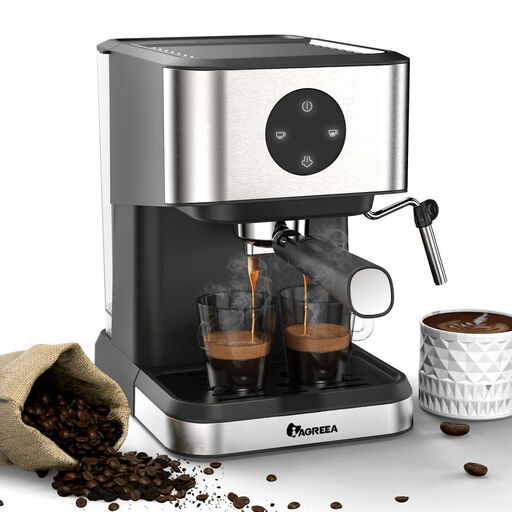
Why It Stands Out: This semi-automatic machine from Iagreea proves that you don't need a large footprint or budget to make great espresso. It packs impressive features into its sleek, stainless-steel body, including a powerful 20-bar pump for excellent extraction and a manual steam wand for frothing milk. Its compact design makes it a superb fit for smaller kitchens or as an entry-level machine for those new to home espresso.
Pros:
Who is it for? A great option for beginners, students or anyone with limited kitchen space who wants to step up from pod machines and start making authentic espresso-based drinks.
If our top recommendations haven't quite matched what you're looking for, or if you'd like to compare a wider range of models with different features, we have more to explore.
Discover our full collection of coffee makers with milk to find the perfect match for your home.
1. What is the difference between a bean-to-cup and a regular espresso machine? A "regular" or semi-automatic espresso machine requires you to grind the coffee, load it into a portafilter and manually start and stop the brew. A bean-to-cup machine is fully automatic; it grinds the beans, tamps the coffee and brews the shot all at the touch of a button, offering greater convenience.
2. Is 15 bar or 20 bar pressure better for an espresso machine? While the perfect espresso shot is extracted at around 9 bars of pressure, both 15-bar and 20-bar pumps are more than capable of achieving this. A higher bar rating indicates the pump's maximum potential power, which helps ensure it can consistently deliver the necessary 9 bars at the group head, even with a very finely ground and tightly packed coffee puck. Both will produce excellent results.
3. Can I use pre-ground coffee in a bean-to-cup machine? Many bean-to-cup machines, including the De’Longhi Magnifica Evo, feature a separate bypass doser that allows you to use pre-ground coffee. This is useful for making the occasional decaf or trying a different blend without emptying the main bean hopper. However, for the freshest flavour, using whole beans is always recommended.