
24/7 Customer Support

Free returns

Same-day & Next-day Delivery

Quality Guaranteed

Unlock Your Welcome Offers: FREE Delivery | Up to 80% OFF | Free 30-day JoyPlus trial
Download the APP
Bringing the coffee shop experience into your kitchen is an appealing thought. The aroma of freshly brewed espresso, the satisfying hiss of a steam wand and a perfectly crafted latte to start your day. However, the journey to finding the right home espresso machine with steam wand is filled with marketing jargon and technical specifications that can lead to a disappointing purchase. Many machines that promise barista-quality drinks end up gathering dust on the countertop.
As a Joybuy Product Recommendation Officer, my role is to help you see past the hype. Before you invest, let's look at the common pitfalls that UK buyers face and how to choose a machine that genuinely delivers.
To avoid these traps, focus on a few non-negotiable technical details. Understanding these will empower you to choose a machine that performs well long-term.
The ideal extraction happens at around 9 bars of pressure. A machine rated for 20 bars has a robust pump capable of consistently reaching and maintaining this optimal level. However, this power is only useful when paired with an efficient heating system. Look for a machine with a thermoblock system and a power rating of at least 1350W. This ensures the water reaches and holds the correct temperature throughout the brewing process. An espresso machine with pressure gauge is an excellent feature, as it provides real-time visual feedback, helping you understand and perfect your extraction.
For a true cappuccino maker for home, the steam wand is critical. It needs sufficient power to create a vortex in the milk jug, which textures the milk into a smooth microfoam. A flexible, rotatable wand is also crucial, allowing you to position the jug at the correct angle for perfect results. A machine that doubles as a coffee maker with milk frother should have this functionality as a priority, not an afterthought.
A stainless steel espresso machine offers more than just a premium look; it's durable, resistant to fingerprints and easy to wipe clean. Practicality is key for daily use. Check for a removable water tank of at least 1 litre and a detachable drip tray. These features make refilling and cleaning significantly easier. For smaller kitchens, carefully check the dimensions to ensure your new small espresso machine fits comfortably on your countertop.
Based on these practical criteria, here are some recommendations matched to different user needs.
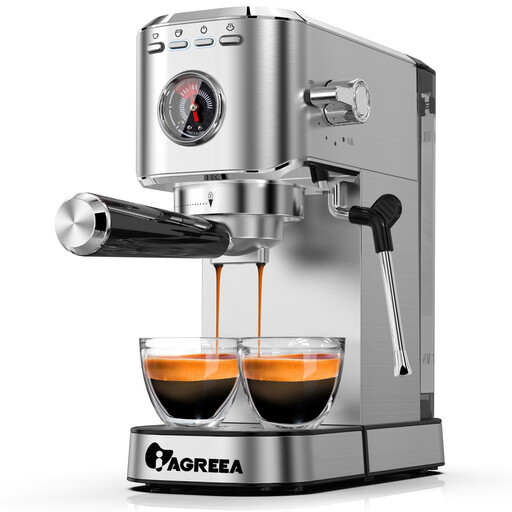
Why This Fits Their Persona: This user wants to learn the craft of espresso making without a huge initial outlay. The combination of a pressure gauge and a powerful, adjustable steam wand provides the tools and feedback needed to practise and improve.
The built-in pressure gauge demystifies the "high-pressure" claim by showing you the actual extraction pressure. Its 1350W heating system supports a capable steam wand, avoiding the "useless frother" problem.
The pressure gauge offers learning feedback usually found on more expensive machines. The compact, stainless steel body fits well in modern UK kitchens.
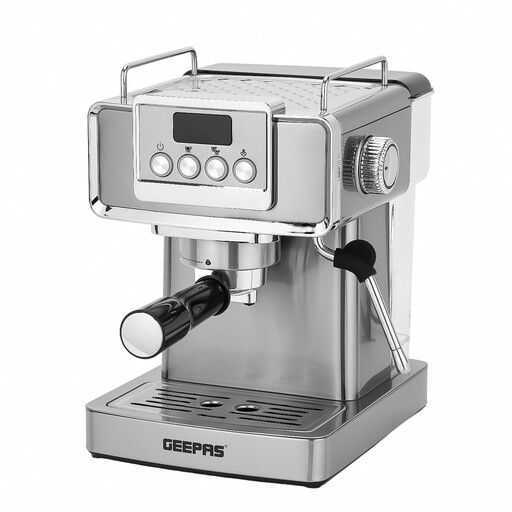
Why This Fits Their Persona: This user values convenience and aesthetics. They need a machine that heats up quickly for the morning rush, can make multiple drinks without constant refilling and looks sleek on the counter.
Its powerful 1465W rapid heat system and 20-bar pump deliver consistent performance. The large 1.8L removable water tank directly counters the "impractical design" flaw of constant refilling.
The large 1.8L water reservoir is a major convenience for households with multiple coffee drinkers. Its higher wattage ensures a very quick warm-up time.
We have compiled a complete, real-time list of products that fully satisfy these strict selection criteria and UK safety regulations.
Is a 20 bar espresso machine really better than a 15 bar one? While the ideal pressure for extracting espresso is around 9 bars, a machine rated for 15-20 bars typically has a more powerful and durable pump. This power ensures the machine can consistently maintain the optimal pressure during extraction. The higher rating is an indicator of a more robust system, but the consistency of both pressure and temperature is more important than the peak number alone.
How often do I need to descale a home espresso machine in the UK? This depends heavily on the water hardness in your area. As a general rule for most parts of the UK, descaling every 2-3 months is a good practice to prevent limescale build-up, which can affect performance and lifespan. Using filtered water can reduce the frequency needed. Some machines also have a built-in indicator to remind you.
Can I use a small espresso machine to make coffee for guests? Yes, but it requires a sequential process. A compact coffee machine is typically designed to prepare one or two drinks at a time. To serve multiple guests, you will need to brew the espresso shots and steam the milk for each drink individually. To make this process smoother, look for a machine with a rapid heating system and a larger water tank (over 1.5L) to reduce the waiting time between each coffee.