
24/7 Customer Support

Free returns

Same-day & Next-day Delivery

Quality Guaranteed

Unlock Your Welcome Offers: FREE Delivery | Up to 80% OFF | Free 30-day JoyPlus trial
Download the APP
Bringing the café experience into your kitchen is an appealing thought, but choosing the right home espresso machine can be a confusing process. The market is filled with technical jargon and features that sound impressive but may not suit your daily routine. As your Joybuy Product Recommendation Officer, my role is to help you navigate the options and focus on what truly matters for a great cup of coffee at home.
Before you invest, it's important to be aware of a few common pitfalls that can lead to disappointment and a machine that gathers dust on the counter.
To find the right machine, let's break down the specifications that will have the biggest impact on your daily coffee.
Your choice here defines the balance between convenience, cost and control.
How you enjoy your milky coffees, like lattes or cappuccinos, will determine which frothing system is right for you.
Instead of a single "best" model, the right machine is one that matches your lifestyle. Here are a few options suited to different types of UK coffee drinkers.

Why This Fits Their Persona: This user lives in a flat or home with limited kitchen space but refuses to compromise on a quality latte. They value both aesthetics and automated convenience for a busy morning routine.
Its ultra-slim 15 cm width directly solves the "Oversized Footprint" problem. The automatic milk frother with a removable container simplifies the cleaning process significantly.
Fully automatic milk frothing for cappuccinos and lattes in a very compact design. It is also compatible with both ground coffee and E.S.E. pods for added flexibility.
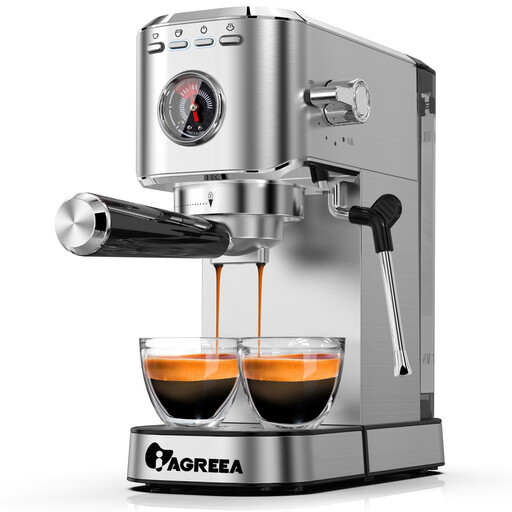
Why This Fits Their Persona: This user wants to move beyond automated coffee and learn the craft. They are looking for tactile feedback and control to perfect their espresso shot and practice latte art.
The built-in pressure gauge helps demystify the "Bar Pressure" issue by providing real-time feedback, allowing the user to adjust their grind and tamp to achieve the optimal 9-bar extraction zone.
The combination of a manual steam wand and a pressure gauge provides the tools needed for learning and control. Its durable stainless steel housing is also easy to maintain.

Why This Fits Their Persona: This user prioritises the flavour of freshly ground beans but wants the convenience of an automated process. They are willing to invest in a single, high-performance unit that handles everything.
By integrating the grinder, it consolidates two appliances into one, managing counter space effectively. Its advanced PID temperature control ensures water is at the optimal temperature, providing consistency that mitigates the risk of bitter coffee from pressure variance.
A true bean to cup coffee machine experience with an integrated burr grinder and 20 grind settings for maximum freshness and flavour customisation.
We have compiled a complete, real-time list of products that fully satisfy these strict selection criteria and UK safety regulations.
Not necessarily. While a high-pressure pump is necessary, the ideal pressure for extracting espresso is around 9 bars at the coffee grounds. Both 15 and 20 bar pumps are capable of achieving this. The more important factor is the machine's ability to maintain a stable and consistent pressure throughout the shot, which prevents bitterness. A machine with a pressure gauge can be helpful to monitor this.
This depends on the water hardness in your area. In hard water areas, which are common across much of the UK, you may need to descale every 1-2 months. For soft water areas, every 3-4 months may be sufficient. Most machines have an indicator light, but it's good practice to descale regularly to maintain performance and prolong the machine's lifespan.
Absolutely. The quality of a latte depends on the quality of the espresso shot and the texture of the frothed milk, not the size of the machine. A slim coffee machine equipped with a capable steam wand or an effective automatic frother can produce excellent lattes and cappuccinos, provided it can generate stable pressure and temperature.