
24/7 Customer Support

Free returns

Same-day & Next-day Delivery

Quality Guaranteed

Unlock Your Welcome Offers: FREE Delivery | Up to 80% OFF | Free 30-day JoyPlus trial
Download the APP
A home workout can be convenient, but buying the wrong home fitness equipment often leaves you with an unused item taking up valuable floor space. A product may look versatile in a listing yet prove unsuitable for your doorway, flooring, body weight or available storage.
The most common buying pitfalls are not always obvious:
Measure the room, doorway or garden area before ordering. For indoor exercise equipment, consider both the footprint and the space needed to move safely.
A mini fitness trampoline measuring 40–48 inches across requires a clear area around the jumping surface. Models with handles also need adequate overhead clearance. For a pull-up bar, measure the door frame carefully: the adjustable bar listed here fits openings between 62 and 91 cm, but the frame must also be strong enough for the intended movement.
Foldable or lightweight designs can help in flats, shared homes and smaller bedrooms. However, “folding” does not mean the equipment can be stored safely anywhere. Keep items dry, away from direct sunlight where advised, and inspect hinges, springs, ropes and frames regularly.
The maximum user weight is a non-negotiable specification. Do not treat it as a flexible suggestion, and do not assume that a larger frame automatically supports more weight.
For example, the listed SPORTSOUL rebounders have maximum user weights of 70 kg, 80 kg, 100 kg and 120 kg, depending on the model. Select based on the actual user and exercise type, leaving a sensible margin rather than buying at the limit.
Families should also note that many products are designed for one user at a time. Children require adult supervision, particularly when using a trampoline, skipping rope or agility training equipment.
Material information helps you judge care needs and likely suitability:
Where a product listing provides standards such as EN ISO 20957-1, treat this as useful product information, but still follow the manufacturer’s instructions and safety warnings. Stop using any item showing damage.
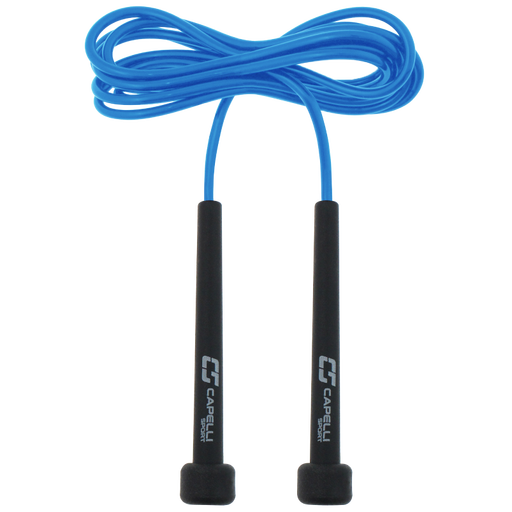
Why This Fits Their Persona: A low-storage starting point for adults or supervised children who want portable cardio equipment for home, the park or the gym.
Its length adjusts up to 9 feet, so buyers can check the fit rather than accepting a fixed rope that is too long or short.
PVC rope, lightweight polypropylene handles and adjustable length. It stores easily between sessions.
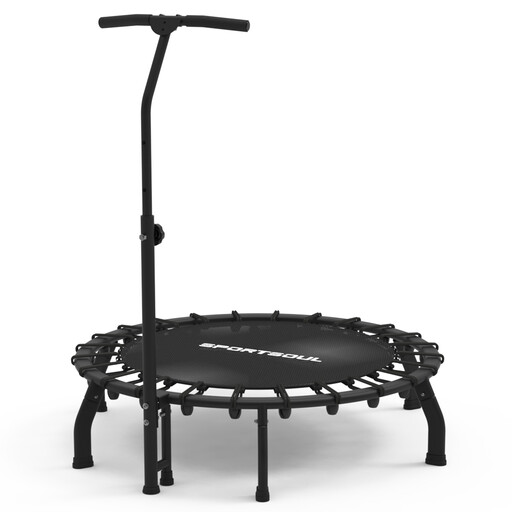
Why This Fits Their Persona: Suitable for buyers prioritising a higher stated user capacity and a compact indoor cardio setup for regular home sessions.
The listing states a 120 kg maximum user weight and provides a clear 42-inch footprint, reducing guesswork about capacity and room planning.
Includes elastic resistance bands, a pre-assembled mat and a steel frame. The listed standards include EN ISO 20957-1.
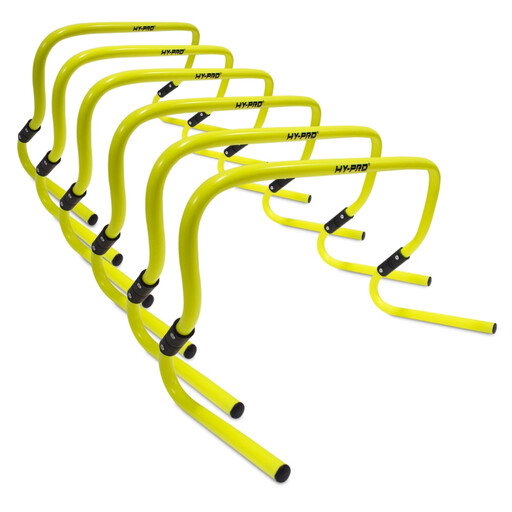
Why This Fits Their Persona: A practical choice for football, rugby, athletics, family drills or users developing footwork and coordination in a garden or sports hall.
Adjustable height allows progression instead of forcing every user into one fixed drill intensity.
The six-piece set is lightweight, made from durable plastic and supplied with a carry handle for storage and transport.
You do not need every type of indoor exercise equipment. Start with the movement patterns you are most likely to practise:
For rehabilitation-related exercise or an existing health condition, seek appropriate professional guidance before beginning a new routine. Product descriptions should not be treated as medical advice.
We have compiled a complete, real-time list of products that fully satisfy these strict selection criteria and UK safety regulations.
Choose equipment with a small footprint and simple storage requirements, such as an adjustable skipping rope, Pilates ring or lightweight training hurdles. A folding rebounder can also work, but measure the usable area and check overhead clearance before purchase.
Lifespan depends on frequency of use, storage, cleaning and inspection. Springs, ropes, mats, foam pads and locking mechanisms are wear points. Follow the care instructions, keep equipment dry and replace or stop using any component that is cracked, stretched, loose or damaged.