
24/7 Customer Support

Free returns

Same-day & Next-day Delivery

Quality Guaranteed

Unlock Your Welcome Offers: FREE Delivery | Up to 80% OFF | Free 30-day JoyPlus trial
Download the APP
Buying home gym fitness equipment can make regular exercise more convenient, but the wrong choice may leave you with an unstable frame, unsuitable resistance or equipment that takes up more room than expected. Whether you want strength training equipment, glute workout equipment, yoga and Pilates equipment or portable fitness equipment, the product needs to match your available space, ability and routine.
A large weight-bearing figure does not automatically mean a product will suit every household. You still need to check the equipment’s dimensions, floor requirements, adjustment range and whether the frame remains practical in your intended workout area.
For example, a multifunction power tower may support demanding exercises, but its height can be unsuitable for a low-ceiling room. Always measure the available floor and overhead space before ordering.
Resistance bands vary considerably in material, width, length and construction. Some buyers choose a band based only on a colour or a vague resistance label, without checking whether it is a fabric loop, flat band or tube-style design.
A glute resistance band may be more comfortable for lower-body exercises, while flat resistance bands can be more versatile for stretching, Pilates and mobility work. A set with light, medium and heavy options also gives you more scope to adjust exercises as your routine develops.
Large strength equipment often requires assembly, and loose bolts can affect stability. Smaller items may appear maintenance-free, but bands can deteriorate if stored near sharp objects, excessive heat or direct sunlight.
Check the care instructions before purchase. For equipment requiring assembly, allow enough time to follow the instructions and inspect connections regularly. Bands should be checked for tears, cracks or loss of elasticity before use.
Start with the product’s assembled dimensions rather than relying on product photographs. A pull-up and dip station needs sufficient overhead clearance, while a bench or power tower also requires space around it for safe movement.
For compact homes, consider equipment that can be folded, stored in a bag or used in more than one way. Resistance bands are easy to move between a living room, home office or outdoor space, making them useful portable fitness equipment for people with limited room.
For a power tower, a heavy-duty steel frame, stable base and non-slip features are important specifications to review. Look for clear information about adjustment points, included components and maximum supported load.
For bands, compare latex-free TPE, cotton fabric and other listed materials according to your intended exercises. TPE flat bands may suit users who want a soft touch and stretchability, while fabric loops can provide grip during squats, lateral steps and glute-focused movements.
A useful set should match your current ability without becoming irrelevant as you progress. Light resistance can be practical for mobility, warm-ups and controlled movement; heavier options may support strength-focused lower-body exercises.
Also check the band’s dimensions. A 15 cm by 120 cm flat band has a different feel and exercise range from a short loop band. If you plan to combine bands with yoga and Pilates equipment, confirm that the shape and stretch are suitable for your routine.
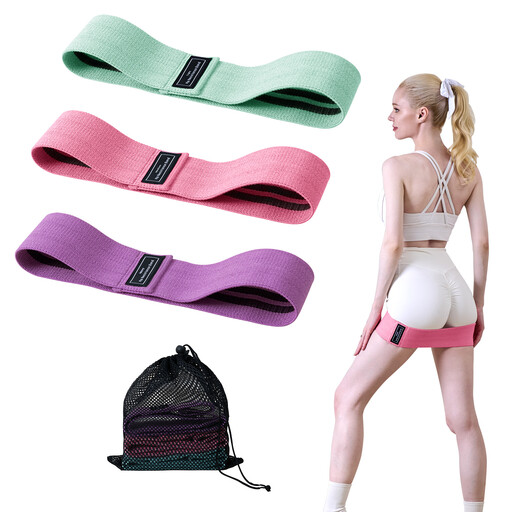
Why This Fits Their Persona: This set is a straightforward starting point for home users who want lower-body exercises without assembling bulky equipment. The three loop bands can be used for squats, hip exercises, Pilates and general fitness in a UK living room or small workout area.
The light, medium and heavy resistance levels make the choice clearer than buying one band with an undefined resistance level. Its non-slip fabric construction is designed to reduce rolling during use.
Three cotton fabric loop bands, a storage bag and no installation requirement.
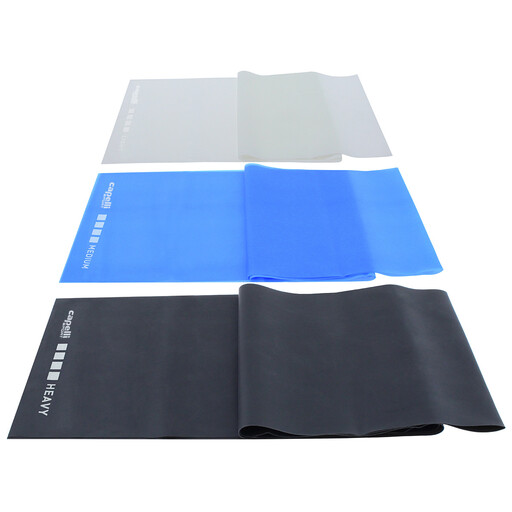
Why This Fits Their Persona: This option suits users who want one portable set for yoga, Pilates, stretching, body conditioning and selected rehabilitation exercises. It can be carried to the office, gym or outdoors when a full home gym setup is not practical.
The product clearly states its 15 cm by 120 cm size, latex-free TPE material and three resistance levels, helping you compare it with loop bands on practical specifications.
Odourless, soft-touch TPE; lightweight format; compatible with Pilates circles and Pilates balls.
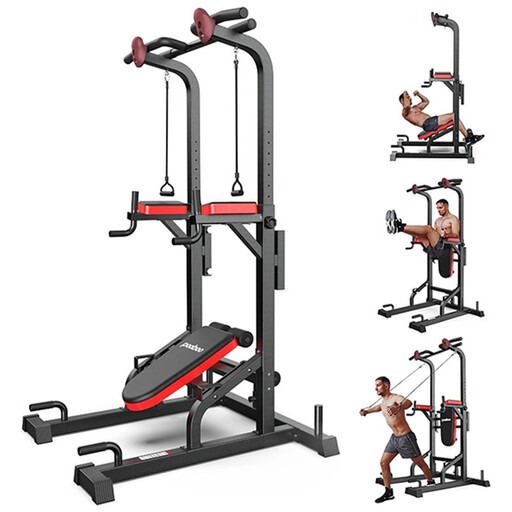
Why This Fits Their Persona: This is aimed at users with a dedicated workout area who want pull-ups, dips, bench exercises and broader strength training equipment in one frame. It is more appropriate for a stable home gym zone than a compact lounge setup.
The listing provides assembled dimensions of 41.00 x 30.00 x 99.00 inches, a 480 lb weight-bearing figure and adjustable-height information, so space and load checks can be made before purchase.
Heavy-duty steel frame; integrated bench, pull-up bar and dip station; non-slip structure.
Place large equipment on flat, stable ground and leave clearance for every movement, not just the frame itself. Follow the supplied assembly instructions and check bolts and connections periodically. Do not exceed the stated load capacity of a power tower.
For resistance bands, inspect the surface before each session and avoid sharp edges. Clean TPE bands with a damp cloth and mild soap, then allow them to air dry. Fabric bands should be stored in their supplied bag where possible. If you are using equipment for rehabilitation or managing an existing condition, seek suitable guidance from a qualified healthcare professional before changing your exercise routine.
We have compiled a complete, real-time list of products that fully satisfy these strict selection criteria and UK safety regulations.
Measure the equipment’s assembled length, width and height, then add room for movement and access. A power tower needs overhead clearance for pull-ups and a stable area around the base. Flat or loop resistance bands generally need much less storage space.
Their usable life depends on frequency of use, stretching range, storage and exposure to heat or sharp objects. Inspect bands regularly and replace them if you notice cracking, tearing, sticky surfaces or significant loss of elasticity.
Most resistance bands and non-powered strength equipment do not require electricity. The main ongoing costs are storage, replacement parts or eventual replacement of worn bands. Powered equipment, such as treadmills, may add to household electricity use and should be assessed separately.