
24/7 Customer Support

Free returns

Same-day & Next-day Delivery

Quality Guaranteed

Unlock Your Welcome Offers: FREE Delivery | Up to 80% OFF | Free 30-day JoyPlus trial
Download the APP
With more of us working and studying from home in the UK, the kitchen table is no longer a sustainable solution. A dedicated home office desk is fundamental to creating a productive and comfortable workspace. However, finding the right one can be a challenge. Do you need a compact study table for a small bedroom, a sprawling surface for multiple monitors or something more flexible?
As the Joybuy Product Recommendation Officer, my role is to help you navigate the options. This guide cuts through the marketing jargon to offer practical advice and highlight some functional choices, helping you find a desk that truly fits your space and work style.
Before you start browsing, consider a few key factors. Getting these right will ensure your new work from home desk serves you well for years to come.
The most important step is to measure the area where your desk will go. Note the available width, depth and height. Think about how you work. A simple laptop setup might only require a small desk for bedroom use, perhaps around 80-100 cm wide. However, if you use multiple monitors, need space for documents or have other equipment, a large office table of 140 cm or more will be necessary. Don't forget depth—a desk that is at least 50-60 cm deep provides enough room for a monitor and keyboard while maintaining a comfortable viewing distance.
Your desk should support a healthy posture. An adjustable height desk is an excellent option, allowing you to switch between sitting and standing, which can benefit circulation and reduce fatigue. If a fixed-height desk is your preference, ensure it allows your arms to rest at a 90-degree angle when typing. Also, consider your storage needs. Do you require built-in drawers, or will a clean, minimalist surface suffice? A well-chosen computer desk should have enough surface area to keep your essentials within reach without feeling cluttered.
Your desk is a piece of furniture, so it should complement your home's decor. The industrial style desk, which often combines a wood-effect top with a black metal frame, is a popular choice that suits many modern interiors. It’s known for its sturdy build and clean lines. Alternatively, you might prefer a minimalist white or a classic wood finish. The material also impacts durability; steel frames offer robust support, while high-quality particleboard tops provide a smooth, easy-to-clean surface.
Based on common user needs for functionality, size and style, here are some noteworthy options to consider for your home office.

Why It Stands Out: This desk is an ideal solution for anyone working with limited space. Its 80 x 50 cm footprint is large enough for a laptop, a notepad and a cup of tea, but small enough to fit comfortably in a bedroom, alcove or the corner of a living room. The greige and black colour scheme offers a modern, understated look that blends well with various decor styles.
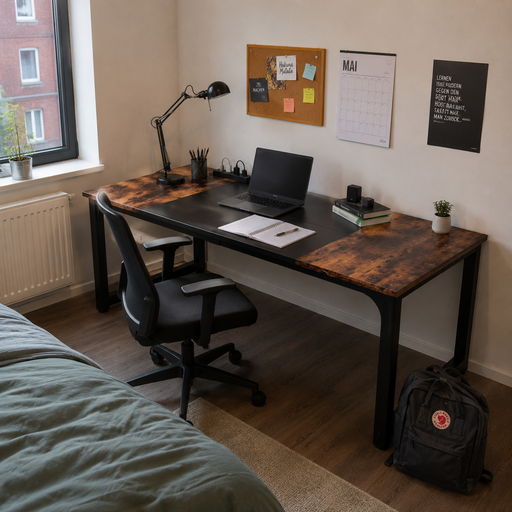
Why It Stands Out: If "more space" is your mantra, this desk delivers. With a massive 180 x 80 cm surface, it can easily accommodate dual monitors, a laptop and all your peripherals with room to spare. The robust steel frame, featuring 5 x 5 cm thick tubes, gives it exceptional stability and an impressive maximum load capacity of up to 260 kg. Its rustic brown and black finish gives it a distinct industrial character.

Why It Stands Out: This table redefines the concept of a workspace. It’s not just a desk; it’s a mobile, adaptable platform for your laptop or books. With adjustable height and a tilting top, you can use it while sitting on the sofa, lying in bed or as a compact standing desk. The lockable wheels allow you to move it easily from room to room and secure it in place when you're ready to work.
Perhaps you're specifically interested in the health benefits of a full-sized standing desk. An adjustable height desk can be a fantastic investment in your long-term comfort and well-being, allowing you to effortlessly change your posture throughout the day.
? Explore our curated selection of standing desks for your home office to find a model that fits your workspace.
The ideal size depends entirely on your available space and how you intend to use it. For a simple setup with a single laptop or monitor, a compact computer desk around 80-120 cm wide is often sufficient. If you work with dual monitors or need space for paperwork, aim for a width of 140 cm or more. A depth of at least 50-60 cm is recommended to ensure a comfortable distance from your screen.
Ergonomics is about fitting your workspace to your body, not the other way around. Start by adjusting your chair so your feet are flat on the floor and your knees are at a 90-degree angle. Your desk height should allow your elbows to also be at a 90-degree angle when typing. Your monitor should be positioned at eye level to avoid neck strain. An adjustable height desk is a great tool for achieving this for both sitting and standing positions.
Solid wood is highly durable but often comes with a higher price tag. For a balance of durability and value, look for desks with a strong steel frame and a top made from high-quality particleboard or MDF (Medium-Density Fibreboard). These engineered wood tops are typically finished with a laminate that provides good resistance to scratches and moisture, making them a practical choice for a daily work from home desk.