Choose powered speakers with an analogue input if you want a simple turntable setup and can supply a line-level signal. Choose compact digital active speakers when computer connections take priority, or passive speakers with an amplifier when you want to change components separately. Whichever route you take, check that the pair fits your office and that the turntable signal passes through exactly one suitable phono stage.
Who each setup suits
Vinyl listener seeking a simple desk system
If you would rather avoid a separate amplifier, powered speakers are worth considering. Check whether your turntable outputs LINE or PHONO before choosing an input: Audio-Technica explains that a LINE output can feed powered speakers directly.
Hybrid work-and-music listener
If the same office speakers must serve a computer and music sources, compact active speakers with suitable digital inputs may be convenient. A wired turntable connection needs its own check: KEF says its LSX II LT connects to a turntable via Bluetooth, not a 3.5 mm analogue input.
Rock listener building a flexible hi-fi chain
If you want to choose the amplifier and phono stage separately, passive standmount speakers offer that arrangement. Allow space for the amplifier, speaker cable and separated speaker placement before settling on a pair.
What matters when choosing
Powered speakers with analogue input
Choose when: You want a turntable and speaker pair without a separate amplifier, and the signal reaching the speakers is at line level.
Trade-off: RCA sockets alone do not provide phono amplification; a PHONO-output turntable needs a suitable phono stage first.
Compact digital active speakers
Choose when: Connecting a computer or other digital source at the workstation matters more than a direct wired turntable input.
Trade-off: Inputs vary by model. KEF says the LSX II LT accepts a turntable connection via Bluetooth rather than a 3.5 mm analogue socket.
Passive speakers with an amplifier
Choose when: You want to select or later change the speakers and amplifier independently.
Trade-off: The amplifier, speaker cable and any required phono stage add equipment to the office.
For consumers choosing speakers for rock albums in a home office, the deciding priority may be the turntable connection, workstation use, room for a stereo pair or the flexibility to change components.
| Concern |
What to check |
Who this matters to |
| Turntable signal chain |
Check whether the deck outputs LINE or PHONO and whether the chosen input is line-level or has a dedicated phono stage. |
I want to put on a record without adding unnecessary boxes, but need the deck and speaker inputs to work together; around 31% of consumers put a straightforward, compatible turntable connection first. |
| Desk space and digital inputs |
Check the speaker dimensions and the inputs needed for your computer or other digital sources; confirm separately how vinyl would connect. |
My speakers need to fit beside my workstation and handle everyday computer audio; for around 25% of consumers, that integration is the primary concern. |
| Stereo placement and rock listening |
Check cabinet size and whether you can position two speakers separately at your listening position; assess bass claims in the context of your room. |
I want room for a separated stereo pair when listening to rock, rather than choosing on connection convenience alone; roughly 25% of consumers prioritise that listening arrangement. |
| Component flexibility |
For passive speakers, check amplifier compatibility and allow space for cabling and any required phono stage. |
I would accept a more involved system if I could change the amplifier or phono stage later; around 19% of consumers place that flexibility first. |
Buying pitfalls
-
Assuming an RCA socket is a phono input
A PHONO-level turntable signal needs gain and RIAA equalisation before it reaches a normal line-level RCA input. Using two phono stages can also cause distortion, as Henley Audio cautions.
Identify the deck’s output setting and use one suitable phono stage: built into the turntable or receiving equipment, if specified, or connected externally.
A separate phono preamp may be needed for a deck that outputs PHONO only.
-
Choosing desktop inputs without checking vinyl connectivity
KEF lists USB-C, HDMI ARC and optical inputs for the LSX II LT, but says this model connects to a turntable via Bluetooth rather than a 3.5 mm analogue input.
If a wired turntable connection matters to you, confirm the exact analogue input on the speaker model before buying.
-
Planning space for passive speakers but not the full system
A passive pair needs an external amplifier. A PHONO-output deck also needs phono amplification before a normal line input.
Plan where the amplifier, speakers and cables will go, and check whether the amplifier has a suitable PHONO input.
Speaker cable and any required external phono stage add to the equipment you must accommodate.
-
Treating bass descriptions as a room-specific result
Q Acoustics describes the 3030c in terms of bass extension and low-end drive within its range. That manufacturer positioning does not establish how it will sound at your desk.
Check cabinet dimensions and placement guidance against the available office space rather than choosing from a bass description alone.
Brands to consider for these speaker setups
Audioengine
The HD6 illustrates a powered-speaker route for a home office where an analogue connection matters.
- Audioengine specifies RCA L/R, optical and Bluetooth inputs for the HD6.
- Its RCA input should not be assumed to accept a PHONO-level signal; check that the turntable supplies LINE output or use a suitable phono stage.
KEF
The LSX II LT illustrates a compact active route centred on digital connections and desktop placement.
- KEF lists USB-C, HDMI ARC and optical inputs for this model.
- KEF says a turntable connects to the LSX II LT via Bluetooth, not a 3.5 mm analogue input.
Q Acoustics
The 3020c and 3030c illustrate passive standmount choices for a system built around a separate amplifier.
- Idealo lists the 3020c as passive, while Q Acoustics positions the 3030c for greater bass extension within its range.
- Check amplifier matching and placement space for the particular pair; Q Acoustics’ bass description is not a guarantee of the result in your office.
Joybuy speaker options
These options cover compact powered listening and passive speaker pairs for a home-office system. For either powered model’s AUX input, check the turntable signal chain; the passive pairs need a suitable external amplifier.
 No image available
Edifier M60 Bluetooth 5.3 desktop speakers, 66W RMS
Consider this desktop pair if you want stereo speakers for a computer and other music sources at the workstation.
The product name specifies USB-C and AUX inputs, 3-inch mid-bass drivers and 1-inch tweeters.
Before using AUX with a turntable, confirm that the signal reaching it is at line level or has passed through a suitable phono stage.
View on Joybuy
 No image available
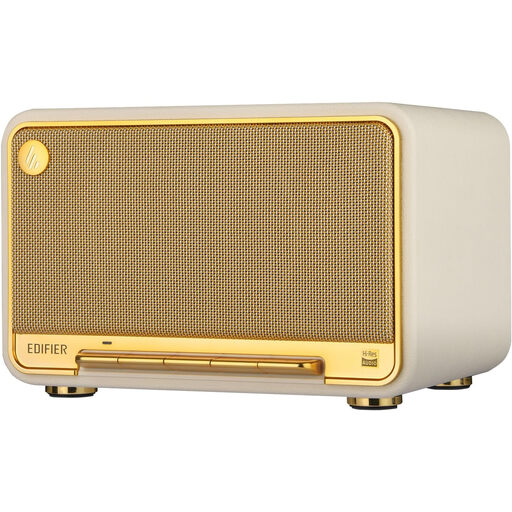
Edifier D32 tabletop wireless speaker, 60W RMS
Consider this tabletop model if you want one speaker unit for music alongside your work area rather than a separated speaker pair.
The product name specifies a 2.1 acoustic arrangement, Bluetooth 5.3, USB-C and AUX inputs.
Check its cabinet dimensions against your intended space. For a turntable on AUX, confirm a suitable line-level signal first.
View on Joybuy
 No image available
HiVi-Swans DIY3.1 passive bookshelf speaker pair, 6.5-inch
Consider this pair if you want to build a separate-speaker system and are willing to provide an amplifier.
The product name identifies the speakers as passive and specifies a 6.5-inch driver.
Check amplifier compatibility and cabinet dimensions before planning placement. A PHONO-output turntable also needs a suitable phono stage in the signal chain.
View on Joybuy
 No image available
HiVi-Swans D3.1MKII passive bookshelf speakers
Consider this passive pair if you want to choose the amplifier separately and have room for two speaker cabinets.
The product name specifies a 6.5-inch mid-bass driver, 28 mm tweeter, rear bass-reflex design and 8-ohm impedance.
Confirm amplifier matching and placement space for the complete system. If your turntable outputs PHONO, include a suitable phono stage before a normal line input.
View on Joybuy
Common questions
Can I connect a turntable directly to powered speakers?
Yes, if the turntable supplies LINE output and the speakers have a suitable line input. Audio-Technica advises using a phono preamp first when the deck outputs PHONO, unless the receiving equipment explicitly provides a phono stage.
Can a turntable set to LINE use an amplifier’s PHONO input?
No. Audio-Technica advises connecting a deck set to LINE to a normal line input, such as Aux or CD, rather than applying phono processing again through the amplifier’s PHONO input.
Can KEF LSX II LT take a wired analogue turntable connection?
KEF’s guidance says the LSX II LT connects to a turntable via Bluetooth and has no 3.5 mm analogue input. If you want to use this model for records, check that your turntable can make the required Bluetooth connection.
What else do passive speakers need for a turntable setup?
Passive speakers need an external amplifier and speaker cable. If the turntable outputs PHONO, use an amplifier with a suitable PHONO input or add a phono preamp before a normal line input.


