Regular home-document printers
If documents pile up each week, compare the ongoing ink or toner needed for your likely output, not just the machine. Which? identifies running costs as an important part of choosing between printer types.


Choose a home printer around the work you do most: an inkjet offers flexibility for documents and occasional images, a laser suits text-led printing and long gaps between jobs, and a refillable ink-tank model is worth considering for regular output. If scanning or copying is routine, choose an all-in-one and check separately for an automatic document feeder and automatic two-sided printing; neither feature comes with every model.
If documents pile up each week, compare the ongoing ink or toner needed for your likely output, not just the machine. Which? identifies running costs as an important part of choosing between printer types.
If work documents are the main job and the printer may sit idle between them, a laser is worth considering. Which? highlights laser printers’ speed and sharp text, while dry toner avoids the ink-drying issue associated with unused inkjets.
If school, household or work paperwork regularly arrives in batches, look beyond a flatbed scanner. As Which? explains, an automatic document feeder moves multiple originals through for scanning or copying without placing each sheet by hand.
For home documents, schoolwork and home-office tasks, settle the main printing workload first, then check scan, copy and two-sided functions on the exact model.
Consider it when: Documents, colour pages and occasional photos all matter, but printing is not especially frequent.
Trade-off: Cartridge use and ink consumed during cleaning matter more with regular output; ink can also dry out after prolonged non-use, according to Which?.
Consider it when: Sharp, prompt text output is the priority, particularly if jobs are separated by long idle periods.
Trade-off: Which? notes that laser printing is less suited to standard glossy photo paper than inkjet printing.
Consider it when: You print documents or colour pages regularly enough for bottled-ink use to matter.
Trade-off: Which? describes tank printers as requiring a larger initial outlay; an automatic feeder or automatic duplex printing still depends on the model.
| Concern | What to check | Who this matters to |
|---|---|---|
| Ongoing supplies | Compare compatible ink or toner yields with your likely black-and-colour print mix; assess optional subscriptions separately. | If I print documents regularly, I want consumables that suit my volume rather than focusing only on the machine. Around 36% of consumers would make ongoing supplies their primary concern. |
| Text productivity | Check mono or colour capability, stated print speed and whether two-sided printing is automatic. | When work is mostly text and the printer sometimes sits unused, I value prompt, clear document output. That would come first for roughly 29% of consumers. |
| Scanning and copying | Confirm an automatic document feeder, its capacity and whether two-sided scanning is supported. | With batches of paperwork to copy or scan, I would rather not place every original on a flatbed. Around 21% of consumers would put that workflow first. |
| Colour and media | Confirm supported colour output and paper types, including glossy photo paper if you need it. | If school graphics and occasional photos share the workload with documents, I need suitable media options. For roughly 14% of consumers, that flexibility would be the leading need. |
Which? notes that refillable tanks can make sense for frequent printing, but the same choice may not suit a household that prints little.
Compare compatible supplies and stated yields against your expected volume and black-and-colour mix.
Scanning and copying do not guarantee an automatic document feeder. Automatic two-sided printing and two-sided scanning are separate capabilities.
Check each function on the exact model, including feeder capacity if you process batches.
Without a feeder, multi-page originals may need to be placed one at a time.
Which? distinguishes inkjet support for glossy photo paper from laser printers’ text strengths and notes that ink can dry out during long periods without use.
Let your actual mix of text, photos and idle time guide the printer type.
An optional plan is a separate way to obtain consumables, not an inherent advantage of the printer.
Before enrolling, compare its page allowance, excess-page rules and cancellation terms with how you normally print.
Brother has UK examples across cartridge inkjet, refillable-tank and colour LED all-in-one printers.
HP Smart Tank is a refillable-ink range for households considering print, scan and copy functions.
Epson EcoTank is another refillable-ink route for colour printing alongside scanning and copying.
These choices cover ink-tank, cartridge inkjet and mono laser printers for home documents and scan-and-copy needs. Match the printing technology and the exact model’s paper-handling features to your workload.
 No image available
Consider this model for regular home-office documents and scan-and-copy tasks; check that its feeder and supported paper sizes fit your usual jobs.
Compare compatible ink-bottle yields with your expected black-and-colour use before deciding.
 No image available
For regular A4 documents alongside scanning and copying, check whether this model’s feeder suits the size of your usual batches.
It is listed as an A4, Wi-Fi multifunction model; compare compatible refill supplies and confirm what the +Ink bundle includes.
 No image available
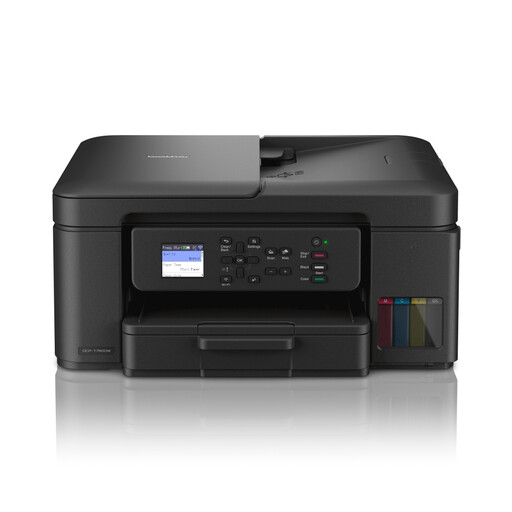
This print, scan and copy model is worth considering when regular documents and smaller batches of originals are both part of the workload.
Brother lists automatic two-sided printing and a 20-sheet automatic document feeder. Check whether that feeder capacity suits your batches and compare compatible ink supplies for your print mix.
 No image available
Consider this inkjet all-in-one if home-office paperwork includes larger-format jobs as well as scanning and copying.
Check that you need its listed A3 capability and have room for its stated 20.2 kg weight. If originals are double-sided, confirm the scanning method separately; also compare compatible ink supplies.
 No image available
For text-led printing with occasional single-sheet scanning or copying, this mono laser model avoids choosing colour printing you do not need.
It has a flatbed scanner but no automatic document feeder, and two-sided printing is manual. Check whether handling pages individually suits you, and compare replacement-toner yield with your expected use.
Choose an all-in-one if scanning or copying is a recurring task. For batches of originals, check for an automatic document feeder as well as a scanner; Which? notes that a feeder moves multiple pages through without placing each one on the flatbed.
No: automatic two-sided printing does not establish two-sided scanning. Check the exact model’s scanning specification separately, particularly if you need to feed double-sided originals in batches.
A laser is worth considering if occasional jobs are mainly text and the machine may remain idle for long periods. Which? notes that dry toner avoids the ink-drying issue of unused inkjets; if glossy photos matter, check an inkjet’s paper support instead.
Only if its page allowance and terms suit the way you print. Treat a subscription as an optional arrangement and check excess-page rules and cancellation conditions before comparing it with buying compatible consumables as needed.