
24/7 Customer Support

Free returns

Same-day & Next-day Delivery

Quality Guaranteed

Unlock Your Welcome Offers: FREE Delivery | Up to 80% OFF | Free 30-day JoyPlus trial
Download the APP
Choosing horse toys for children can be harder than it looks. A product may appear engaging online but prove unsuitable once it arrives: it might contain fiddly pieces, need frequent battery changes or offer less play value than the packaging suggests.
Parents, grandparents and other gift-givers should look beyond colour and character appeal. The most useful questions are whether the toy matches the child’s age, suits the available play space and supports the type of play they actually enjoy.
An interactive horse toy with sounds and movement can attract attention quickly, but younger children may become frustrated if buttons are difficult to find or if the toy needs close supervision. Likewise, a detailed horse building set may be a poor match for a child who prefers immediate role-play.
Think about the child’s preferred experience:
Horse toys often include brushes, buckets, figures, bricks or miniature accessories. These can add play value but may also create a choking risk for younger children.
Always check the stated age range and product warnings. In the UK, toys should comply with the applicable Toys (Safety) Regulations 2011 and carry the appropriate conformity marking, such as CE or UKCA where applicable. A safety mark does not replace checking the individual product’s age warning. For example, a toy marked from age 7 should not be passed to a younger child simply because they are interested in horses.
Battery-operated toys can involve ongoing costs and maintenance. Before buying, check:
A toy that fits the household routine is more likely to be played with regularly.
Age guidance reflects more than a child’s reading ability. It can relate to small components, construction complexity and the level of supervision required. A plush walking pony designed for children aged 4 and above is a different proposition from a 685-piece model intended for children aged 9 and above.
For children aged 3 to 9, compare the product’s recommended age with the child’s fine-motor skills and patience. Younger children may benefit from larger, easier-to-handle pieces, while older children may prefer poseable models and multi-stage building.
Measure the intended play area before selecting an animated or moving toy. Penny the Feed and Prance Pony is approximately 30.5 × 20.3 × 33 cm and walks when activated, so it needs clear floor space. A horse figurine or building model takes up less active play space but may need a stable, shelf or storage box.
For a horse trailer toy, look at wheel movement, door access and whether the trailer can be detached. These details affect how easily children can create transport and stable-care scenarios.
Check whether the toy is plush, plastic, brick-built or a combination of materials. A soft toy may be comfortable for indoor play but still require careful cleaning. Penny is listed as surface washable only, with batteries to be removed before cleaning.
For construction sets, confirm the piece count, rebuild options and whether all models can be built simultaneously. The LEGO Creator horse set offers three build choices, but the models cannot be assembled at the same time. These are practical details that may be missed in short product listings.
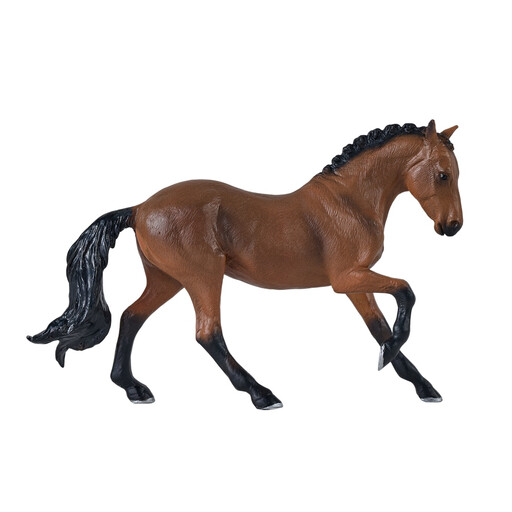
Why This Fits Their Persona: A compact choice for children beginning imaginative equestrian play, with no batteries or complicated setup. It is suitable from age 3 and above.
It avoids battery costs and complex electronic features. Adults should still follow the small-parts warning and age guidance.
No batteries required; compact dimensions of approximately 3.5 × 15 × 11 cm; suitable for role-play and display.
Why This Fits Their Persona: Its hand-painted coat, mane and tail details suit horse lovers who value a realistic horse toy for storytelling, collecting or a school display.
The product description identifies the horse breed and physical detailing rather than relying on electronic effects to create interest.
No batteries required; detailed Hanoverian design; suitable for children aged 3 and above.
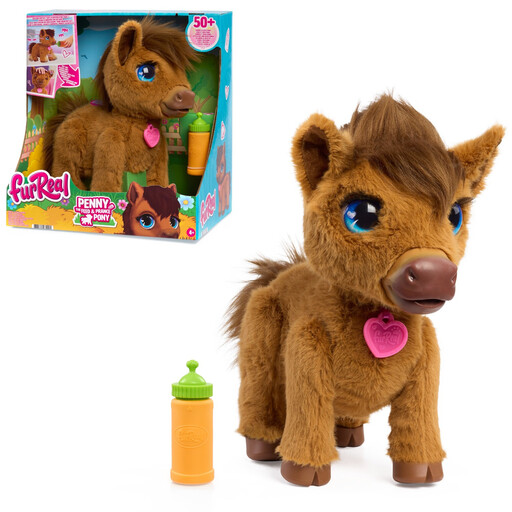
Why This Fits Their Persona: Suited to children aged 4 and above who want an animated companion for indoor play, feeding games and short walks around the home.
Its listed functions are clear: head-touch responses, walking, tail movement and bottle interaction. The battery requirement and surface-washable care are also stated.
Over 50 combinations of sound and motion reactions; 4 AA batteries included; 11-inch soft walking pony.
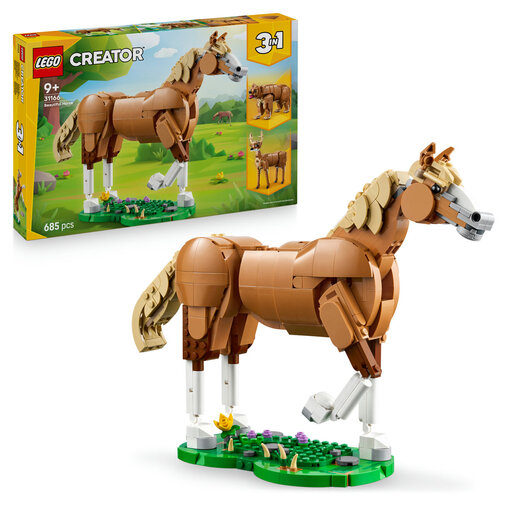
Why This Fits Their Persona: Designed for LEGO fans aged 9 and above who enjoy longer building sessions, poseable models and rebuilding the same set in different ways.
The 3-in-1 format offers defined rebuild options, while the 685-piece count makes the construction commitment clear before purchase.
Builds a horse, bear or deer; poseable head, limbs and tail; no batteries required.
We have compiled a complete, real-time list of products that fully satisfy these strict selection criteria and UK safety regulations.
Look for larger horse figurines, soft toy ponies and simple accessories with clear age guidance. Avoid sets containing small parts unless the packaging confirms suitability. Adult supervision is recommended where the product warning specifies it.
Battery life depends on frequency of play and the type of movement or sound used. Check the required battery type before buying. Penny the Feed and Prance Pony requires 4 AA batteries, which are listed as included, and batteries should be removed before cleaning.
Many building sets are designed for older children because of their piece count and small components. The LEGO Friends Horse & Baby Foal Trailer is suitable from age 7, while the LEGO Creator Beautiful Horse is suitable from age 9. Always follow the manufacturer’s stated age range rather than judging suitability by appearance alone.