
24/7 Customer Support

Free returns

Same-day & Next-day Delivery

Quality Guaranteed

Unlock Your Welcome Offers: FREE Delivery | Up to 80% OFF | Free 30-day JoyPlus trial
Download the APP
Choosing horse toys for children can be more complicated than expected. A plush pony, wooden rocker, realistic horse figurine or building set may all look appealing online, but each suits a different age, play style and home environment.
Parents, grandparents and gift-givers should look beyond attractive packaging. The most common buying mistakes involve choosing a toy that is unsuitable for the child’s age, underestimating its space or cleaning requirements or paying for features that will not be used regularly.
This guide explains what to check before buying, then matches several children’s horse toys with different types of young horse lovers.
A product may be marketed as suitable for toddlers or young children, but the safety warning and small-parts guidance still need to be checked. For example, a toy may be listed as suitable from 12 months while carrying a warning that it is not suitable for children under three. When information differs, follow the clearest safety warning and supervise play where recommended.
Also check whether the child can physically use the toy. A rocking horse requires balance, grip and enough room for safe movement, while a construction set may require patience and fine motor control.
An interactive horse toy with batteries can provide sounds and movement, but parents should consider battery replacement, storage and cleaning. Plush toys may only be surface washable, making them less suitable for messy play. Wooden toys can be easier to wipe, but painted finishes still need appropriate care.
Before purchasing, check whether batteries are included, whether they can be removed before cleaning and whether the toy can be machine washed. These details can affect the real cost and convenience over time.
A realistic horse figurine can be useful for imaginative play, collecting or school projects, but it may not offer the movement or sensory interaction of an electronic pony. Equally, a highly interactive toy may be less suitable for a child who prefers quiet storytelling.
The right choice depends on how the child usually plays, not simply on the number of advertised features.
Look for a clearly stated age recommendation and read the warning section. Toys containing small parts may present a choking risk for younger children. Construction sets and detailed toy horse figures are generally more appropriate for older children, while larger, simpler designs may suit early play.
For toys for ages 3 to 9, do not assume one product will suit the entire range. A three-year-old and a nine-year-old may have very different expectations regarding challenge, movement and independence.
Measure the intended play area before buying a rocking horse. The Le Toy Van model measures 24 × 65 × 53 cm when assembled, so it needs clear floor space and should be used away from furniture, stairs and other obstacles.
For smaller bedrooms or travel, a compact realistic horse figurine may be easier to store. The MOJO Hanoverian Bay Horse has package dimensions of 3.5 × 15 × 11 cm, making it suitable for shelves, dioramas or a small play box.
Check the construction material and the type of play each product offers. The wooden rocking horse is made from rubberwood and plywood, while the MOJO figure uses durable materials and is hand-painted.
For an interactive horse toy, check the number and type of batteries required. furReal Penny the Feed and Prance Pony requires four AA batteries, which are included. It responds to head pats, a back button and bottle play with combinations of sounds and movements. This may suit children who enjoy responsive role-play, but parents should remember that the product is surface washable only.
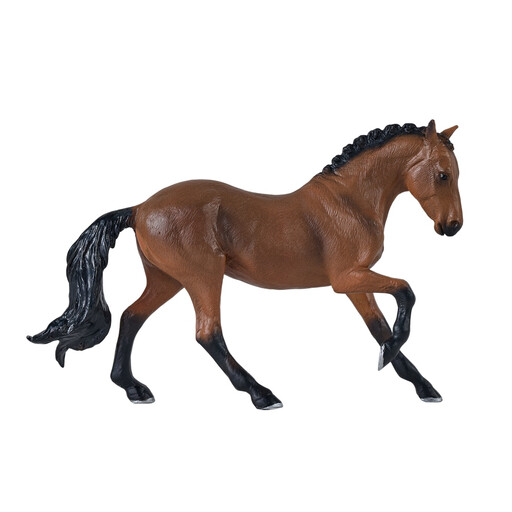
Why This Fits Their Persona: A compact, battery-free choice for children who enjoy animal stories, collecting or imaginative play without a large feature-heavy toy.
It avoids battery costs and bulky storage, while its stated age suitability is three years and above. Small-parts guidance still applies.
No batteries are required; the hand-painted design supports role-play, display and equestrian-themed projects.
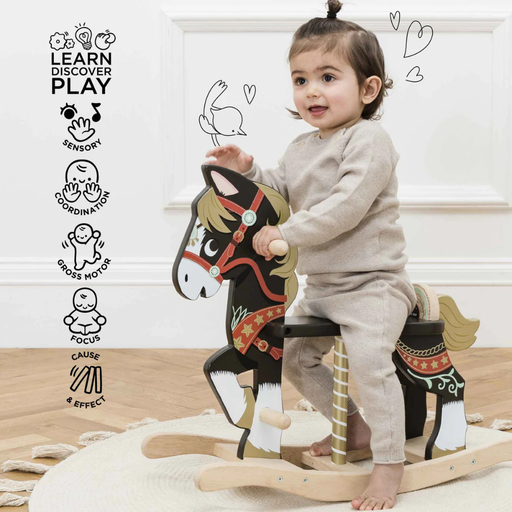
Why This Fits Their Persona: A traditional choice for families wanting a substantial nursery or playroom piece with active movement and a decorative finish.
Its assembled measurements, 50 kg maximum weight capacity and self-assembly requirement are clearly stated, helping buyers plan safely.
Made from rubberwood and plywood, with two wooden handles and child-safe, non-toxic paints. No batteries are required.
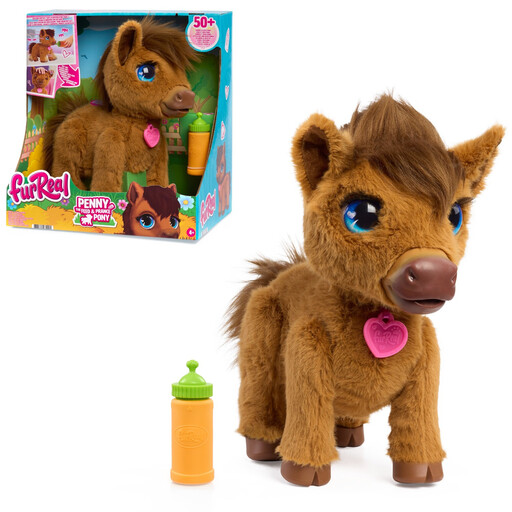
Why This Fits Their Persona: Designed for children aged four and above who want an interactive pet-style experience involving feeding, walking and sound.
The listed interactions explain what the child can actually do, while the battery and surface-cleaning requirements make running costs and care easier to assess.
Offers more than 50 combinations of sound and motion reactions; four AA batteries are included. Adult supervision is recommended.
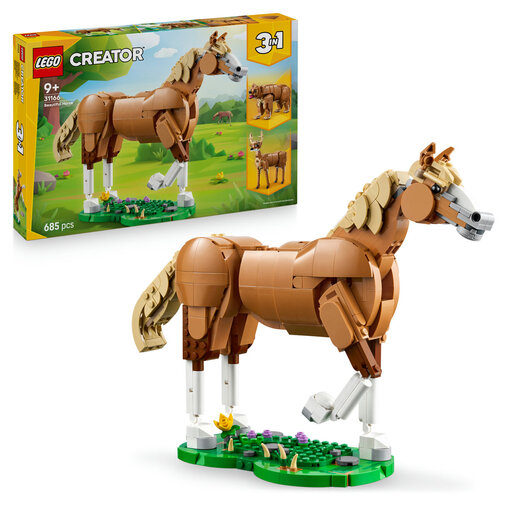
Why This Fits Their Persona: A suitable gift for animal-loving girls and boys aged nine and above who enjoy building, rebuilding and posing display models.
The 685-piece count and nine-plus age guidance set realistic expectations about assembly time and complexity. Models cannot be built simultaneously.
The set can be rebuilt as a horse, bear or deer, and the horse has poseable limbs, head and tail.
We have compiled a complete, real-time list of products that fully satisfy these strict selection criteria and UK safety regulations.
Match the toy to the child’s main interest:
Check the product dimensions, recommended age, safety warnings and cleaning instructions before ordering. These practical details are more useful than broad claims about excitement or developmental benefits.
It depends on the design. The featured rocking horse is listed as suitable from 12 months but also includes a warning against use under three, so buyers should follow the safety warning and supervise use. The interactive Penny pony is suitable from age four, the MOJO figure from age three and the LEGO set from age nine.
The main ongoing cost is usually battery replacement. Penny requires four AA batteries, although they are included. Battery-free wooden and model horse toys have no battery-running cost, but construction sets may require replacement pieces if parts are lost.
Lifespan depends on construction, storage and how the toy is used. Wooden toys and durable figures may suit repeated play when cared for properly. Electronic plush toys need careful cleaning and should not be machine washed unless the instructions specifically permit it. Always store small components securely and inspect toys regularly for damage.