For a long simulated moon-landing session, choose dual-stick HOSAS if your PC simulator accepts separate movement and rotation bindings and those controls are your priority. A HOTAS gives you a dedicated throttle alongside the stick; a single-unit flightstick makes more sense when desk space or Xbox compatibility matters more. Check the exact game’s controller support before committing to any layout.
Who each layout suits
Space-sim pilots prioritising separate controls
If you want to manage rotation and translation without returning to the keyboard during descent, a PC dual-stick layout is worth considering. Its usefulness depends on whether your simulator accepts the separate bindings.
Long-session HOTAS users
If sustained thrust adjustments matter to your landing technique, a stick and dedicated throttle may suit you. Consider where both units will sit and whether their controls remain reachable throughout a session.
Xbox players and compact-desk users
If platform support or a one-unit setup is the deciding constraint, look at an all-in-one flightstick. Turtle Beach lists Xbox Series X|S and Windows 10/11 compatibility for the VelocityOne Flightstick II; support for your particular game still needs checking.
What matters when choosing
Dual-stick HOSAS
Choose it when: you want one hand available for translational movement while the other manages the craft’s attitude in a PC simulator that supports both sticks.
Allow for: space for two bases and time to configure and learn the bindings.
Stick-and-throttle HOTAS
Choose it when: a dedicated control for sustained thrust changes fits the way you approach descent.
Allow for: a less direct arrangement for independent translation than two full sticks, depending on the game’s bindings.
All-in-one flightstick
Choose it when: one controller fits your desk better, or you need a model explicitly specified for your console.
Allow for: fewer physically separated controls for simultaneous manoeuvres than a two-unit arrangement.
| Concern |
What to check |
Who this matters to |
| Independent movement |
Check whether your game accepts separate axes for rotation, sideways movement and vertical or fore-and-aft thrust. |
If I need to correct my position while changing attitude, I want movement controls I can use at the same time; around 36% of consumers put independent movement first. |
| Fine touchdown inputs |
Identify the axis for descent thrust and check the game’s sensitivity and dead-zone settings. |
Near touchdown, I want to make small stick and thrust adjustments without an abrupt response; fine input control is the primary need for around 29% of consumers. |
| Long-session fit |
Check grip and wrist position, adjustable resistance where offered, and whether the bases sit securely at your usual seating height. |
For extended landing practice, I need to reach common controls without an awkward hand position; around 21% of consumers place fit and access first. |
| Platform and setup |
Confirm the stated platform, your game’s controller support and the desk area needed for the units. |
If I play on Xbox or have little room for separate controls, I need a compatible layout I can accommodate; platform and setup are the main concern for around 14% of consumers. |
Mistakes to avoid
-
Choosing by button count alone
Extra controls are useful only if your simulator accepts the bindings and you can remember the layout. A larger set of commands can also take longer to configure.
Before buying, inspect the game’s controller settings or support material and list the controls you need for descent, translation, attitude and camera movement.
-
Assuming a PC controller will work on a console
Thrustmaster lists the Sol-R 2 HOSAS Space Sim Duo and Sol-R 4 HOTAS as PC products, whereas Turtle Beach specifies Xbox Series X|S and Windows 10/11 for the VelocityOne Flightstick II.
Check both the controller’s stated platform compatibility and the particular game’s controller support before choosing a layout.
-
Leaving desk fit until after purchase
A control arrangement that feels manageable for a short attempt may put your hands or its bases in awkward positions during extended practice. Adjustable rests, tension or throttle friction are features to assess for your own setup, not assurances of comfort.
Measure the available desk area and consider where each control will sit at your normal seating height.
-
Putting an old controller in household rubbish
GOV.UK advises that electrical products displaying the crossed-out wheelie-bin symbol should not go in household rubbish.
Use an appropriate electrical-waste collection point or household waste recycling centre when replacing a controller.
Brands to consider
Thrustmaster
Thrustmaster offers both conventional stick-and-throttle controls and a PC dual-stick route aimed at space simulation.
- Thrustmaster specifies two sticks with six physical X/Y/Z movement axes for the Sol-R 2 HOSAS Space Sim Duo, while its Sol-R 4 HOTAS pairs a stick with an 80 mm throttle.
- Check PC compatibility and the exact simulator’s bindings before relying on either layout for separate landing controls.
Logitech G
The X56 is a stick-and-throttle option for PC space or VR simulation.
- Logitech G specifies thumb analogue sticks that provide additional axes for assigning space-simulation inputs.
- The X56 remains a HOTAS, not a pair of full sticks; check how your game assigns translational movement.
Turtle Beach
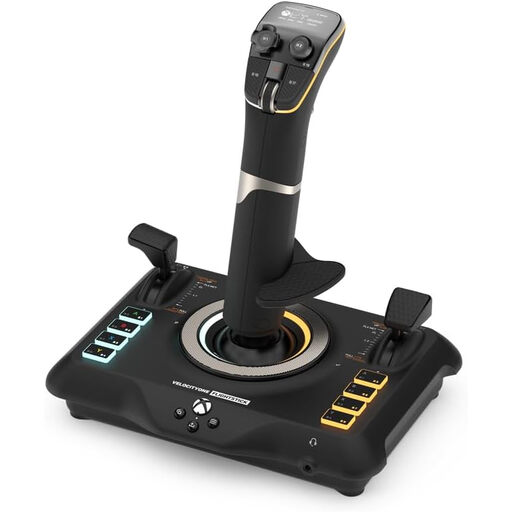
The VelocityOne Flightstick II is a single-unit option specified for Xbox Series X|S and Windows 10/11.
- Turtle Beach specifies eight axes, 38 programmable inputs, dual levers and adjustable rests for the Flightstick II.
- A single unit does not provide two independent full sticks; confirm that your game can map its controls as intended.
Joybuy product choices
These choices cover a single-unit Xbox/PC flightstick and two stick-and-throttle arrangements with different stated platform support. For a moon-landing simulation, check the game’s available bindings as well as the controller’s platform before choosing.
 No image available
Turtle Beach VelocityOne Flight Stick for Xbox/PC
Consider this single-unit flightstick if an Xbox/PC setup or a smaller control footprint is your priority. It is not a pair of full sticks, so check whether your simulator can map the simultaneous movement and attitude controls you need.
View on Joybuy
 No image available
HORI HOTAS Flight Control System & Mount (PC Windows 11/10)
This stick-and-throttle arrangement suits a PC user who wants a separate thrust control. Check the mount’s fit with your desk and confirm that your simulator accepts the landing bindings you plan to use.
View on Joybuy
 No image available
Thrustmaster T.Flight Hotas 5 Stick & Throttle (PS5, PS4, PC)
Consider this stick-and-throttle layout if you prefer a separate control for thrust and need one of its stated platforms. Platform compatibility alone does not establish support in a particular lunar-landing game; check its controller and axis-binding options.
View on Joybuy
Frequently asked questions
Should I choose HOSAS or HOTAS for a simulated moon landing?
Choose HOSAS if separate translation and rotation controls are your priority and your PC simulator supports the required bindings. Choose HOTAS if a dedicated throttle and stick better fit your descent controls. Neither layout’s axis count guarantees that your particular game will accept every intended command.
Does the VelocityOne Flightstick II work on Xbox and PC?
Turtle Beach lists the VelocityOne Flightstick II for Xbox Series X|S and Windows 10/11 PCs. Check that your specific simulation runs on your chosen platform and accepts the controller mappings you need.
What should I set up before repeated landing practice?
Set the game’s controller bindings first, then test sensitivity and dead zones where the game permits adjustment. If your chosen hardware offers tension, friction or throttle-detent adjustments, try them during practice to find a feel that lets you make the corrections you intend.
How should I dispose of an unwanted flightstick?
Do not put an electrical product displaying the crossed-out wheelie-bin symbol in household rubbish. GOV.UK advises using an appropriate electrical-waste collection point or household waste recycling centre.


